I used to think warming drawers were just fancy pantries for rich people who couldn’t be bothered to reheat things in a microwave.
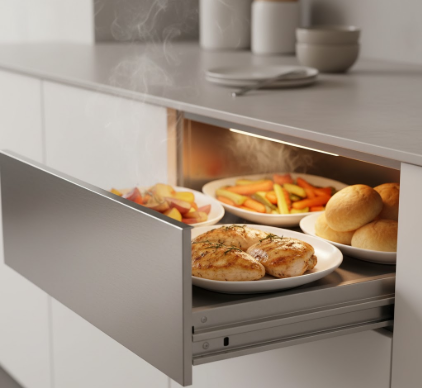
Turns out—and here’s the thing that kind of blew my mind when I started digging into this—they’re actually precision temperature machines designed around a very specific biological problem: bacteria love the danger zone. That zone sits between 40°F and 140°F, roughly speaking, where pathogens like Salmonella and E. coli can double their population every 20 minutes or so. A warming drawer’s entire job is to keep food above that threshold, usually hovering around 150°F to 200°F, which is hot enough to halt bacterial growth but (theoretically) gentle enough not to turn your mashed potatoes into crusty cement. The USDA actually recommends keeping cooked food at 140°F minimum if you’re holding it for service, which is why restaurant kitchens have those massive heated cabinets that hum all night. Your home warming drawer is basically that, shrunk down, slid under your oven, and marketed as a luxury feature you definately didn’t know you needed until Thanksgiving dinner when everything finishes cooking at different times.
But wait—maybe I’m getting ahead of myself. The temperature thing is trickier than it sounds. Different foods want different treatment, and a warming drawer set to 180°F doesn’t magically solve everything.
The Strange Physics of Keeping Things “Just Right” Without Destroying Them
Moisture is the enemy and also the savior, which is one of those contradictions that makes kitchen science so maddeningly inconsistent. If you leave a casserole uncovered in a warming drawer for two hours, you’ll recieve what essentially amounts to a science experiment in desiccation—the top layer hardens, the edges crisp up, and the center stays weirdly soggy because heat isn’t distributing evenly. Some drawers have humidity controls, little vents you can adjust to trap steam or let it escape, which sounds great until you realize you’re now responsible for micro-managing the atmospheric conditions of your green beans. I’ve seen people cover dishes with foil, which helps retain moisture but also traps condensation that can drip back down and make everything soggy anyway. It’s a lose-lose wrapped in aluminum.
The other issue is that not all foods age gracefully at 160°F. Proteins, especially, start to break down in weird ways—think overcooked chicken that turns rubbery, or prime rib that slowly climbs from medium-rare to medium-well while you’re trying to get everyone to sit down. Vegetables lose their snap. Sauces separate. Bread goes from warm and comforting to weirdly leathery.
Honestly, the sweet spot for most foods is probably 140°F to 165°F, held for no more than two hours, and even then you’re compromising texture for convenience.
Why Restaurants Can Pull This Off But Your Thanksgiving Might Still Be Chaos
Professional kitchens have the advantage of turnover—they’re not holding food for three hours while Uncle Jerry finishes his story. They plate, they serve, they move on. A warming drawer in that context is a staging area, not a long-term parking lot. At home, though, the math changes. You’ve got a turkey that finished at 3 PM, sides that are ready at 4, and guests who won’t arrive until 5, and suddenly you’re asking a $1,200 drawer to perform miracles. The temperature stays safe, sure, but the quality degrades in ways that are hard to quantify. Your stuffing gets drier. Your gravy develops a skin. The rolls lose that fresh-baked magic and turn into warm, sad lumps. Some people argue you’re better off letting things cool and reheating just before serving, which feels like heresy but might actually preserve texture better than extended low-heat exposure. I guess it depends on whether you prioritize food safety or food excellence, and whether you’re willing to gamble on timing everything perfectly instead of relying on the drawer as a safety net. Either way, the warming drawer isn’t really keeping food at “serving temperature” so much as keeping it at “technically safe and vaguely warm temperature,” which is less romantic but probably more honest. It’s a tool, not a miracle—and like most kitchen tools, it works best when you understand its limits and plan around them rather than expecting it to fix your scheduling problems.