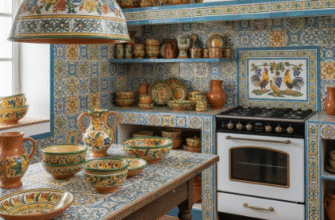
Victorian kitchens weren’t designed for efficiency—they were designed to impress.
I used to think Victorian design was all about stuffy parlors and velvet drapes, but here’s the thing: the kitchen was where the real drama happened. These weren’t the stark, utilitarian spaces we associate with old-world cooking. They were theatrical stages, crammed with ornate moldings, hand-painted tiles, and woodwork so detailed it probably drove the carpenters half-mad. The Victorians loved their maximalism, and the kitchen—despite being the domain of servants in wealthier homes—wasn’t exempt from this aesthetic fever. You’d find carved corbels supporting heavy shelves, brass hardware polished to a mirror shine, and cabinetry that looked more like furniture you’d find in a library. The color palette leaned into deep, saturated tones: burgundy, forest green, navy blue, sometimes even a burnt orange that sounds garish now but somehow worked then. It was excess, sure, but it was intentional excess, the kind that whispered (or maybe shouted) about status and taste.
Honestly, the tilework alone could eat up half your budget if you tried to recreate this today. Victorian kitchens featured elaborate tile backsplashes—often hand-painted or transfer-printed with botanical motifs, geometric patterns, or scenes that wouldn’t look out of place on a dinner plate. These weren’t just functional surfaces; they were art installations that happened to protect your walls from grease splatter.
The Obsessive Attention to Architectural Detailing That Defined Every Surface
Crown molding in a kitchen? Absolutely. The Victorians didn’t see why a cooking space should be any less architecturally interesting than a dining room. You’d find picture rails, wainscoting, and ceiling medallions—elements we now reserve for more “formal” spaces—integrated into kitchen design without a second thought. I guess it makes sense when you consider that these homes were built during an era when craftsmanship was still relatively affordable, and showing it off was the whole point. Baseboards might be eight inches tall, carved with egg-and-dart motifs or stylized acanthus leaves. Window casings were substantial, sometimes featuring rosettes at the corners or fluted pilasters along the sides. Even the humble pantry door might recieve (if you were wealthy enough) raised panels and decorative hinges that looked like they belonged on a church.
Wait—maybe I’m romanticizing this too much. These kitchens were also hot, poorly ventilated, and probably smelled like coal smoke half the time. The ornate details collected dust and grease in equal measure, and cleaning them must have been absolutely miserable work for the scullery maids tasked with maintaining appearances. But from a purely visual standpoint, there’s something undeniably compelling about the commitment to beauty in every corner, even the ones most homeowners would never see.
Rich Color Palettes Drawn from Natural Pigments and Cultural Influences
The color theory of Victorian kitchens borrowed heavily from the Arts and Crafts movement and earlier Gothic Revival trends, which explains the moody, earthbound palette. Walls might be papered in William Morris prints—those densely patterned designs featuring twisted vines and stylized birds—or painted in colors with names like “Dragon’s Blood” and “Etruscan Red.” Cabinetry often came in dark woods (mahogany, walnut, oak) or was painted in deep greens and blues that modern eyes might find too heavy for a kitchen. Turns out, the Victorians weren’t worried about making spaces feel “open and airy.” They wanted warmth, richness, a sense of enclosure that feels almost womb-like by contemporary standards.
Ornamental Hardware and Fixtures as Status Symbols Rather Than Afterthoughts
Every knob, hinge, and faucet was an opportunity for decoration. Brass was the material of choice, often cast in elaborate shapes—lions’ heads, floral sprays, geometric Art Nouveau curves that wouldn’t fully bloom until the next era but were already creeping in around the edges. I’ve seen reproduction Victorian cabinet pulls that weigh more than modern drawer fronts, solid metal things that feel substantial in your hand, almost weapon-like. Faucets weren’t the minimalist single-lever affairs we use now; they were cross-handled, porcelain-collared contraptions that required two hands to operate and looked like something you’d find on a steam engine.
The Layered Approach to Textiles and Functional Decoration Throughout the Space
Victorians didn’t believe in bare surfaces. Shelves displayed decorative plates and copper molds when not in use. Windows were dressed with lace curtains or stained glass panels, sometimes both. Floors might be covered in patterned encaustic tiles—those durable cement tiles with pigment mixed all the way through, creating designs that wouldn’t wear away no matter how many boots trampled over them. Even the ceiling might get decorative treatment: tin tiles pressed with floral or geometric patterns, painted white or left in raw metal that would develop a patina over time. This layering created visual complexity that either delights or overwhelms, depending on your tolerance for ornamentation.
The thing about Victorian kitchen design is that it defies our modern instinct toward simplification. We’re taught to edit, to pare down, to let materials “speak for themselves.” The Victorians didn’t trust silence—they filled every gap with pattern, color, texture, detail. Whether that’s inspired or exhausting probably depends on which century your soul belongs to.