I used to think Thai kitchens were just about the food.
Then I spent three weeks in Chiang Mai watching my landlord’s grandmother cook in what I can only describe as a half-indoor, half-outdoor culinary laboratory, and everything I thought I knew about kitchen design got turned sideways. She’d be chopping lemongrass at a wooden counter that opened directly onto a garden where chickens wandered, steam from her tom yum rising into open air while monsoon rains drummed on a corrugated overhang just two meters away. The whole setup felt chaotic, but also—and here’s the thing—perfectly calibrated to a climate where walls feel like punishment and ventilation isn’t a luxury, it’s survival. No exhaust fan could match what that open-air design accomplished naturally, pulling smoke and heat out faster than any mechanical system I’d seen in Western kitchens, and doing it with roughly zero energy consumption, give or take the occasional ceiling fan.
Turns out Thai kitchen architecture evolved less from aesthetic preference and more from thermodynamic necessity. The humidity, the heat, the constant cooking of pungent ingredients—it all demands airflow. Which is why traditional designs blur boundaries in ways that would horrify most building codes elsewhere.
When Walls Become Suggestions Rather Than Requirements
Thai open-air kitchens operate on a principle I’d call “selective enclosure.” You’ll see a roof, definitely, because rain isn’t negotiable in Southeast Asia. You might get one or two walls, usually on the side where prevailing winds come from or where storage needs protection. But the rest? Open. Just open. I’ve seen kitchens in Bangkok suburbs where the “wall” facing the backyard was nothing but a waist-high counter and some potted plants, with the cooking happening in full view of a small jungle of banana trees and ferns.
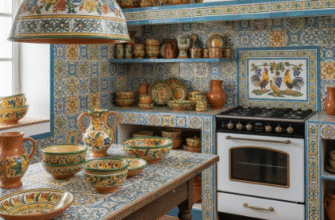
The materials matter more than you’d think. Teak and bamboo show up constantly, not because they’re trendy but because they handle moisture without rotting into oblivion within a year. Concrete gets used for floors—practical, cleanable, and it doesn’t warp when someone spills a pot of curry. Tile work appears in splashes, often with patterns that feel almost excessive, blues and greens mimicking water and foliage, which I guess makes sense when your kitchen is already half-merged with a garden. Metal fixtures corrode fast in that humidity, so you see a lot of stainless steel or just wooden implements that get replaced regularly.
Anyway, the real genius is in what doesn’t get built.
Where a conventional kitchen might install cabinets, Thai designs often use open shelving or hanging racks, letting air circulate around dishes and ingredients. Where you’d expect a closed pantry, you find woven baskets suspended from ceiling beams, keeping rice and dried goods away from floor moisture and pests while staying breathable. I used to think this was quaint, some holdover from pre-refrigeration days, but then I watched how efficiently it worked—no mold, no mustiness, just constant gentle airflow doing the work that climate control does in sealed environments. The cooking zones themselves rarely center around one big stove; instead, you get multiple small cooking stations, sometimes scattered across the space. One burner near the outdoor edge for high-heat wok cooking where smoke can escape immediately, another more sheltered spot for slower simmering, maybe a charcoal grill off to the side under its own small roof. It’s decentralized, almost modular, adapting to whatever’s being cooked rather than forcing everything through one workflow.
Tropical Elements That Actually Function Beyond Looking Pretty
The plants aren’t decorative—well, they are, but that’s not why they’re there. I kept noticing herb gardens integrated directly into kitchen spaces, sometimes in ground plots, sometimes in elevated planters built into counters. Basil, cilantro, kaffir lime, galangal, all within arm’s reach of the chopping board. This isn’t Instagram aesthetics; it’s functional agriculture compressed into cooking infrastructure. The plants also help: they transpire moisture, cool the immediate air slightly, and some—like lemongrass and citronella—actively repel insects, which matters when your kitchen doesn’t have screens.
Water features appear more often than you’d expect. Not fountains exactly, but often a large ceramic jar or concrete basin for washing, positioned where it catches rainwater from the roof. The evaporation provides passive cooling, and honestly, there’s something psychologically cooling about seeing water nearby when it’s 35 degrees Celsius and you’re standing over a wok.
Lighting gets tricky. You need enough to prep food safely, but you’re working with an open space that transitions from bright daylight to total darkness with only about twenty minutes of usable dusk in between. So you see a lot of hanging pendant lights on long cords, positioned low over work surfaces, sometimes with metal shades that direct light downward while letting heat rise and dissipate. During the day, the open design means natural light floods in from multiple angles—no dim corners, no need to flip switches just to see if your shallots are actually caramelizing or just burning.
Adapting Traditional Concepts Without Losing What Makes Them Work
Modern Thai homes can’t always go full open-air, especially in urban areas where neighbors are three meters away and air conditioning is non-negotiable. But I’ve seen clever compromises. Large sliding glass panels that can receed completely during cooking and close afterward. Kitchens positioned on upper floors with balcony extensions, creating semi-outdoor zones. Ventilation grilles designed to look like traditional carved wood panels, giving the aesthetic while pulling air through mechanically.
Wait—maybe the most telling thing is how these kitchens handle the boundary between inside and outside. In most Western designs, that boundary is a threshold, a door, a clear transition. In Thai open-air kitchens, it’s a gradient. You move from fully enclosed living space to covered-but-open kitchen to maybe a partially roofed prep area to full garden, and at no point is there a hard line. It’s all continuous, all breathing together.
The skeptic in me used to worry about pests, about dirt, about security. And yeah, those are considerations—geckos definitely wander through, and you need to be mindful about leaving food out. But the trade-off is a kitchen that doesn’t feel like a hot box, that doesn’t trap cooking odors for hours, that connects you to weather and seasons and the actual act of transforming raw ingredients in a way that sealed, climate-controlled spaces just don’t. I’m not saying everyone should knock down their kitchen walls, but there’s something to learn from a design tradition that treats air and light and the boundary between nature and dwelling as variables to work with rather than problems to solve with more walls and bigger HVAC systems. The Thai approach feels less like containing cooking and more like choreographing it within a larger environmental context, which, honestly, might be the smarter framework as climates everywhere get hotter and energy costs climb.