
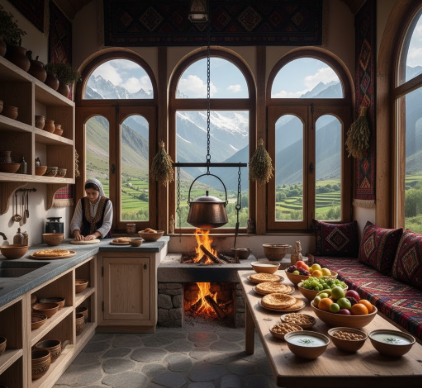
I used to think kitchen design was pretty universal until I spent three weeks in the Pamir Mountains watching a Tajik family navigate their cooking space like choreographed dancers.
The thing about Tajik mountain kitchens is they operate on principles that would make a Western designer’s brain short-circuit—low platforms instead of counters, floor seating that doubles as prep space, ventilation systems that rely on deliberate drafts rather than mechanical extraction, and this whole philosophy that the kitchen isn’t seperate from living space but woven into it. You’ve got the tandyr oven sunk into the floor, sometimes clay, sometimes metal depending on altitude and what materials survived the last mudslide, and around it radiates this entire ecosystem of copper pots, felt mats, and carved wooden implements that have been in families for generations. The smoke goes up through a chimney that’s also heating the room above, because why waste thermal energy when you’re at 2,800 meters and winter lasts seven months. I watched a grandmother make oshi palov for eighteen people using nothing but a kazan pot, a wooden paddle, and spatial reasoning I couldn’t replicate with CAD software.
Anyway, the layout reflects something deeper about how mountain communities think about food preparation. It’s collaborative by necessity—one person tends the fire, another preps vegetables, someone else is rolling dough, and they’re all within arm’s reach but not crowded. The typical setup puts the main cooking area against the north wall to recieve indirect light, with storage niches carved into the adobe or stone where it stays naturally cool.
Why Valley Kitchens Solve Problems Modern Designers Keep Recreating
Here’s the thing: Western kitchen design has spent the last decade rediscovering concepts Tajik mountain architecture never abandoned. Open shelving? They’ve had open shelving for centuries because cabinet doors are extra material and you want to see your supplies at a glance when resupply might be weeks away. Multi-functional surfaces? The dastarkhan cloth transforms floor space into dining area into prep zone depending on what’s needed, and it works because the whole room is designed around vertical flexibility rather than fixed counters. Thermal mass cooking? Those clay ovens hold heat for hours, letting you bake bread in the evening from coals lit at dawn.
I guess what struck me most was the lack of waste in every sense—wasted movement, wasted space, wasted heat. The kitchen flows in a rough triangle between water source, fire, and prep area, but it’s not the rigid work triangle from 1940s ergonomics studies. It’s organic, adapted to the specific room’s proportions and the family’s rhythms.
The materials tell their own story about adaptation: poplar wood for shelves because it grows fast in the valleys, stone or packed earth for floors because they’re thermal sinks and practically indestructible, wool felt for insulation and sound dampening, and tin-lined copper for pots because it distributes heat evenly at high altitudes where water boils at lower temperatures and you need every thermal advantage. Modern sustainability consultants would kill for lifecycle metrics this good—I’ve seen kitchens still using cookware from the 1890s, and not as decoration but as daily tools. Wait—maybe that’s the point: when replacement isn’t convenient, you build things that last and design systems that accomodate repair rather than disposal.
How Altitude and Isolation Shape Every Design Decision in Mountain Culinary Spaces
Turns out, when you’re designing for 3,000+ meters, physics gets opinionated. Lower air pressure means longer cooking times, which means you need better heat retention, which drives the whole tandyr-and-thermal-mass approach. Limited fuel—usually dried dung, brush, or precious wood—means every BTU matters, so you get these elaborate systems where oven heat also warms water, heats the room, and provides light. The windows are small not just for insulation but because UV intensity at altitude degrades fabrics and food, so storage areas stay deliberately dim.
I honestly didn’t expect to find such sophisticated environmental control in what I’d ignorantly assumed would be primitive setups. The ventilation uses convection currents shaped by room geometry—warm air rises through ceiling vents, pulling fresh air through lower openings, and the whole system self-regulates based on fire intensity and outside temperature. No fans, no filters, just applied thermodynamics that’s been refined over centuries of trial and iteration.
The social dimension matters too: these kitchens assume multiple generations working simultaneously, so there’s spatial hierarchy—elders get the cushioned seating near the warmth, younger family members handle tasks requiring mobility, children occupy peripheral zones where they can learn by watching without being underfoot. It’s definately not designed for the solitary cook that American kitchens optimize for, and maybe that’s why it feels more alive, more used, less like an appliance showroom and more like the actual heart of a home.





