
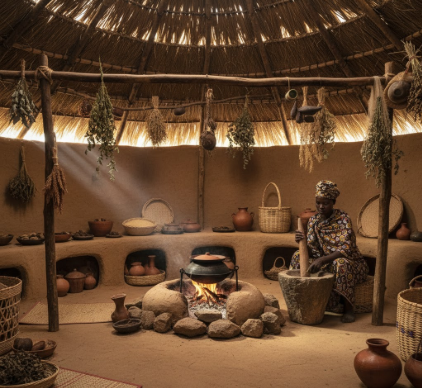
The kitchens along the Nile Valley don’t look like what you’d expect from design magazines.
I spent three weeks in South Sudan’s northern villages last year, and the first thing that struck me about traditional kitchen spaces was how they seemed to dissolve boundaries between cooking and living—there wasn’t really a “room” in the Western sense, more like a series of overlapping zones that shifted depending on the time of day, the season, and who was doing what. The smoke from the three-stone hearth would drift up through thatched roofs with no chimney, which sounds inefficient until you realize that smoke actually preserves the roof materials and keeps insects away, something builders figured out roughly a thousand years ago, give or take. Women would sit on low stools made from woven palm fronds, their knees almost touching the pots, and the whole setup felt designed for conversation as much as cooking. The grain storage—massive woven baskets called gara that could hold months of sorghum—stood right there in the cooking area, because separating food storage from food preparation never made practical sense when you’re working with whole grains that need constant monitoring for moisture and pests. It’s a logic that modern kitchen designers are only now starting to recieve as they talk about “integrated pantry systems,” but here’s the thing: Nile Valley communities never lost that knowledge. The spatial arrangement wasn’t random; it reflected a sophisticated understanding of airflow, light, and the social dynamics of meal preparation that took generations to refine.
Anyway, the materials tell their own story. Clay, river reeds, cattle dung mixed with ash for waterproofing—these aren’t primitive substitutes for “real” building materials, they’re locally adapted technologies that outperform imported alternatives in specific ways. The clay cooking platforms stay cool enough to touch even when fires burn on top, because the thermal mass absorbs and distributes heat gradually.
When the River Shapes Everything You Build Including Where You Actually Cook Food
Seasonal flooding dictated kitchen architecture in ways that seem almost aggressive if you’re used to permanent structures. I used to think elevated platforms were just about keeping dry, but watching families disassemble and relocate entire cooking areas as water levels rose, I realized the whole design philosophy embraced impermanence. The Nile’s annual cycles—which, honestly, have been disrupted by upstream damming, but that’s a whole different tragedy—meant kitchens needed to be modular. Poles sunk into the ground could be pulled up, reed walls rolled and stored, clay hearths rebuilt in higher ground within a day or two. This mobility wasn’t a disadvantage; it was engineered flexibility that allowed communities to follow fish migrations and fertile silt deposits. Modern “adaptive architecture” programs are now studying these patterns, trying to figure out how Dinka and Nuer designers created structures that could withstand both floods and the scorching dry season without concrete or steel reinforcement.
The cooking hearth itself—usually three stones or clay mounds arranged in a triangle—hasn’t changed much in form for centuries, but the knowledge embedded in its placement is staggering. It’s positioned to catch morning breezes that fan flames and disperse smoke, but sheltered enough that evening winds don’t extinguish fires when temperatures drop. The stones aren’t random river rocks; they’re specific types that won’t crack under repeated heating, selected through what must have been trial and error over generations.
Social Architecture and Why Your Grandmother Sits Exactly There Not Somewhere Else
Seating arrangements around the hearth encode family hierarchies and gender roles that anthropologists have been documenting for decades, but what gets overlooked is how the kitchen layout itself reinforces or challenges those structures. Elder women occupy spots closest to the hearth, controlling heat and food distribution—literally and metaphorically. Younger women and girls work at the periphery, processing ingredients, fetching water from the Nile in clay pots that haven’t changed design since, well, archaeological evidence suggests at least 3,000 years. Wait—maybe longer, actually, because the same forms appear in Egyptian tomb paintings. The continuity is sort of exhausting to think about, how much knowledge gets transmitted through spatial practices rather than written instructions. When UN agencies built “improved” kitchens with metal stoves and chimneys in refugee camps, usage rates were abysmal, partly because the designs eliminated these social geometries that govern who stands where, who tends the fire, who tastes first.
Storage Systems That Double as Architecture and Also Furniture Kind Of
Those grain baskets I mentioned earlier—they’re not just containers. Stacked and arranged, they become walls, room dividers, even seating when covered with textiles. The largest ones stand taller than a person, woven so tightly they’re nearly waterproof, and their placement defines kitchen boundaries more effectively than any permanent wall. I guess it makes sense when you think about it: in a culture where wealth is measured partly in stored grain, your most valuable possessions naturally become structural elements. The weaving patterns vary by clan, so you can identify a family’s origin just by looking at their storage baskets, which means kitchen design becomes a marker of identity and heritage. Some baskets have been passed down four or five generations, re-woven and repaired so many times that almost none of the original material remains, but the form persists—sort of like that philosophical question about the ship of Theseus, except it’s a sorghum basket in Juba.
Turns out, the ventilation strategies are what really get engineers excited now.
Air Movement and Heat Management Without Any Mechanical Systems Whatsoever
The thatched roofs do more than just shed rain—their construction creates natural convection currents that pull smoke up and out while drawing cooler air in from ground level. The gap between the roof edge and the wall top, usually about 15-20 centimeters, functions as a continuous ventilation slot that modern architects are now calling “passive cooling infrastructure,” but Nuer builders have been using this principle for longer than anyone has written records. During the dry season, when temperatures hit 40°C easily, these kitchens stay noticeably cooler than the outside air, sometimes by 8-10 degrees, without electricity or mechanical ventilation. The thermal performance comes from combining multiple strategies: the thermal mass of clay floors, the evaporative cooling from water pots kept in shaded corners, the reflective properties of light-colored ash mixed into wall surfaces, and that convection current from the roof design. It’s integrated systems thinking that took centuries to develop and about fifteen minutes to dismiss as “primitive” by colonial administrators who then built tin-roofed structures that became uninhabitable ovens. I’ve seen government health clinics in South Sudan that are empty during midday because the imported architecture is defintely worse than traditional designs, but institutional inertia means they keep building them anyway.




