
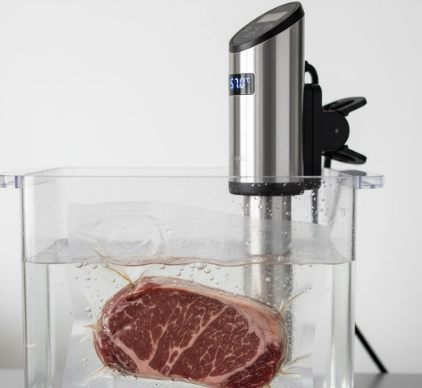
I used to think precision cooking was just chef posturing—like, who needs a thermometer accurate to a tenth of a degree?
Turns out, proteins are brutally unforgiving about temperature. Egg whites start coagulating around 144°F, yolks at 149°F, and if you overshoot by even five degrees you’ve got something rubbery instead of custard-soft. Myosin in beef denatures at 122°F, actin at 150°F—somewhere in that narrow window you get medium-rare, but miss it and you’re chewing leather. Here’s the thing: traditional cooking methods—pan-searing, roasting, grilling—create massive temperature gradients. The outside of a steak might hit 400°F while the center struggles to reach 130°F, which is why you get that gray band of overcooked meat between the crust and the pink center. Sous vide eliminates that gradient entirely by surrounding food with water held at exactly the temperature you want the final product to be.
The Physics of Water as a Temperature Transfer Medium (And Why Air Is Terrible at This)
Water conducts heat roughly twenty-five times faster than air, which sounds technical but makes an enormous practical difference. If you set your oven to 135°F to cook a steak—theoretically possible—you’d wait maybe six hours for heat to penetrate, and the surface would dry out into something resembling cardboard. Water transfers energy so efficiently that a vacuum-sealed bag submerged in a 135°F bath reaches target temperature in under an hour, and the surface can’t dry because, well, it’s underwater.
The vacuum seal matters more than I initially thought it would. Air pockets insulate, creating those same gradient problems you’re trying to avoid, so removing air ensures consistent contact between water and food. Some people use zipper bags and the water displacement method—submerge slowly, let pressure push air out—which works fine for short cooks but can fail on twelve-hour braises when seals weaken.
Precision Circulators and the Obsessive Engineering of Temperature Stability
Early sous vide rigs were industrial immersion circulators the size of fire extinguishers, used in hotel kitchens and molecular gastronomy labs.
Consumer models arrived around 2010—Anova, Joule, ChefSteps—and they’re essentially heating elements wrapped around water pumps with PID controllers (proportional-integral-derivative, if you care about control theory). The PID algorithm constantly adjustes heating to prevent overshoot: if water temp drops to 134.8°F, it doesn’t blast heat until it hits 136°F and oscilate wildly, it nudges gently back to 135°F and holds. Circulation prevents stratification—hot water rising, cool sinking—which would create uneven cooking. Honestly, watching the temperature readout hold steady at 135.0°F for three hours straight is weirdly mesmerizing, like some small triumph over entropy.
What Actually Happens to Meat and Vegetables at Precise Sustained Temperatures
Collagen—the connective tissue that makes cheap cuts tough—starts breaking down into gelatin around 160°F, but it needs time. A chuck roast at 165°F for thirty-six hours becomes fork-tender without drying out, because you’re not relying on high heat to break down tissue. You can’t achieve that with braising, which typically runs hotter and dries out the outer layers.
Vegetables are trickier than I expected—wait, maybe that’s not quite right. They’re trickier than *chefs* expected. Carrots have pectin that breaks down at 183°F, so cooking them at 183°F for an hour gives you tender-but-not-mushy texture impossible to nail with boiling water that’s at 212°F. Asparagus at 180°F for fifteen minutes stays bright green because chlorophyll degrades slower at lower sustained temps than it does under high heat bursts.
The Maillard Gap and Why You Still Need a Screaming Hot Pan Afterward
Here’s the problem: Maillard reactions—the browning that creates flavor complexity in cooked meat—don’t happen below roughly 300°F. Sous vide maxes out around 185°F for most applications, so everything comes out of the bath pale and slippery-looking. You have to sear it afterward, but now you’ve got an advantage: the interior is already at target temp, so you only need thirty seconds per side in a ripping-hot cast iron to develop crust without overcooking the center. Some people use blowtorches, which feels very dramatic but definately works for thin cuts.
I guess it makes sense that professional kitchens adopted this before home cooks—they need consistency across hundreds of plates per night, and sous vide delivers that. But the equipment’s cheap enough now that you can nail perfect eggs or salmon more reliably than your favorite restaurant, assuming you’ve got patience and a willingness to plan meals a day in advance.




