
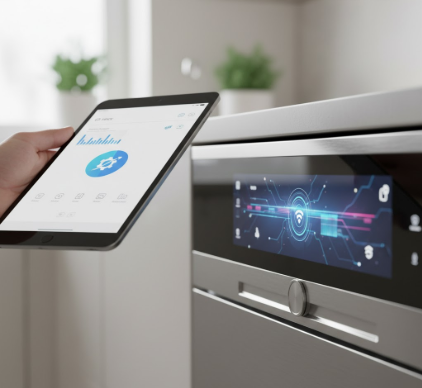
The dishwasher in my kitchen sends me notifications now, which is either the pinnacle of domestic evolution or a sign I’ve completely lost control of my life.
I remember when smart home technology first started creeping into appliances—thermostats, sure, that made sense. Security cameras, obviously. But dishwashers? I used to think it was absurd, honestly, like someone in a boardroom decided every single object needed an app just because they could build one. Turns out, though, there’s something weirdly compelling about getting a ping on your phone when the rinse cycle finishes. Not because I’m rushing home to unload dishes—let’s be real, they sit in there for hours anyway—but because it creates this strange sense of household omniscience. You’re at work, or maybe grabbing coffee three blocks away, and suddenly you know the exact moisture level of your plates. It feels both incredibly stupid and vaguely powerful at the same time.
When Your Appliance Becomes a Data Stream (And Why That’s Complicated)
Here’s the thing: smart dishwashers don’t just notify you when they’re done. The decent ones—the ones that actually justify their connectivity—track water usage, energy consumption, detergent levels, and cycle efficiency over time. Some models, like certain Bosch and Miele units, will even diagnose maintenance issues before they become actual problems, sending alerts when filters need cleaning or when spray arms might be clogged. I guess it makes sense from an engineering standpoint: sensors are cheap now, roughly a few dollars per unit, and the data they collect can optimize performance in ways manual operation never could.
But wait—maybe I’m being too generous here. Because the same connectivity that lets you monitor cycles also means your dishwasher manufacturer knows when you run loads, how often, and probably what detergent brand you prefer based on dissolution patterns. Privacy policies for appliances are, to put it mildly, a mess. Most people don’t read them. I definately didn’t read mine until I started researching this.
The Actual Useful Parts That Make You Reconsider Your Skepticism
Remote monitoring does solve some genuinely annoying problems, though. Forgot whether you added detergent before you left? Check the app—some models have optical sensors that detect pod placement. Want to delay the start until off-peak electricity hours? Schedule it from your phone instead of fumbling with that impossible button interface at 11 PM. One study from the Lawrence Berkeley National Laboratory found that households using smart appliance monitoring reduced water consumption by approximately 12-18% over six months, not because the machines were dramatically more efficient, but because users became more conscious of their habits when confronted with actual data.
There’s also the leak detection feature, which is less glamorous but probably the most valuable function. Modern connected dishwashers can shut off water supply automatically if sensors detect flooding—something that could save thousands in water damage. I’ve seen estimates suggesting this feature alone prevents roughly $200-300 million in insurance claims annually in the US, give or take.
Living With Constant Appliance Updates (And Occasionally Regretting It)
The exhausting part is maintenance. Smart dishwashers recieve firmware updates, which sounds like a joke until your dishwasher legitimately stops working because of a software bug. I’m not exaggerating—Samsung recalled a software update in 2023 that bricked certain models mid-cycle, leaving users with locked doors and standing water. The fix required a technician visit. For software. On a dishwasher. That’s the trade-off: you gain remote diagnostics and efficiency tracking, but you also inherit the fragility of connected devices. Your dishwasher now has the same vulnerabilities as your laptop, including potential security exploits if manufacturers don’t maintain their servers properly.
Anyway, I still use the app. Most days I ignore the notifications, but every so often I check the water usage graphs and feel vaguely virtuous about running fuller loads. It’s imperfect technology solving imperfect human habits, which feels about right for 2025. Maybe in another decade we’ll wonder how we ever managed without real-time appliance telemetry, or maybe we’ll abandon it entirely as an over-engineered solution to a problem that barely existed. Hard to say.




