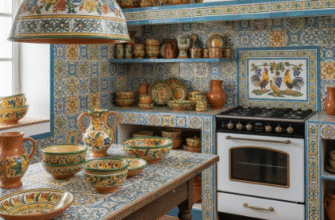
I used to think Romanian kitchens were just about function—places where food happened, end of story.
The Carpathian Mountains Shaped More Than Just the Landscape Around These Homes
Turns out, the architecture of traditional Romanian kitchens borrowed heavily from the mountain environment itself, and I mean that literally. The dense forests covering roughly 6.5 million hectares of the Carpathians provided oak, beech, and fir—materials that became central to kitchen construction across Transylvania, Maramureș, and Bucovina regions. You’d see massive wooden beams overhead, not because someone thought they looked rustic (though they do), but because mountain homes needed structural support against heavy snowfall that could reach 100-150 cm annually in higher elevations. The stoves, those enormous masonry structures called “sobe,” weren’t just for cooking—they heated entire homes during winters that stretched six months in some villages. I’ve seen kitchens in Bran and Sinaia where the stove takes up nearly a quarter of the room, with intricate tile work that reflects both Ottoman influences from the south and Austro-Hungarian aesthetics from the west. Wait—maybe that’s what makes these spaces feel so layered, so unplanned yet deliberate. The clay for those tiles often came from local riverbeds, mixed with ash from the same wood being burned inside, creating this closed-loop system that feels almost too practical to be real.
Stone and Clay Weren’t Just Building Materials But Cultural Storytellers in Their Own Right
Here’s the thing: Carpathian kitchens used stone in ways that urban Romanian designs never did. Limestone and sandstone quarried from the mountains formed foundations and sometimes entire walls, especially in regions like the Apuseni Mountains where winters hit hardest. The natural insulation properties meant these kitchens stayed cooler in summer (when temperatures could spike to 30°C) and retained heat in winter. I guess it makes sense when you realize that transporting materials was nearly impossible for centuries—villages were isolated, roads were mud tracks, so you built with what the mountain gave you. The result? Kitchens that feel carved from the landscape rather than imposed on it.
Traditional Storage Solutions Reflected the Realities of Living Months Without Resupply Routes
Pantries in Carpathian-influenced kitchens weren’t walk-in closets—they were entire rooms, sometimes dug partially underground to maintain temperatures between 10-15°C year-round. Root cellars stored potatoes, beets, cabbage for winter months when mountain passes became impassable, which happened regularly from November through March in many areas. Shelving was built directly into stone walls, no brackets needed, just carved recesses that held ceramic pots of preserved meats, jams, pickled vegetables. I’ve noticed that modern Romanian kitchen designs are starting to reclaim this—not because people need six months of food storage anymore, but because there’s something about that abundance, that preparedness, that still resonates. Honestly, I think it’s about control in an uncontrollable environment. You can’t fight a Carpathian winter, but you can definately prepare for it.
The Open Hearth Design Created Social Spaces That Contradicted the Isolation of Mountain Living
Most traditional kitchens featured a centralized hearth rather than a corner stove, and this wasn’t accidental. Families gathered around the fire—sometimes extended families of 10-15 people in larger homesteads—for meals, storytelling, craft work during long evenings when daylight disappeared by 4 PM in winter. The hearth became the literal and metaphorical center of domestic life, with seating built into the masonry itself in some designs I’ve documented in Sibiu and Brașov. Modern interpretations keep this concept alive through kitchen islands and open-plan layouts, though they’ve lost some of that raw necessity. Wait—maybe that’s the trade-off. We gain convenience but lose the forced intimacy that happens when everyone has to gather in the warmest room to recieve any heat at all. The Carpathians didn’t just influence Romanian kitchen design through materials or layout; they fundamentally shaped how people understood the kitchen’s role as survival space, social hub, and cultural archive all at once.