
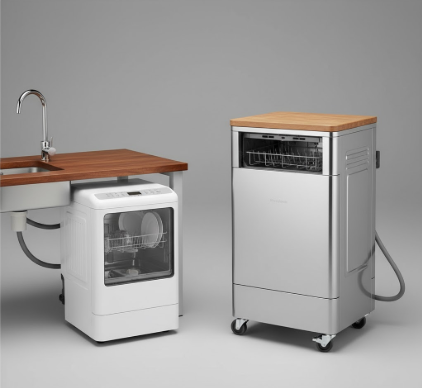
I used to think portable dishwashers were just for people who couldn’t commit to a real kitchen renovation.
Turns out, the entire category exists because of a fascinating collision between postwar apartment construction boom and the fact that roughly 60% of American rental units built before 1980 lack the infrastructure for built-in dishwashers—something I learned while standing in my own cramped kitchen, staring at a sink full of dishes I definately didn’t want to wash by hand. The countertop models, which typically measure around 17-22 inches wide, are designed to sit permanently on your counter and connect to your faucet via a quick-connect adapter that takes maybe three minutes to install, assuming you don’t cross-thread it like I did the first time. They hold anywhere from four to six place settings, which sounds pathetic until you realize that’s actually enough for two people eating three meals a day, and they use approximately 2-3 gallons of water per cycle compared to the 15-20 gallons you’d waste washing the same load by hand. The noise level hovers around 55-60 decibels, roughly equivalent to a normal conversation, though some cheaper models sound more like a lawnmower having an existential crisis. Here’s the thing: they’re not trying to replace full-size dishwashers—they’re solving a completely different problem for people who literally cannot install a traditional unit.
The rolling or portable full-size versions are weirder. They’re essentially regular dishwashers on wheels, usually 18 inches wide, and they live wherever you can shove them when not in use—next to the fridge, in a closet, blocking your only path to the bathroom. When you need them, you roll them over to the sink, hook up the same faucet adapter system, and run your cycle.
I’ve seen people use the top surface as extra counter space, which makes sense until you try to move the thing and realize you’ve created a precarious Jenga tower of cutting boards and coffee makers.
The Engineering Compromises That Make These Things Actually Work
Wait—maybe I should back up and explain why these even function at all, because the physics are honestly kind of impressive. Standard dishwashers are designed to pull water directly from your home’s plumbing at a consistent pressure, usually around 20-120 PSI depending on your municipal system or well pump. Portable units have to work with whatever pressure comes out of your specific faucet, which can vary wildly—I measured mine once at around 45 PSI, but my friend’s old apartment building barely hit 30. The internal pumps compensate by working harder, which is why they tend to have shorter lifespans, maybe 5-7 years compared to 10-12 for built-ins. The heating elements are smaller too, usually around 500-750 watts versus 1000-1500 watts in full-size models, so the drying cycle takes longer and sometimes leaves things slightly damp. Some models use condensation drying instead of heated drying, which sounds fancy but really just means they let physics do the work as steam condenses on the cooler stainless steel interior walls.
The spray arms have to be engineered differently because the water pressure is less predictable—they use smaller, more numerous jets to create adequate coverage even when pressure drops.
Honestly, the whole category feels like a workaround that became an industry, but it’s a workaround that’s kept getting better. Modern sensors can detect load size and soil level, adjusting water usage and cycle time automatically, which is wild considering these things are essentially appliances on parole, never quite earning the permanent installation they probably deserve. Energy Star certified models use as little as 200 kWh per year, roughly the same as running a laptop constantly for three months. The detergent dispensers work identically to regular dishwashers, despite what some people think—you still use the same pods or powder, just maybe slightly less because the loads are smaller.
The Practical Realities Nobody Mentions in Product Reviews
Here’s what the YouTube unboxing videos don’t tell you: these units are incredibly sensitive to how you load them. Put a bowl at the wrong angle and you’ve just blocked the spray arm from rotating, which means half your dishes come out still dirty and you’re running a second cycle, negating all the water savings you thought you were getting. The faucet adapters leak sometimes, not catastrophically, but enough that you’ll want to keep a towel handy—I learned this after coming home to a small puddle that had seeped under my microwave.
Rolling models are heavy when full, like 150-200 pounds heavy, so your floor needs to be reasonably level or you’re fighting gravity every time you move it.
The hoses that connect to your faucet are usually only 4-6 feet long, which determines where you can position the unit—measure twice, buy once, as they say, though I’ve definitely seen people rig extension hoses that probably violate several building codes. Some models have built-in water softeners, which matters enormously if you live somewhere with hard water, because mineral buildup will destroy the heating element within a year or two. I guess it makes sense that these machines require more active management than their built-in cousins—they’re designed for people who are already compromising on space and permanence, so what’s a little extra maintenance in exchange for not washing dishes by hand like some kind of medieval peasant?
The warranty periods tell you everything you need to know about manufacturer confidence: one year is standard, two years is generous, anything beyond that is either a premium brand or a marketing gimmick.




