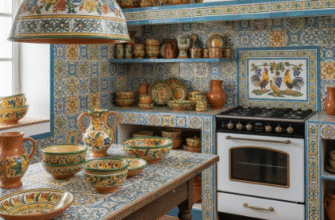
I used to think Polish kitchens were just about pierogis and cabbage, but turns out the design tradition runs deeper than any fermented vegetable I’ve ever encountered.
The first time I walked into a proper Polish kitchen—one belonging to my friend’s babcia in Kraków—I noticed something immediately: the tiles. Not just any tiles, but hand-painted ceramic squares depicting folk motifs, roosters with impossibly red combs, flowers that didn’t quite exist in nature. These weren’t mistakes; they were deliberate imperfections, the kind that come from artisan workshops in places like Bolesławiec, where pottery has been made since the 13th century, give or take a few decades. The tradition of ceramic work in Poland connects directly to broader Slavic craft movements, where functionality and beauty weren’t supposed to be seperate things. You see this in Ukrainian vyshyvanka patterns, in Czech glass work, in the way Hungarian kitchens incorporate colorful textiles—it’s all part of this Eastern European insistence that daily objects should carry meaning, should tell stories, even if those stories are just about someone’s great-grandmother’s favorite color.
The Stove That Refused to Die: Tile Ovens and Thermal Mass Engineering
Here’s the thing about Polish tile stoves—or piec kaflowy, if you want to get technical. They’re massive.
We’re talking structures that can weigh over a ton, built from ceramic tiles and designed to absorb heat slowly, then radiate it for hours after the fire dies down. I’ve seen modern Polish kitchen renovations where families refuse to remove these relics, even when they’re no longer functional, because they anchor the entire room’s aesthetic. The engineering is actually fascinating: the flue system creates a labyrinth inside the stove, forcing hot gases to travel through channels before exiting, maximizing heat transfer to the ceramic mass. This isn’t some quaint folk technology—it’s thermodynamics applied through trial and error over centuries. Slovakia, Lithuania, and parts of Russia have similar traditions, but the Polish versions often incorporate these incredibly ornate tile patterns, sometimes with religious imagery, sometimes with geometric designs that echo Łowicz paper-cutting traditions.
Wait—maybe I should mention that these stoves are making a comeback? Architects in Warsaw and Gdańsk are designing contemporary kitchens around restored tile ovens, treating them as sculptural focal points. The irony is delicious.
Wood, Width, and the Problem of Grandmother’s Furniture Syndrome
Polish kitchens traditionally favor heavy wood furniture—oak, pine, sometimes birch—but not in the minimalist Scandinavian sense. These are robust, wide pieces with visible joinery, often left slightly unfinished or painted in muted colors like cream, dusty blue, or that particular shade of green that I can only describe as “Soviet hospital meets forest moss.” The tables are wide enough to accommodate large family gatherings, because Polish food culture revolves around communal eating in ways that make modern open-plan concepts look antisocial. I guess it makes sense when you consider that Eastern European winters are long, and kitchens historically served as the warmest room in the house, the place where everyone congregated not just to eat but to exist. You’ll find similar furniture styles in Czech and Slovak kitchens, though the Polish versions tend to incorporate more storage—think deep drawers for root vegetables, compartments for preserving jars, spaces designed around the logistics of seasonal food preservation. My friend’s mother has a cabinet from the 1950s with a built-in flour sifter, which sounds absurd until you realize she still uses it weekly.
Textiles, Tensions, and the Curious Case of Too Many Doilies
Honestly, the textile situation in traditional Polish kitchens can feel overwhelming.
Embroidered curtains, table runners with cross-stitch borders, decorative towels that are absolutely not for drying hands—it’s a lot. But there’s a logic to it, rooted in the same folk art traditions that produced Kraków’s famous costumes and the paper cutouts called wycinanki. These textiles serve as color anchors in spaces that might otherwise feel dominated by wood and ceramic, and the patterns often carry regional significance. Red and white geometric designs from the Łowicz region look entirely different from the floral motifs you’d find in Podhale mountain kitchens. The tension here—and I’ve definately noticed this in modern Polish design blogs—is between honoring these textile traditions and avoiding the “grandmother’s house” aesthetic that younger Poles sometimes find stifling. Some designers are incorporating single statement pieces, like one contemporary embroidered panel, rather than covering every surface. Others are leaning into maximalism, combining traditional patterns with modern materials in ways that feel intentionally chaotic.
The Pantry Logic: Why Polish Kitchens Still Plan for Apocalypse-Level Food Storage
There’s this assumption in Western kitchen design that you’ll shop frequently, buy small quantities, keep minimal inventory. Polish kitchens reject this entirely.
The pantry—or spiżarnia—remains central to kitchen planning, often occupying space that would otherwise go to, I don’t know, a wine fridge or second dishwasher. This isn’t nostalgia; it’s living memory of food scarcity, of communist-era shortages, of winters when fresh produce meant whatever you’d preserved in August. I’ve seen modern Warsaw apartments with climate-controlled pantries designed to store homemade kompot, pickled cucumbers, jars of mushrooms foraged from forests near the Belarusian border. The shelving systems are engineered for jars—specific depths, heights calculated for standard preserving containers. Ukrainian and Lithuanian kitchens share this emphasis on storage, though the Polish versions often integrate the pantry more visibly into the kitchen layout rather than hiding it away. It’s a statement: we remember, and we prepare. Anyway, this mentality is showing up in contemporary sustainable design movements, where designers are realizing that maybe our great-grandmothers knew something about food systems and resilience that we’ve forgotten in our rush toward just-in-time grocery delivery.