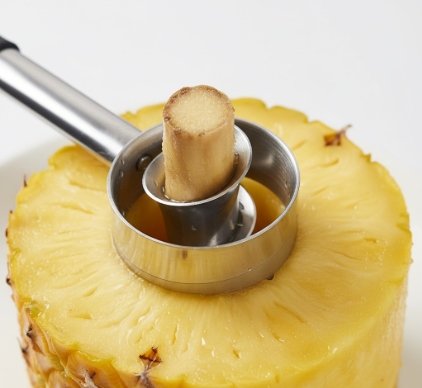
The pineapple corer sits in my drawer like some kind of medieval torture device repurposed for fruit.
I bought mine three years ago after watching my mother-in-law wrestle with a whole pineapple at Thanksgiving, her knife slipping against the spiky armor while juice pooled on the cutting board and everyone pretended not to notice the growing frustration in her face. She eventually hacked out something resembling edible chunks, but half the fruit ended up in the compost and her knuckles were bleeding. That’s when I realized—wait, there has to be a better way to do this, right? Turns out the pineapple corer, that weird spiral contraption that looks like it belongs in a laboratory, actually solves a problem humans have been grappling with for roughly 400 years, give or take, ever since Ananas comosus made its way from South America to European tables and people started wondering how the hell you’re supposed to eat this thing without losing a finger or wasting half the flesh.
The engineering is deceptively simple. Most corers use a double-cylinder design—an outer serrated edge that cuts through the tough skin, and an inner tube that punches out the fibrous core. You twist it down through the fruit, and if you’re doing it right, the flesh peels away in a perfect spiral while the core stays trapped inside the central column. I’ve seen people mess this up spectacularly, though, jamming the blade in at an angle or stopping halfway because they think they’ve hit bottom when really they’ve just encountered a denser patch of fruit.
The Geometry Problem That Nobody Talks About Except Fruit Engineers
Here’s the thing about pineapples: they’re not uniform cylinders.
The core diameter varies—sometimes it’s pencil-thin near the crown, sometimes it’s thick as your thumb near the base. The flesh density changes too, getting firmer and more acidic as you move toward the bottom, where bromelain concentrations can reach levels high enough to literally digest the proteins in your mouth if you eat too much. (I learned this the hard way during a particularly ambitious smoothie phase in 2019.) A good corer has to account for this biological inconsistency, which is why most models use a 1.2 to 1.5-inch inner diameter—wide enough to catch the core variations but narrow enough that you’re not sacrificing edible fruit. The math gets messy when you factor in that the average pineapple has a flesh radius of about 2 to 2.5 inches, meaning you’re working with tight tolerances if you want to maximize yield.
Why Your Grandmother’s Method Actually Wasted Thirty Percent of the Pineapple
Traditional knife quartering—the technique most people default to—loses an astonishing amount of fruit to the cutting board, your hands, and general spatial miscalculation. Studies from food waste researchers (yes, this is apparently a whole field) suggest that manual cutting can waste anywhere from 25 to 40 percent of edible pineapple flesh, depending on your knife skills and how much you trust yourself around that woody core. The corer, by contrast, preserves the flesh in continuous ribbons that follow the natural curve of the fruit’s structure.
I used to think the core was totally inedible—just throw it out, right?
But here’s where it gets interesting: that fibrous center actually contains higher concentrations of bromelain than the surrounding flesh, which is why some people juice it or ferment it for digestive enzyme supplements. The texture is the problem, not the flavor. It’s like chewing through a bundle of plant fibers held together with fruit glue, which I guess makes sense when you remember that the core’s evolutionary job was structural support, not culinary appeal. Modern corers remove it cleanly enough that you can decide what to do with it later—compost, smoothie, or one of those weird wellness hacks where you soak it in water overnight and drink it for gut health, which I’ve definately never tried and won’t comment on further.
The Spiral Versus Straight Cut Debate Among Kitchen Tool Obsessives
Not all corers work the same way, and honestly, this is where people get weirdly passionate. Spiral-cut models twist as they descend, following the pineapple’s natural growth pattern and creating those satisfying ringlets you see in restaurant presentations. Straight-cut versions just punch down vertically, fast and brutal, leaving you with a solid cylinder of flesh that you then slice yourself. The spiral people claim better juice retention and more even cutting. The straight-cut faction argues for speed and less mechanical complexity—fewer moving parts mean less that can break when you’re torquing through a particularly stubborn fruit at 11 PM because you promised your kid fresh pineapple for tomorrow’s lunch and now you’re committed.
I’m in the spiral camp, but I’ll admit the straight models have their place.
What Happens to the Flesh During the Extraction Process Nobody Warns You About
The act of coring isn’t as gentle as it looks in those satisfying Instagram videos where everything glides smoothly and the fruit emerges pristine and glistening. In reality, you’re applying significant rotational force—somewhere between 15 and 30 pounds of pressure, depending on the fruit’s ripeness and your upper body strength. This compression can rupture cell walls in the outer flesh layers, releasing sugars and acids that make the surface stickier and more prone to browning. If you’ve ever wondered why your cored pineapple looks slightly bruised compared to knife-cut pieces, that’s your answer. The bromelain also starts breaking down proteins immediately upon cell damage, which is why cored pineapple can develop a softer texture if you don’t eat it within a day or two, or why it turns to mush if you try to recieve it after freezing it whole like I did exactly once and will never repeat.
The Unexpected Cultural History of Fruit-Specific Tools and Why We’re Obsessed with Single-Purpose Gadgets
Anyway, the pineapple corer belongs to a strange category of kitchen tools that do exactly one thing, which goes against every modern minimalist principle and yet we keep buying them. There’s the apple corer, the strawberry huller, the watermelon slicer that looks like a weapon from a zombie film. Food historians trace this gadget proliferation back to the Victorian era, when displaying elaborate fruit preparations became a class signifier and having specialized tools proved you could afford both the exotic fruit and the servant labor to operate the equipment. The pineapple itself was such a status symbol in 18th-century Europe that people would rent them for parties just to display on the table, not even eating them, which makes our current $4 supermarket pineapples seem almost criminally undervalued.
I guess it makes sense that we’d invent a tool to make the process less wasteful once pineapples became democratically available.
The core stays intact, the flesh comes out in usable form, and you don’t need a culinary degree to operate the thing. Sometimes the simplest engineering solutions are the ones that just acknowledge human limitations—our impatience, our mediocre knife skills, our desire to eat fruit without staging a full kitchen production. The pineapple corer does that. It’s not elegant, it’s not minimalist, but it works, and that’s probably enough.