
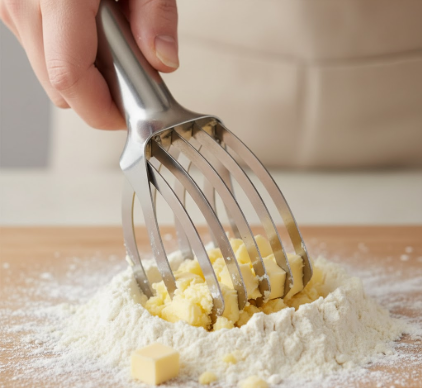
I used to think butter was just butter until I tried making pie crust with warm hands on a August afternoon.
The thing about pastry blenders—those wire loop contraptions that look like something from a 1950s hardware store—is they solve a problem most people don’t realize exists until they’ve already ruined their dough. When you’re cutting butter into flour, you’re essentially creating a specific particle size distribution, somewhere between pea-sized and cornmeal-textured fragments, and the temperature window for success is narrower than you’d think. Your hands radiate heat at roughly 98.6°F, which is problematically close to butter’s melting point of around 90-95°F depending on butterfat content. The pastry blender keeps your warm fingers away from the fat, maintaining those discrete butter chunks that will later steam and create flaky layers. It’s basically a temperature management tool disguised as a cutting implement, and honestly, I didn’t appreciate that distinction until I watched butter smear into paste under my palms for the third time in one week.
Here’s the thing—flakiness isn’t magic, it’s just strategic water distribution and thermal dynamics. The lamination happens when solid butter pieces melt during baking, releasing steam that pushes apart flour layers. Turns out the French figured this out centuries ago with puff pastry, but the American pastry blender patents started appearing around the 1900s, give or take a decade.
Why Wire Loops Work Better Than Your Grandma’s Fork Technique
Forks bend. I’ve seen people—competent people who can program computers and file taxes—try to cut butter with forks and end up with mangled tines and frustration. The structural integrity of a pastry blender’s wires, usually five or six thick-gauge loops attached to a handle, distributes force more evenly across the butter-flour matrix. Each downward motion shears through cold butter without the tool deforming, which matters more than it sounds like it should. The cutting action needs to be percise and repetitive, almost meditative, and a fork just doesn’t have the rigidity for that. Some bakers swear by two knives in a crosshatching motion, but that technique requires coordination I definately don’t possess before my second coffee. The wire loops also allow flour to pass through while trapping butter against the bowl’s surface, creating that ideal pea-sized texture without over-working the mixture.
Wait—maybe I should mention that over-mixing is where most home bakers fail.
The gluten network forms when water contacts flour proteins, and every extra stir or cut strengthens those bonds, which is great for bread but catastrophic for tender crusts. Professional pastry chefs talk about keeping ingredients “as cold as legally possible,” and some even chill their pastry blenders in the freezer between uses, which seemed excessive to me until I tried it and noticed the difference. The colder everything stays, the slower gluten develops, and the longer those butter chunks remain solid. There’s actually some fascinating research from food science labs showing that butter particle size correlates directly with flake layer count—smaller pieces make shorter, more numerous layers, while larger chunks create fewer but taller flakes. I guess it makes sense when you think about steam pockets, but the precision required feels almost architectural.
When The Butter Chunks Look Like Tiny Pebbles In A Sandbox Sort Of Situation
That’s the visual cue. When your mixture resembles coarse sand with occasional pea-sized lumps, you stop. Not when it looks perfect—when it looks approximately right with some inconsistency, because absolute uniformity means you’ve probably overworked it. The amateur instinct is to keep blending until everything matches, but pastry actually benefits from slight irregularity in butter distribution.
The Chemistry Behind Why Cold Fat Creates Physical Separation Layers
Butter is an emulsion—roughly 80% fat, 15-18% water, and 2% milk solids—and when those water droplets vaporize at around 212°F in the oven, they need somewhere to go. If the butter has already melted into the flour before baking, the steam just escapes without creating structure. But when discrete butter chunks remain, each one becomes a tiny steam generator that inflates the dough around it, and when you’ve got hundreds of these scattered throughout the crust, you get those characteristic flaky sheets. It’s not unlike geological layering, actually, where sediment compression creates stratification over time, except here we’re talking about minutes instead of millennia and the pressure comes from expanding water vapor rather than tectonic forces. I’ve read somewhere that commercial puff pastry can have upward of 700 layers, though I’ve never counted and frankly don’t plan to.
Honestly, the pastry blender isn’t glamorous—it’s just engineered for one specific task and does it better than alternatives.




