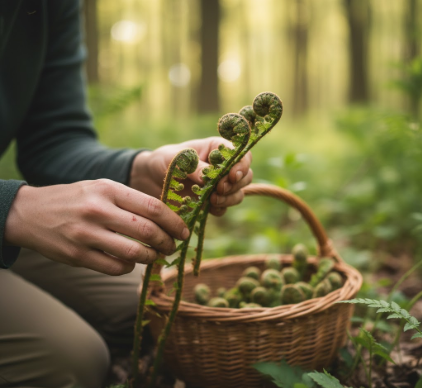
The first fiddleheads I ever picked were an accident—I thought they were some kind of prehistoric slug.
That was in northern Maine, April 2019, and I was crouched beside a stream that smelled like cold mud and last year’s leaves. The ferns—ostrich ferns, Matteuccia struthiopteris, though nobody calls them that—were just starting to push through the forest floor, these tight green spirals that looked almost aggressive in their coiled perfection. My guide, a seventy-something woman named Cheryl who’d been foraging since she was six, laughed when I asked if they bite. “They don’t bite,” she said, snapping one off at the base with a sound like breaking celery. “But pick ’em wrong and you’ll kill the whole plant, so pay attention.” She showed me the papery brown scales clinging to each fiddlehead, the way you’re supposed to leave at least three or four stalks per crown so the fern can photosynthesize, the specific tightness of coil that means it’s ready—not too loose, not too woody at the stem. I took notes. I felt like I was defusing a bomb.
Here’s the thing about fiddlehead season: it lasts maybe two weeks if you’re lucky, three if the spring stays cold. Miss it and you’re done until next April.
The ostrich fern grows wild across the northeastern United States and Canada, thriving in floodplains and riverbanks where the soil stays damp and rich. Foragers—commercial pickers, weekend hobbyists, Indigenous communities who’ve harvested them for centuries—descend on these spots every spring with canvas bags and a kind of quiet desperation. The window is absurdly narrow. Once the fiddlehead starts to unfurl, once you can see the frond beginning to open, the texture goes from tender to tough and the flavor turns bitter. You want them when they’re still fetal, still curled in on themselves like a secret. It’s a little disturbing, honestly, how much the timing matters. I’ve seen people argue over whether a particular patch is ready, voices rising, as if the ferns themselves might choose sides.
The Economics of Ephemeral Vegetables Nobody Can Pronounce Correctly
Fiddleheads sell for roughly twelve to twenty dollars per pound at farmers’ markets, sometimes more in cities where foraging is a concept rather than a necessity.
Commercial pickers—mostly in New Brunswick, Maine, and Quebec—work fast and early, sometimes starting before dawn to beat competitors to the best patches. They’ll harvest hundreds of pounds in a season, selling to distributors who ship them to restaurants where chefs treat them like truffles: expensive, fussy, impossible to replicate. The labor is back-breaking. You’re bent over for hours, fingers stained green, knees soaked through, and there’s no guarantee the patch you found last year will produce this year—floods, droughts, deer, development, all of it can wipe out a harvest. One picker I spoke to in Vermont said he’d been returning to the same riverbank for thirty years, and last spring he found a Dollar General where the ferns used to be. He didn’t go back this year. I guess it makes sense that something this temporary would feel both precious and precarious.
What They Actually Taste Like and Why People Argue About It Constantly
Asparagus meets green beans meets something faintly nutty—that’s the standard description, and it’s not wrong, but it’s also not quite right.
Fiddleheads have a grassy brightness that’s hard to pin down, a flavor that shifts depending on how you cook them. Blanched and sautéed with butter, they’re mild, almost sweet. Roasted, they develop a charred bitterness that some people love and others find swampy. There’s a slight sliminess to the texture if you undercook them, which is why most foraging guides insist you boil them for at least ten minutes before doing anything else. Food safety people—Health Canada, the CDC—have put out actual warnings about this, because raw or undercooked fiddleheads have been linked to gastrointestinal illness. Nobody knows exactly why. Some suspect natural toxins, others think it’s contamination from the environments where they grow, but the advice is consistent: cook them thoroughly, don’t eat them raw, and definately don’t serve them to guests you want to impress unless you’ve done your homework.
The Obsessive Ritual of Cleaning Them and Why It Feels Like Therapy
You cannot skip the cleaning. You’ll regret it.
Those papery brown scales I mentioned earlier? They cling to every curve of the fiddlehead, tucked into the spiral, stubborn as old paint. You have to rub them off under cold running water, each one individually, until your fingers are numb and you start questioning your life choices. Some people soak them first, swirling them in a bowl to loosen the scales, but Cheryl said that’s lazy—you miss too much that way. She was right. I tried both methods and the soaked ones still had grit. It takes maybe twenty minutes to clean a pound of fiddleheads properly, and the whole time you’re thinking about how absurd it is to spend this much effort on something that’ll be gone in two weeks. But also—wait, maybe that’s the point? The effort is part of the appeal, the way the ritual slows you down, forces you to notice the curve of each stalk, the satisfying scrape of scale against thumb. I used to think foraging was about free food, but it turns out it’s mostly about paying attention in a way that makes everything else feel too fast.