I used to think Norwegian kitchens were just about minimalism and white walls.
Turns out, the whole thing is way more complicated—and way more interesting—than that clean-lines aesthetic you see plastered across Pinterest boards. When you actually spend time in coastal Norway, maybe in one of those old fishing villages where the houses cling to the rocks like barnacles, you start to notice something. The kitchens aren’t trying to look Scandinavian. They just are. There’s a difference, and it’s the kind of difference that comes from geography, from weather patterns that haven’t changed in roughly 10,000 years, give or take, from the way light behaves when it bounces off water for months at a time. The木材 they use—pine, mostly, sometimes birch—it’s local because transporting anything else up those fjords used to be a nightmare. Still is, honestly.
Here’s the thing: the coastal influence isn’t decorative. It’s structural. The color palettes in these spaces—those soft grays, the blue-greens, the occasional burst of ochre—they’re literally stolen from the landscape outside the window.
Light and Water Dictate Every Single Design Decision in Norwegian Coastal Kitchens
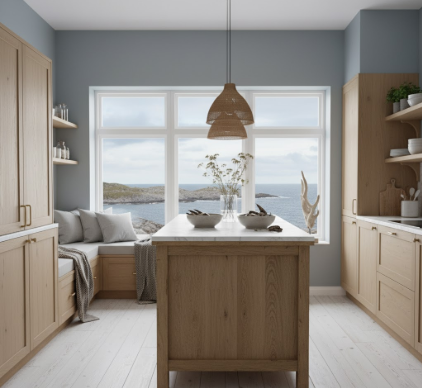
Wait—maybe “dictate” is too strong. But the relationship between interior space and the coastal environment is so deeply embedded that it’s almost genetic at this point. Norwegian designers I’ve spoken with, they don’t talk about “bringing the outside in” like it’s some trendy concept. They talk about windows. Lots of windows. Because during winter, you’re getting maybe five or six hours of weak daylight, and you need to capture every photon. So kitchens face the water when possible, and the window treatments are minimal or nonexistent. Reflective surfaces—polished stone countertops, glass backsplashes—they’re not just aesthetic choices. They’re light-multiplying strategies. I guess it makes sense when you consider that for half the year, the sun barely clears the horizon, and when it does, it’s traveling across water before it reaches your kitchen, picking up this diffused, silvery quality that’s impossible to replicate artificially.
The materials themselves tell you everything about the coast. Granite countertops aren’t imported Italian marble—they’re Norwegian stone, often with these dark flecks and veins that look like the rock faces you see along the shoreline. Wood is treated minimally, sometimes just with soap and water, because the culture here has this almost stubborn resistance to over-processing natural materials. One designer in Bergen told me, “Why would we cover wood with twelve layers of varnish when the wood itself is already perfect?” Which, honestly, made me reconsider every piece of furniture I own.
Functional Simplicity That Actually Comes From Fishing Communities Not Design Schools
There’s this narrative that Scandinavian design emerged from design schools and modernist movements, which is partly true, but also misses the point entirely. The kitchens in coastal fishing villages—some of them hundreds of years old—they’ve always been efficient, compact, organized. Because when you’re a fishing family and you need to process the day’s catch, preserve food for winter, and cook for multiple generations in a space that’s maybe 150 square feet, you don’t have room for decorative nonsense. Every shelf has a purpose. Storage is built into walls. The table is where you prep, eat, and do the accounting. This isn’t minimalism as an aesthetic philosophy. It’s minimalism as survival strategy. Modern Norwegian kitchen design didn’t invent this—it just formalized it, gave it a name, sold it to the rest of us.
The layout follows what they call the “work triangle,” but that’s a recent term for something fishermen’s wives figured out centuries ago: stove, sink, prep area, arranged so you’re not walking back and forth like an idiot. Anyway, the point is that the functionality came first, and the beauty emerged from that functionality, not the other way around.
Color Theory Borrowed Directly From Foggy Mornings and Atlantic Storm Systems
I’ve seen probably a hundred Norwegian coastal kitchens at this point, and maybe three of them had bright colors. The rest? Variations on gray, blue-gray, green-gray, white-gray. At first I thought it was boring, but then I spent a week in Lofoten during October, and I finally got it. The weather patterns there cycle through about fifteen different types of gray in a single afternoon. The fog rolls in, and suddenly everything—the sea, the sky, the mountains—it’s all the same color, this uniform pearl-gray that’s somehow both depressing and beautiful. And when you come inside, and your kitchen is painted in that same palette, there’s no jarring transition. You’re not fighting the environment. You’re continuous with it. Which sounds like design-school nonsense, but it’s actually just practical. Jarring color contrasts in a place where the light is already strange and limited—it messes with your head. The soft, muted tones are easier to live with when you’re living with them through six months of darkness.
Occasionally you’ll see a pop of color—deep red, ochre yellow—but it’s usually in textiles or small objects, things that can be changed or moved. The architecture stays neutral. It has to.
Open Shelving and Glass Cabinets Because Hiding Things Makes No Sense in Small Coastal Communities
Here’s something I didn’t expect: the prevalence of open shelving and glass-front cabinets in Norwegian coastal kitchens isn’t just a design trend. It comes from a cultural attitude about possessions and transparency. In small fishing communities, everyone knows what everyone else has anyway. There’s no point in hiding your dishes behind solid cabinet doors. Plus—and this is the part that definately matters more—open shelving makes small spaces feel larger. When you can see through the kitchen to the wall behind, or to the window beyond, the room doesn’t close in on you. And in houses that were built narrow and tall to withstand coastal winds, where rooms are often smaller than modern Americans would find comfortable, that visual continuity is crucial. I used to think open shelving was impractical, that everything would get dusty, but in homes where people actually cook daily and use their dishes regularly, dust doesn’t accumulate the way it does on decorative objects. Things are in constant circulation.
The lesson, I guess, is that Norwegian coastal kitchen design isn’t something you can buy at IKEA and install in Phoenix. It’s a response to specific environmental pressures, cultural values, and historical constraints. You can imitate the aesthetic—the pale wood, the stone, the muted colors—but without the context, you’re just buying a look. Which is fine, I suppose. Most of us are just buying looks anyway.