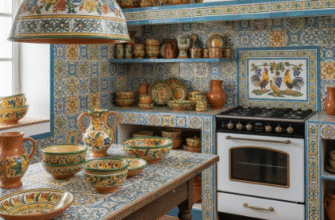
I used to think tagine cooking was just about the clay pot—you know, that conical lid everyone photographs at Moroccan markets.
Turns out, designing a kitchen around tagine preparation means rethinking nearly everything about how heat, moisture, and space interact in ways that most Western kitchens completely ignore. The tagine itself—both the cooking vessel and the dish it produces—demands low, steady heat for anywhere from ninety minutes to three hours, which means your stovetop needs to accomodate prolonged simmering without hotspots that scorch the bottom or uneven flames that crack the clay. Traditional Moroccan kitchens often used charcoal braziers called majmar, positioned low to the ground where cooks could sit on cushions and tend multiple tagines simultaneously, adjusting coals beneath each pot with a kind of practiced intuition I’ve watched older women in Fez execute with barely a glance. Modern adaptations try to capture that control through gas burners with precise low-flame settings or even induction cooktops with tagine-specific modes, though honestly, induction feels like trying to teach a smartphone to understand smoke signals. Heat diffusers—those flat metal discs you place between burner and pot—become non-negotiable if you’re using traditional unglazed clay tagines on contemporary stoves, because the thermal shock from direct contact will crack your pot faster than you can say “preserved lemons.”
Storage becomes its own spatial puzzle when you’re serious about tagine cooking. I guess it makes sense that Moroccan households don’t just own one tagine—they might have five or six in different sizes, plus the serving tagines that never touch heat, plus the everyday ones that can handle abuse. Wait—maybe that’s why so many Moroccan kitchen designs incorporate open shelving at multiple heights rather than closed cabinetry, allowing these wide, shallow vessels to nest vertically without chipping their delicate rims or trapping moisture that leads to mildew in the porous clay.
The Moisture Problem Nobody Mentions Until Your Ceiling Peels
Here’s the thing about tagine cooking that renovation blogs conveniently skip: it produces an astonishing amount of steam. The entire point of that conical lid is to capture condensation and drip it back onto the ingredients, creating a self-basting cycle that keeps lamb shoulder tender and apricots plump through hours of cooking. But all that moisture has to go somewhere, and in a kitchen without proper ventilation, “somewhere” usually means your walls, your cabinets, and eventually your drywall. Traditional Moroccan kitchens often featured high ceilings—sometimes ten or twelve feet—with small windows positioned near the roofline to let steam escape through natural convection, a passive ventilation system that worked beautifully in Marrakech’s dry climate but fails spectacularly in, say, rainy Manchester or humid Houston. Modern solutions involve range hoods with CFM ratings of at least 400 (preferably 600-plus if you’re running multiple tagines), though I’ve seen home cooks try to make do with recirculating vent fans that basically just blow tagine-scented humidity back into the room—not ideal.
Tile selection matters more than you’d think.
Moroccan kitchens traditionally used zellige tilework not just for aesthetics but because those hand-cut geometric pieces, sealed with multiple coats of linseed oil or modern sealants, create a moisture-resistant surface that can handle the daily reality of steam, spills, and the occasional enthusiastic splash of harissa. The grout lines in zellige are often wider and more prominent than in standard Western tile installations, which actually helps—wait, this sounds counterintuitive—because the slight irregularities and texture prevent water from sheeting across surfaces and instead encourage it to bead and evaporate more quickly. I used to think any tile would work, but porous materials like travertine or unsealed terracotta will absorb moisture and stain within months if you’re cooking tagines twice a week, developing a musty smell that no amount of scrubbing really fixes. Glazed ceramic or properly sealed cement tiles handle the humidity far better, though they lack some of the tactile warmth that makes Moroccan kitchens feel lived-in rather than showroom-perfect.
Counter Height and the Ergonomics of Stirring for Two Hours Straight
Nobody talks about how exhausting traditional tagine cooking can be on your back and shoulders. Standard American counters sit at 36 inches, optimized for chopping and prep work while standing upright, but tending a tagine—lifting that heavy conical lid to check doneness, stirring preserved lemon into the sauce, adjusting the position of chicken thighs so they cook evenly—all happens more comfortably at a slightly lower height, somewhere around 32 to 34 inches. Some contemporary Moroccan-inspired kitchens incorporate a dedicated tagine station at this reduced height, almost like a prep sink but designed around a powerful burner instead, with heat-resistant tile or stone surfaces extending at least 18 inches in all directions to protect surrounding cabinetry from errant heat.
Honestly, the seating element gets overlooked entirely in most Western kitchen designs. Traditional tagine cooking involved sitting on low stools or cushions, which distributed weight differently and made those long cooking sessions less physically taxing—your grandmother in Casablanca could tend tagines for three hours without the lower back pain that sends modern cooks reaching for ibuprofen. I’ve seen a few kitchen designers incorporate low bench seating adjacent to the cooking zone, with cushioned surfaces at about 16 to 18 inches high, though this creates awkward spatial dynamics if you’re also trying to maintain standard counter workflow for other cooking tasks. The compromise some people reach involves adjustable-height seating—basically kitchen stools that telescope down to traditional Moroccan cooking height but can rise for standard counter work—though finding ones stable enough for prolonged use takes some hunting.
Spice Storage That Actually Preserves Ras el Hanout Instead of Turning It Into Dust
Tagine cooking lives or dies on spice freshness, which means your kitchen design needs to acommodate proper storage for cumin, coriander, cinnamon, ginger, saffron (the real stuff, not that yellow sawdust), paprika, turmeric, and the dozen other components that might go into ras el hanout depending on whose grandmother’s recipe you’re following. Heat and light destroy volatile oils in spices faster than most people realize—roughly 50% potency loss within six months if stored poorly, according to food science research I’ve seen from UC Davis. Moroccan kitchens traditionally kept spices in small drawers or clay containers stored in the coolest part of the kitchen, often a north-facing wall or a pantry-like alcove that stayed relatively dim and temperature-stable. Modern interpretations might use pull-out spice racks inside cabinets rather than on open shelves, or dedicate a drawer with a cool-touch liner positioned away from the stove’s heat zone, though I guess the real answer is just buying spices in small quantities and replacing them often—which nobody actually does because who wants to buy saffron every eight weeks at $15 a gram?