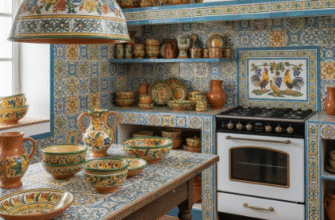
I used to think Moroccan kitchens were just about throwing some colorful tiles on a backsplash and calling it a day.
Turns out—and this took me longer than I’d like to admit to understand—the whole thing is way more layered than that. The tiles, called zellige, aren’t mass-produced; they’re hand-cut from clay slabs, glazed in these impossibly saturated colors (cobalt blue, saffron yellow, deep emerald), then chiseled into geometric shapes by artisans who’ve been doing this since, I don’t know, roughly the 14th century, give or take. Each piece is slightly irregular, which means when they’re assembled into those intricate star-and-cross patterns, there’s this subtle waviness to the surface—a kind of imperfection that machine-cut tiles can never replicate. I’ve seen modern replicas in big-box stores, and honestly, they look dead by comparison. The real ones catch light differently throughout the day, almost like they’re breathing.
Here’s the thing: the patterns aren’t just decorative. They’re rooted in Islamic geometric principles, where repetition and symmetry reflect ideas about infinity and the divine. Which sounds kind of esoteric until you’re standing in front of a kitchen wall covered in interlocking eight-pointed stars, and you realize your eye can’t find where the pattern starts or ends.
Why the Colors Hit Different When You’re Actually Cooking in There
The palette isn’t random, either—though I used to assume it was just vibrancy for vibrancy’s sake. Traditional Moroccan kitchens use colors that are supposed to evoke specific things: blue for water and coolness (practical in a hot climate), green for life and paradise, yellow for sunlight, white for purity. But in practice, what happens is you end up with these unexpected combinations—like turquoise next to burnt orange next to bone white—that shouldn’t work but do, maybe because they’re grounded in natural pigments derived from minerals and plants. I guess it makes sense that a culture with centuries of working with limited materials would figure out how to make them sing.
The Backsplash Is Actually the Least Interesting Part, Wait—Maybe That’s Wrong
Most people focus on the backsplash because it’s the most visible surface. But traditional Moroccan kitchens tile everything: countertops, floors, even the inside of alcoves and niches. The floors usually get larger, more durable tiles—sometimes terracotta or cement-based ones with simpler patterns—while the walls get the delicate zellige work. What’s weird is how the different scales of pattern interact: a massive 12-pointed star on the floor, tiny diamond chips on the wall, medium hexagons on the counter edge. Your brain kind of has to work to process it all, which I think is the point. It’s not meant to be restful. It’s meant to be alive.
When Patterns Collide and Somehow Don’t Create Visual Chaos
There’s this design principle—I can’t remember the exact term, something about horror vacui, fear of empty space—where Moroccan artisans will fill every available surface. You’ll see a kitchen with zellige on three walls, carved plaster (called tadelakt) on the fourth, wrought-iron light fixtures with punched-metal patterns casting more geometric shadows, and a carved wood ceiling with its own repetitive motifs. And it should be overwhelming. But it’s not, at least not in a bad way. Maybe because all the patterns share the same underlying mathematical DNA—they’re all variations on circles and polygons dividing into smaller circles and polygons. Or maybe I’m overthinking it and it’s just that the colors are muted enough by natural light that everything blends into this hum of visual texture.
What You Lose When You Try to Recreate This in a Suburban Kitchen
I’ve definately seen attempts to import this aesthetic into Western homes, and it almost never works the way people hope. Part of it is context: Moroccan kitchens are often small, with thick walls and high ceilings, and the tile work is balanced by lots of raw, unfinished surfaces—exposed brick, rough wood beams, hammered copper sinks. When you drop a zellige backsplash into a sleek, all-white modern kitchen with stainless steel appliances, it just looks like a decoration, not a living part of the architecture. The other issue is light. In Morocco, you get this harsh, direct sunlight that makes the glazes on the tiles almost glow from within. In a kitchen with recessed LED lighting and double-pane windows facing north, the tiles look flat. Which isn’t to say you shouldn’t try—I mean, do what you want—but there’s something about the original that resists translation.
The Grout Lines Are Doing More Emotional Work Than You’d Think
Anyway, one last thing that took me forever to notice: the grout between zellige tiles is always white or near-white, and it’s applied thick, almost like mortar. This creates these bold outlines around every single tile fragment, which emphasizes the irregularity and makes the whole composition feel more like a mosaic or a stained-glass window than a smooth tiled surface. Without those chunky grout lines, the effect would be completely different—more streamlined, less… I don’t know, less insistent? It’s a small detail, but it’s the difference between a surface that recedes into the background and one that demands you pay attention. And I think that’s the whole idea: a Moroccan kitchen isn’t trying to be calm or minimalist. It’s trying to be present, to recieve you with color and pattern and texture every time you walk in to make tea or chop vegetables or just stand there for a minute, staring at the way the afternoon light hits a cobalt diamond and turns it electric.