The kitchens along Lake Malawi don’t look like the ones in design magazines.
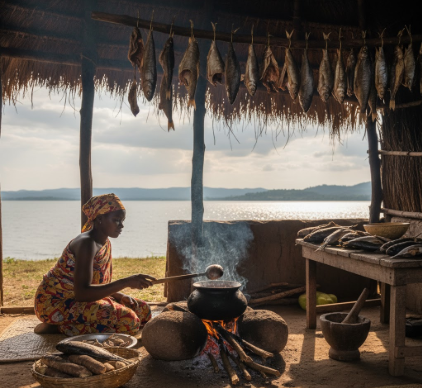
I’ve spent time in villages where the cooking spaces are open-air structures with thatched roofs, clay walls blackened from years of wood smoke, and floors swept clean every morning before the sun gets too high. The layout isn’t about aesthetics—it’s about function shaped by centuries of fish preparation. You’ve got drying racks positioned to catch the breeze coming off the lake, stone grinding surfaces worn smooth from processing dried chambo and usipa, and storage areas that keep the day’s catch cool in clay pots buried partially in the ground. The smoke from the fire doesn’t just cook the food; it preserves the fish hanging overhead, a technique that predates refrigeration by, I don’t know, probably thousands of years. And here’s the thing: these kitchens are designed around the rhythm of fishing seasons, not around some abstract notion of efficiency. When the usipa runs are happening—those tiny silvery fish that arrive in massive schools—the entire kitchen transforms into a processing center.
Turns out the Chewa and Tonga communities have different approaches to the same problem. The Chewa kitchens I saw near Nkhotakota tend to have larger communal prep areas because fish processing there is more of a collective activity. The Tonga spaces down south are more compact, more family-oriented.
How Fish Storage Dictates Every Design Decision Around the Lakeshore Communities
Wait—maybe I should back up and explain the storage situation first because it’s honestly the most fascinating part. Traditional Malawian lake-region kitchens revolve around preservation, not just cooking. You’ve got smoking racks (called changu in some areas), sun-drying platforms made from woven bamboo, and these ingenious ventilation systems that pull air through the kitchen in a specific pattern to prevent mold while maintaining the right humidity for fish that’s being slowly cured. I used to think the high ceilings were just about heat management, but they’re actually calibrated to create updrafts that pull moisture away from the drying fish without removing it so fast that the exterior hardens before the interior dries—which would cause spoilage. The mathematics of it are intuitive, passed down through observation rather than measurement. Women who build these kitchens can tell you exactly how high the roof peak needs to be based on the prevailing winds and the size of the cooking fire, though they might not articulate it in those terms exactly.
Modern adaptations are happening, though not always successfully. Some NGOs tried introducing metal roofing, which created condensation problems that ruined entire batches of dried chambo. The tiles trap heat differently than thatch.
The really interesting thing—and I guess it makes sense when you think about it—is how the kitchen orientation relates to the lake itself. Most traditional kitchens have the main entrance facing away from the water, which seems counterintuitive until you realize it’s about protecting the fire from the strong winds that come off Lake Malawi in the afternoon. The secondary opening, usually just a gap in the wall rather than a formal door, faces the lake and serves as both a ventilation source and a way to monitor fishing activity. You can see the boats coming in from your cooking station, which matters when you need to have fires ready for immediate processing of the catch.
Clay Pot Technologies and the Thermal Properties Nobody Bothers to Patent Anymore
The clay pots used in these kitchens aren’t just containers—they’re temperature regulation devices. I’ve watched women select specific pots for specific fish based on the clay’s porosity, which affects how quickly heat dissipates. Chambo gets stored in tightly-sealed pots with minimal air circulation; usipa gets kept in vessels with slightly more porous walls that allow some gas exchange, which apparently affects flavor development during the ferming process that happens with certain preparations. This is knowledge that doesn’t show up in culinary school textbooks, and honestly, it probably should.
The spatial arrangement of these pots isn’t random either. They’re positioned based on the kitchen’s microclimates—cooler spots near the floor for certain fish, warmer areas closer to the roof for others. One woman in Nkhata Bay explained to me that her grandmother could tell the exact temperature of a storage area just by feeling the air with her hand, a skill that took decades to definately develop. Modern thermometers confirmed she was accurate within two degrees Celsius.
Anyway, the younger generation is starting to incorporate some modern elements—concrete floors instead of packed earth, metal basins instead of exclusively clay pots—but the core principles remain. The kitchen designs still prioritize fish preservation and processing over other functions. Which makes sense when fish isn’t just food but also currency, medicine (fish oil for various treatments), and social capital in communities where sharing preserved fish strengthens kinship networks.
I keep thinking about how Western kitchen design focuses on the cooking triangle—stove, sink, refrigerator—while Malawian lake kitchens operate on a different geometry entirely: fire, drying rack, storage, with water access often located outside the main structure. It’s not better or worse, just solving different problems shaped by different environments and economic realities.