I used to think desert kitchens were all about minimalism—bare walls, maybe a few copper pots hanging sadly from hooks.
Turns out, Libyan kitchen design is nothing like that sterile fantasy I’d imagined. The first time I walked into a traditional home in Tripoli’s medina, the kitchen felt like a small fortress: thick walls that could probably survive a sandstorm (and have, repeatedly, for generations), tiny windows positioned high up near the ceiling, and this overwhelming sense that every single design choice was made by someone who actually understood what 120-degree summer heat feels like. The floors were often unglazed terracotta or simple concrete, cool underfoot even at midday. Storage was built directly into the walls—these deep, arched niches called khazana—because freestanding cabinets would just trap heat and dust. And the color palette? Earthy ochres, sun-bleached whites, the occasional shock of indigo tile that reminded you someone here once traded across the Sahara and brought back fragments of beauty from Timbuktu or Ghat.
Here’s the thing: North African desert influences aren’t just aesthetic. They’re survival architecture. The Berber and Arab communities who’ve lived in Libya for, what, roughly 3,000 years give or take, figured out that you don’t fight the desert—you design around it. Heavy wooden doors. Ventilation shafts that create natural airflow without letting in sandstorms. And honestly, the kitchens I saw barely had what we’d call “counter space,” but they had these low stone or tile work surfaces where you could sit on a cushion and knead dough for hours without wrecking your back.
How Courtyard Living Reshapes the Entire Cooking Experience Completely
Most traditional Libyan homes are built around a central courtyard, which—wait—maybe this seems irrelevant, but it changes everything about the kitchen. Cooking often happens in semi-outdoor spaces or in rooms that open directly onto the courtyard, so smoke from the kanun (a clay brazier) can escape naturally. I guess it makes sense when you realize that enclosed kitchens with gas stoves are a relatively modern thing here. The courtyard acts as a thermal buffer: it’s shaded during the day, releases heat at night, and creates this microclimate that’s maybe 10 degrees cooler than the street outside. The kitchen isn’t isolated—it’s part of a breathing, living system.
And the materials? Limestone, clay, palm wood—all local, all chosen because they don’t conduct heat like modern metals do.
The Quiet Genius of Ventilation Systems Nobody Talks About Anymore
I’ve seen these wind towers called barjeel or malqaf in parts of Libya’s old towns, though they’re rarer than in, say, Egypt or the Gulf. But the principle is everywhere: you catch the breeze, channel it down into the living spaces, and push hot air out through high vents. In kitchens, this means small, strategically placed openings near the ceiling—sometimes covered with decorative ironwork—that pull smoke and heat up and out. Honestly, it’s kind of ingenious, and I can’t help but feel a little exhausted by how much we’ve forgotten in favor of air conditioning units that just blast cold air and hum aggressively in the corner.
Some families still use clay pot inserts in the walls to store grains and spices—because clay breathes, it keeps things dry even during humid coastal winds.
Color, Tile, and the Trade Routes That Left Their Mark Everywhere
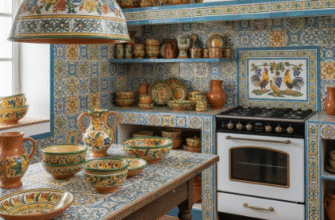
Libyan kitchens—especially in coastal cities like Benghazi or Misrata—often feature glazed ceramic tiles, intricate geometric patterns, sometimes calligraphy. These aren’t random decorations; they’re echoes of Ottoman influence, Andalusian refugees, and trans-Saharan trade that brought ideas (and artisans) from Morocco, Tunisia, and beyond. I used to think tilework was just pretty, but it’s also practical: tiles are easy to clean, they don’t absorb grease or odors, and they reflect light into otherwise dim spaces. The colors—deep blues, greens, burnt oranges—are deliberately chosen to feel cool, psychologically if not literally. Wait—maybe that sounds unscientific, but there’s research showing that color temperature affects perception of physical temperature, even if the actual degrees don’t change.
Anyway, the patterns themselves are often based on Islamic geometric principles: infinite repetition, no beginning or end, a kind of visual rhythm that’s supposed to evoke the divine order of the universe. Whether that makes your couscous taste better is debatable.
What Happens When Modernization Collides With Centuries of Practical Wisdom
Here’s where things get messy. Newer Libyan homes—especially post-1970s oil boom construction—often abandon these traditional principles entirely. You’ll see kitchens with sealed windows, synthetic materials that trap heat, layouts that ignore natural ventilation because, well, there’s supposed to be AC running 24/7. Except when there’s a power outage (which happens), or when fuel shortages make electricity unreliable (which also happens), and suddenly you’re stuck in a sweltering box that would’ve been uninhabitable to your grandparents. I guess the irony is that the “modern” kitchens are often less resilient than the old ones. Some architects and designers in Libya are now trying to revive traditional techniques—thicker walls, passive cooling, local materials—but it’s slow going. There’s this tension between wanting to appear “developed” and recognizing that the old ways actually worked better for the climate. And honestly, I don’t have a neat answer for how that gets resolved, because it’s tangled up with politics, economics, and identity in ways that go way beyond kitchen design.
But the desert’s still there, waiting patiently, indifferent to whatever we build.