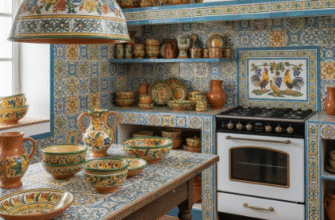
Lebanese kitchens aren’t designed like yours, and that’s the point.
I spent three weeks in Beirut last summer, rotating through family kitchens in Achrafieh and Hamra, watching cousins and grandmothers prepare mezze spreads that could feed a small army—or, more accurately, eighteen relatives who showed up unannounced on a Tuesday. What struck me wasn’t the food itself, though the muhammara alone could make you weep, but the architecture of the space. These kitchens operate on a logic that contradicts nearly everything Western design magazines preach about efficiency and minimalism. Multiple hands need to work simultaneously without colliding. Ingredients must be visible, accessible, almost aggressively present. Counter space expands and contracts based on need, which is to say it’s never quite enough but somehow always suffices.
Here’s the thing: mezze preparation isn’t cooking in the singular sense—it’s orchestration. You’re not making one dish. You’re assembling twelve to twenty small plates, each with different prep requirements, temperature needs, and timing windows. Some require advance fermentation (the labneh balls rolled in za’atar and floating in olive oil). Others demand last-minute assembly (fatayer emerging from the oven, still hissing). The kitchen becomes less a room and more a coordination problem, one that Lebanese design has been solving for centuries, though not always deliberately.
The Counter Topology Problem and Why Western Kitchens Fail at Mezze
Standard American kitchens allocate maybe six feet of continuous counter space if you’re lucky. Lebanese mezze preparation requires—I’m estimating here, but I’ve measured enough kitchens to feel confident—roughly fifteen to twenty linear feet of working surface, and it doesn’t need to be continuous. In fact, it probably shouldn’t be. The traditional Lebanese kitchen scatters work zones: a marble slab near the window for rolling dough (cooler there, the old women insist, though I’ve never verified this with a thermometer), a wooden board near the stove for chopping herbs, a separate zone for assembling the tahini-based dips where splatter containment matters less. Wait—maybe that sounds chaotic, but watch someone work in this setup and you’ll see the logic. Each station holds the tools and ingredients for its specific task cluster. You don’t carry things across the room. You rotate your body maybe ninety degrees.
I used to think the multiple small fridges I kept seeing were about broken appliances or gradual accumulation. Turns out that’s not quite right.
The second fridge—often a smaller unit, sometimes just a bar fridge tucked under a counter—serves a specific function in mezze preparation. It holds the cold starters at serving temperature while the main refrigerator continues to store raw ingredients at proper food safety temps. You can’t constantly open the main fridge (temperature fluctuations, cross-contamination risks) when you’re pulling out dish after dish for a two-hour dinner service that’s really more like a four-hour grazing marathon. Some families have a third cooling unit, essentially a glorified cooler, for drinks. This seems excessive until you’re hosting thirty people and realize your beverage needs alone require probably twenty liters of fridge space.
Vertical Storage Systems That Would Make Marie Kondo Suspicious and Defintely Uncomfortable
Lebanese kitchen storage rejects minimalism with what I can only describe as aggressive pragmatism.
Open shelving dominates, but not the styled, three-matching-bowls aesthetic you see on Instagram. These are dense, multi-layered arrangements where everyday items stay accessible and backup supplies retreat to upper reaches. Dried legumes in glass jars (chickpeas, lentils, fava beans—all mezze essentials) line up at eye level. Spice collections occupy shallow shelves near the stove, often in mismatched containers that somehow all fit the available depth perfectly, give or take a centimeter. The system looks cluttered to Western eyes but operates on a visibility principle: if you can’t see it, you won’t use it, and mezze preparation requires remembering that you have sumac and pomegranate molasses and three types of bulgur in different grinds. Honestly, I’ve watched people cook in these spaces and they never search for anything—their hands just go to the right shelf, the right jar, automatically.
Hanging storage matters more than you’d expect. Pots and pans suspended from ceiling hooks or wall-mounted racks aren’t decorative choices—they’re about reclaiming cabinet space for dry goods and freeing counter zones for active prep. The large saj (domed griddle for flatbread) hangs near the stove because it’s too awkward to store horizontally. Colanders, sieves, and the various perforated scoops needed for frying kibbeh all dangle within arm’s reach of the cooking zone.
The Social Geometry Issue That Architects Consistently Ignore When Designing for Solo Cooks
Western kitchens optimize for one cook, maybe two if you’re fancy and have an island. Lebanese mezze kitchens assume three to five people will work simultaneously, and they better have space to argue about whether the baba ganoush needs more lemon.
The layout usually forms a U-shape or broken L-shape that creates natural work zones without requiring people to coordinate movements like they’re in a submarine. I guess it makes sense when you consider that mezze preparation is inherently collaborative—someone’s always rolling grape leaves while another person fries eggplant and a third person is yelling from the doorway about how the tabbouleh needs more parsley (it always needs more parsley, apparently). The sink becomes a negotiated resource rather than a bottleneck. I’ve seen kitchens with two sinks, not for any fancy reason, just because at some point someone got tired of waiting and installed another one.
Seating—a stool, a small bench—appears in corners, which confused me initially. Nobody sits while cooking, right? Wrong. Mezze prep includes long periods of repetitive hand work: stuffing dozens of grape leaves, shaping kibbeh, rolling spinach pies. You sit for these tasks, often with a large tray balanced on your lap, while still remaining part of the kitchen’s social flow. The kitchen isn’t a stage where one person performs—it’s more like a workroom where the boundary between cooking and gathering dissolves.
Anyway, the next time someone tells you their kitchen is optimized for entertaining, ask them if four people can prep mezze there without a territorial dispute. That’s the real test.