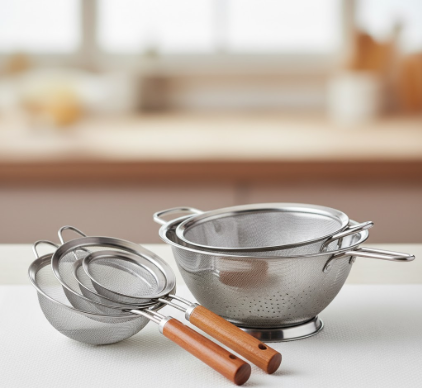
I used to think storing kitchen strainers was just about shoving them in a drawer until I couldn’t close it anymore.
Turns out—and this is the thing nobody tells you when you’re setting up your first kitchen—fine mesh strainers and coarse mesh colanders have completely different storage needs, and mixing them up is basically asking for bent wires, torn mesh, and that specific kind of kitchen frustration where you can’t find the right tool even though you know it’s in there somewhere. The fine mesh ones, those delicate spider-web affairs you use for sifting flour or catching every last quinoa grain, they’re fragile in ways that aren’t immediately obvious. I’ve seen people stack them inside each other thinking they’re being efficient, and then six months later the mesh is stretched out and useless. The coarse mesh strainers—your standard pasta colanders, your vegetable rinse baskets—they’re sturdier, sure, but they take up roughly three times the space and have these handles that stick out at angles designed, I swear, specifically to catch on every other item in your cabinet.
Here’s the thing about vertical storage: it works brilliantly for some strainers and creates chaos for others. Hanging fine mesh strainers on hooks sounds elegant in theory, but the weight distribution is all wrong and you end up with permanently deformed rims. I guess it makes sense when you think about the physics—all that pressure on one point—but it took me ruining two perfectly good strainers to figure it out.
The Drawer Divider Approach That Actually Prevents Mesh Damage and Handle Tangles
Honestly, drawer dividers changed everything for my strainer situation, though not in the way those organization blogs suggest. You can’t just buy any divider system and expect it to work—the depth matters, the adjustability matters, and whether the dividers are tall enough to keep a coarse mesh colander from flopping over onto a fine mesh sieve matters more than you’d think. I use spring-loaded dividers (the kind that expand to fit your drawer width) set about four inches apart, which gives each strainer its own slot without wasting space. The fine mesh ones go upright, handles down, which protects the mesh surface from anything pressing against it. Wait—maybe this seems obsessive, but I’ve definately noticed my strainers lasting years longer since I started doing this.
The coarse mesh strainers, those I store nested but with silicone trivets between each layer. Sounds fussy, I know.
But the trivets prevent scratching and they’re thin enough that you’re not adding significant height to your stack. Anyway, the really game-changing realization was that not every strainer needs to live in the same zone—my everyday fine mesh strainer sits in a utensil crock on the counter because I use it literally every day for rinsing rice or draining canned beans, and having it instantly accessible turns out to be worth the counter space it occupies. The specialty ones—the extra-fine mesh for tea, the medium mesh for berry rinsing, the tiny one for straining cocktail ingredients that I use maybe twice a year—those live in a deeper drawer with the divider system. The big coarse mesh colanders, I keep those in a lower cabinet near the stove, stacked with trivets, because they’re primarily for pasta and steamed vegetables and it makes sense to store them where I’ll actually use them rather than where organizing logic says they should go.
Wall-Mounted Solutions for Awkwardly Shaped Strainers Nobody Knows What to Do With
Some strainers just don’t fit normal storage paradigms and pretending they do is a losing strategy. Those handled cone-shaped chinois strainers, the spider skimmers with the long bamboo handles, the oversized rectangular mesh baskets for Asian cooking—these need wall-mounted solutions or they’ll just migrate around your kitchen creating clutter hotspots. I installed a simple rail system (the kind designed for hanging pots, but shorter) on the inside of my pantry door, and it’s become the home for all my oddly-shaped straining tools. The key is using S-hooks that you can adjust, because the spacing required for a chinois is completely different from what you need for a spider skimmer.
Turns out the mesh type matters for how you hang things too—fine mesh tools need padded hooks or the contact point wears through eventually, while coarse mesh can handle standard metal hooks just fine.
The Container-Within-Container Method for Small Mesh Tools That Always Get Lost
I’ve lost count of how many tiny mesh strainers I’ve bought over the years because I couldn’t find the ones I already owned. Those little tea strainers, the small handheld mesh scoops, the miniature sieves—they’re too small for standard storage solutions and they end up buried in junk drawers or shoved behind larger items where you’ll never see them again. My solution, which I resisted for a long time because it seemed too simple to actually work, is keeping all the small mesh tools in a clear plastic bin (maybe six inches square) that lives in a cabinet near where I make tea and coffee. The bin itself sits on a lazy Susan, which sounds like overkill but means I can spin it around to see everything instead of digging through layers. Wait—the transparency is actually the critical factor here, because if the bin were opaque I’d forget what was in it and we’d be back to the original problem. I’ve noticed this setup also protects the fine mesh on these smaller tools because they’re not getting crushed under heavier items or scraped by metal utensils. Sometimes the solution really is just giving things their own dedicated space, even if that space is just a small plastic box.
Anyway, strainer storage isn’t glamorous, but getting it right means your tools last longer and you stop buying duplicates of things you already own but can’t find.