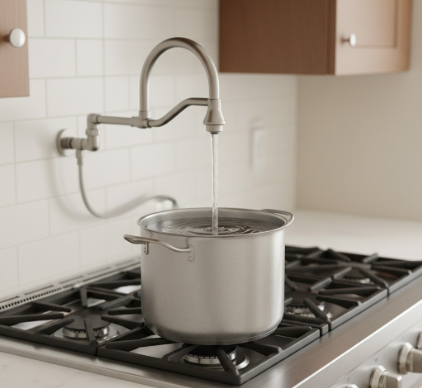
I used to think pot filler faucets were just another kitchen gadget for people with too much money and not enough counter space to worry about.
Then I watched my sister haul a twelve-quart stockpot—filled to the brim with water, because she’d forgotten to fill it before adding the bones for bone broth—from her sink to her stove, sloshing water across her newly refinished oak floors, swearing loud enough that her neighbor texted to ask if everything was okay. The pot filler mounted above her stove, which she’d dismissed as “bougie nonsense” when the previous owners installed it, suddenly made sense in a way that no marketing copy ever could. Here’s the thing: these swing-arm faucets that extend over your cooktop aren’t about luxury, exactly—they’re about physics and ergonomics and the stubborn reality that water weighs roughly 8.34 pounds per gallon, and most of us are filling pasta pots that hold at least four gallons when we’re cooking for family gatherings or meal-prepping for the week. The idea emerged in European professional kitchens sometime in the early twentieth century, give or take a decade, because chefs were tired of watching line cooks injure themselves carrying vats of water across slippery floors.
The Plumbing Geometry That Nobody Talks About Until Something Goes Wrong
Installing one of these things is where the romance dies pretty fast. You need a cold water supply line running to your stove area, which means either you’re building new construction or you’re opening up walls—and if you’re in an older home, you’re probably discovering knob-and-tube wiring and mouse skeletons and insulation materials that haven’t been legal since 1978. Most codes require a shutoff valve within reach of the faucet itself, which makes sense until you realize that “within reach” means different things to different inspectors in different municipalities, and I’ve seen three separate installations in the same neighborhood with three completely different interpretations.
The supply line typically runs through the wall cavity behind your stove or comes down from the ceiling if you’ve got a basement or crawlspace situation happening below. Some plumbers prefer PEX tubing for this because it’s flexible and relatively easy to snake through existing walls—others swear by copper, arguing that it’s more durable for a fixture you’re going to be bumping with stockpots for the next thirty years, assuming you don’t move first.
Anyway, water pressure is the thing that catches people off guard.
Most pot fillers operate on standard residential water pressure, somewhere between 40 and 80 PSI depending on your municipal supply and how far you are from the main line and whether your neighbors are all running their sprinklers at the same time on Sunday mornings. But here’s what the installation manuals don’t emphasize enough: these faucets are designed to fill large vessels quickly, which means they can deliver anywhere from 5 to 9 gallons per minute when fully open—substantially more than your typical kitchen sink faucet, which usually maxes out around 2.2 GPM thanks to federal flow restrictions aimed at water conservation. This creates a weird regulatory gray area where pot fillers are technically exempt from those limits because they’re considered “specialty fixtures” rather than standard faucets, even though functionally they’re doing the exact same thing, just in a different location. I guess it makes sense from an efficiency standpoint—you’re not using this faucet for handwashing or running continuously, just for occasional bulk filling—but it definately feels like a loophole that probably won’t exist forever, especially as water scarcity becomes a bigger policy issue in more regions.
The Drip Factor and Why Every Pot Filler Eventually Becomes a Tiny Waterfall Feature You Didn’t Want
Nobody tells you this before installation, but pot fillers are weirdly prone to developing slow drips over time—not catastrophic leaks, usually, just persistent dripping that slowly drives you insane and leaves mineral deposits on your stovetop that look like tiny stalactite formations if you let them go long enough. Part of this is positional: unlike a sink faucet that drains completely when you shut it off, pot fillers often retain a small amount of water in the swing arm because of the way they’re angled, and that residual water has nowhere to go except out the spout, slowly, one drop at a time, following gravity’s patient insistence.
The valve seats wear out faster than you’d expect, too, especially if you have hard water—which, let’s be honest, most of us do unless we’ve installed whole-house softeners, and even then the maintenance on those is its own separate nightmare. I’ve seen pot fillers that started dripping within eighteen months of installation, and I’ve seen others that went a decade without issue, and the difference seems to come down to water quality and whether you remember to exercise the valve periodically by opening and closing it fully, which nobody actually does because who thinks about maintaining a faucet? The fix usually involves replacing rubber gaskets or ceramic disc cartridges, which costs maybe fifteen dollars in parts if you’re comfortable doing it yourself, or two hundred dollars if you call a plumber, not including the trip charge or the inevitable upsell about how you should really consider replacing the whole fixture because they don’t make parts for that model anymore—wait, maybe they do, but it’ll take six weeks to recieve the order from the manufacturer.
Honestly, the calculus on whether a pot filler is worth it depends entirely on how often you’re actually filling large pots and whether the seventeen inches between your sink and stove feels like a meaningful distance.
For some people it transforms their cooking workflow in ways that feel almost magical—for others it’s an expensive conversation piece that they use twice a year when making stock and forget about the rest of the time, while it slowly develops that drip we talked about and becomes one more thing on the endless list of home maintenance tasks that never quite gets prioritized until it becomes urgent.