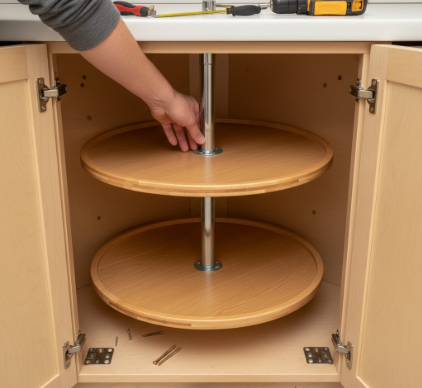
I spent twenty minutes yesterday staring into the black hole of my corner cabinet, fishing for a jar of paprika I knew was in there somewhere.
Here’s the thing about corner cabinets: they’re architectural orphans, these weird triangular voids that builders stick in kitchens because, well, what else are you going to do with that space? For decades, homeowners just shoved stuff back there and hoped for the best—canned goods disappearing into the abyss, spice jars achieving sentience in the darkness, that waffle maker you got for your wedding collecting dust like some forgotten relic. The Lazy Susan, which sounds like a piece of 1950s misogyny but is actually named after Thomas Jefferson’s daughter (or maybe not, the etymology is genuinely murky), changed all that. It’s basically a turntable for your stuff, and installing one in a corner cabinet is the difference between a functional kitchen and a storage black hole that mocks you every time you need cumin.
Most people don’t realize there are, like, four different types of Lazy Susans designed specifically for corner cabinets. The kidney-shaped ones with the weird cutout? Those are for blind corners where one cabinet door blocks access to another. The full-circle versions work in cabinets with double doors that swing open completely.
I used to think installation was this nightmarish project requiring power tools and an engineering degree, but honestly, it’s more annoying than difficult—the kind of task where you’ll definately spend more time clearing out the cabinet than actually mounting the hardware.
The Mechanics of Not Losing Your Mind (or Your Measuring Tape in the Cabinet Void)
Measuring is where most installations go sideways.
You need to account for the cabinet’s actual interior dimensions, not the exterior ones, because—wait, this seems obvious but I’ve seen it go wrong repeatedly—the walls have thickness. Most corner cabinets are either 33 or 36 inches on each side, but the usable space inside is roughly 30-33 inches, give or take. Lazy Susans come in diameters from 16 to 32 inches, and here’s where it gets fussy: you need about an inch of clearance on all sides so the shelves don’t scrape against the cabinet walls when they rotate. I measured mine three times and still managed to buy one that was a half-inch too wide, which meant an extra trip to the hardware store and a solid ten minutes of existential frustration in the aisle.
The mounting itself involves attaching a center pole or post to the cabinet floor (and sometimes the ceiling of the cabinet, depending on the model). Some Lazy Susans are independent units that just sit there, no installation required, which sounds great until you realize they slide around every time you spin them, which kind of defeats the purpose.
Corner Cabinet Chaos Theory and Why Everything You Own Will Fall Off at Least Once
The actual organization part—deciding what goes on the Lazy Susan—is weirdly personal and reveals things about your cooking habits you might not want to confront. Spices are the obvious choice, but here’s what nobody tells you: round containers work way better than square ones because they don’t catch on each other during rotation. I learned this after my carefully arranged grid of rectangular spice jars created a domino effect that sent cayenne pepper cascading onto the cabinet floor like some kind of culinary disaster movie.
Heavy items go on the bottom tier if you’ve got a two-level system, lighter stuff up top—basic physics, but you’d be surprised how many people stack canned goods on the upper level and then wonder why the whole apparatus wobbles like it’s experiencing a minor earthquake every time they reach for the tomato paste. Oils, vinegars, and other liquids are risky on Lazy Susans because if a bottle tips over mid-spin (and it will, eventually), you’ve got a cleanup situation that’ll make you reconsider your life choices.
Anyway, my paprika turned up exactly where I thought it was, except now I can actually reach it without dislocating my shoulder or accidentally knocking over three other jars in the process.
Turns out, solving a spatial problem from the 18th century with a rotating shelf genuinely does make daily life incrementally less irritating, which is maybe the most we can ask from kitchen hardware.