
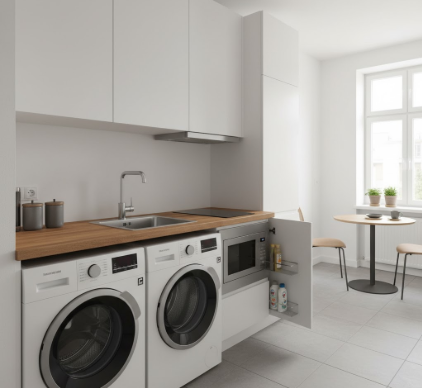
I used to think combining a kitchen and laundry room was one of those desperate design moves you only saw in cramped studio apartments or basement rentals.
Turns out, the whole concept has this surprisingly rich history—architects in post-war Europe were already experimenting with multi-functional spaces back in the 1950s, mostly out of necessity when cities were rebuilding and square footage was, well, nonexistent. The idea was simple: why dedicate precious room to a single appliance when you could stack functions vertically or nestle them into dead zones? Fast forward to today, and urban housing costs have made this approach almost mainstream. I’ve seen penthouse apartments in Manhattan where a washer-dryer sits three feet from a Wolf range, and nobody blinks. The trick, though, isn’t just shoving a washing machine next to your stovetop and calling it innovative—it’s about understanding the actual ergonomics of how people move through these spaces, the moisture loads, the ventilation requirements, and honestly, the psychological weirdness of folding laundry where you also chop onions.
Here’s the thing: most people get the layout completely wrong. They put the washer right under a cabinet that blocks top-loading access, or they forget that dryers vent heat and humidity—which, surprise, your kitchen already produces in abundance.
The Vertical Stack Strategy and Why It Fails Half the Time
Stacking washer-dryer units seems like the obvious solution, and in theory it is—you’re reclaiming maybe fifteen square feet of floor space. But I’ve walked into so many homes where the stack sits in a corner with zero consideration for door swing, and the homeowner has to do this awkward sideways shuffle just to load towels. The machines themselves have gotten quieter (modern front-loaders run at roughly 50-60 decibels during spin cycle, which is about the noise level of a normal conversation), but vibration is still an issue. If you mount a stack on a hollow wall or skip the anti-vibration pads, you’ll hear it through the whole house. Also—and I can’t stress this enough—you need at least four inches of clearance behind the units for hoses and venting, which installers routinely ignore. I guess it’s easier to just push everything flush and hope the homeowner doesn’t notice until the dryer starts overheating.
Ventilation is where things get tricky. Your kitchen already needs proper exhaust for cooking fumes, grease particulates, all that. Adding a dryer means you’re introducing lint and moisture into the same airspace. Some building codes actually require separate vent runs, but enforcement is inconsistent. Wait—maybe that’s why I’ve seen so many combo spaces with persistent mildew problems.
Plumbing Proximity Isn’t Just Convenient It’s Basically Mandatory
One advantage kitchens have is existing water lines and drainage. If you’re retrofitting laundry into a kitchen, tapping into the same supply lines as your dishwasher or sink saves thousands in plumbing costs—I’ve heard estimates ranging from $1,200 to $3,500 depending on whether you need to reroute pipes through exterior walls. The catch is water pressure: running a dishwasher and washing machine simultaneously can drop pressure below the 40-50 PSI threshold most appliances need, especially in older buildings with galvanized pipes. You might not notice until your dishwasher starts throwing error codes or your washer takes twice as long to fill. Honestly, a pressure regulator costs maybe $150 installed, but it’s one of those unglamorous fixes people skip. Drainage is the other half of the equation—washing machines dump 15 to 30 gallons per load, and if your kitchen drain can’t handle the surge (or if there’s a partial clog you didn’t know about), you’ll get backflow. I’ve definately seen kitchens flood because someone assumed a single 1.5-inch drain pipe could manage everything.
Then there’s the aesthetic problem nobody wants to admit: laundry is ugly. Even the sleekest front-loaders look industrial.
Concealment Tactics That Actually Work Without Destroying Your Workflow
Custom cabinetry is the gold standard—bi-fold doors, pocket doors that slide into the wall, even those tambour roll-up panels that hide the machines completely when not in use. But good custom work runs $2,000 to $5,000 easy, and cheaper options like curtain panels or freestanding screens tend to look exactly as budget as they are. I used to think open shelving above the machines was a clever compromise (store detergent, dish soap, keep everything accessible), but detergent containers are dust magnets and the visual clutter is real. What seems to work better, at least in the dozen or so combination spaces I’ve poked around in, is integrating the machines into a floor-to-ceiling pantry wall—everything behind matching cabinet faces, with pullout shelves for supplies. You lose some storage depth, sure, but the trade-off is a kitchen that doesn’t announce “hey, we do laundry here” the second someone walks in. Noise barriers help too: a layer of mass-loaded vinyl behind the cabinet backs cuts down on the thrum you’d otherwise here through adjacent rooms. It’s not foolproof—spin cycles still rattle dishes if you’ve got open shelving nearby—but it’s better than nothing.
Anyway, the reality is that combining these spaces isn’t some radical innovation anymore. It’s just pragmatic math when you’re working with 600 square feet total and every closet counts.




