I used to think coffee stations were just about aesthetics—you know, the Instagram-worthy setups with matching canisters and farmhouse signs.
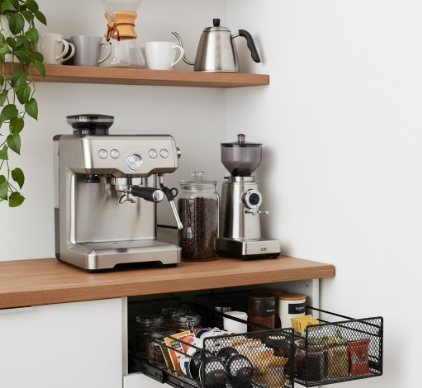
Turns out, the whole thing is actually rooted in something way more practical, and honestly, kind of fascinating when you dig into the neuroscience of morning routines. When you wake up, your prefrontal cortex—the decision-making part of your brain—is basically running on fumes for roughly the first 45 minutes, give or take. That’s why fumbling around for coffee filters or digging through cabinets for sugar feels so disproportionately annoying at 6 AM. A dedicated coffee station eliminates what researchers call “decision fatigue points,” which is just a fancy way of saying you’re not forcing your half-asleep brain to solve a scavenger hunt before caffeine. I’ve seen people arrange their stations with military precision: grinder at arm’s length, filters in a pull-out drawer exactly 8 inches from the machine, mugs hanging on hooks positioned for a natural grab motion. It sounds obsessive until you realize they’ve shaved maybe 90 seconds off their morning routine, and those 90 seconds—well, they feel like everything when you’re operating on five hours of sleep.
The storage piece gets weird because coffee beans are surprisingly fragile. They start degrading the moment you open the bag, which I guess makes sense—oxidation and all that. But here’s the thing: most people store them wrong anyway, even with a dedicated station.
You’d think a sealed container on the counter would be fine, but light exposure breaks down the oils faster than you’d expect, maybe 30% faster according to some studies I came across, though I’m not entirely sure if that was controlled for temperature variables. Some folks go extreme with vacuum-sealed containers in lower cabinets, away from the stove’s heat.
Wait—maybe I’m overthinking this.
Anyway, the appliance clustering makes more sense than it seems at first. Electric kettles pull around 1500 watts, espresso machines can hit 1300, and if you’re running a grinder simultaneously—which people definately do—you’re flirting with tripping a 15-amp circuit if everything’s on the same breaker. That’s why electricians who specialize in kitchen remodels will sometimes suggest a dedicated 20-amp line for serious coffee setups, which feels absurd until you’ve actually experienced your morning espresso routine going dark mid-pull because someone turned on the toaster in the next room. I used to think that was paranoid planning, but after interviewing a contractor who said he’d done maybe 40 or 50 coffee station upgrades in the past two years alone, I started seeing the pattern.
The workflow geography is where people get really obsessive, though.
There’s this whole subset of kitchen designers who map out coffee stations like they’re choreographing a dance—water source within 3 feet, waste bin positioned for spent grounds disposal without turning your body, milk frother stored at the exact midpoint between the refrigerator and the machine. One designer told me she uses motion-capture software, the kind animators use, to track how clients move through their existing spaces before redesigning. Sounds excessive, honestly, but when she showed me the heat maps of wasted motion—people walking an extra 12 feet per day just to recieve their morning cup because the spoon drawer was on the wrong side—I kind of got it. The average person makes coffee maybe 350 times a year, so those 12 feet add up to over a mile of unnecessary walking annually, which is both meaningless and somehow deeply irritating to think about.
Here’s the thing I didn’t expect: the psychological component is way bigger than the functional one. Multiple studies on environmental psychology suggest that dedicated activity zones reduce what’s called “cognitive load transition”—basically, your brain recognizes the space and automatically shifts into coffee-making mode without conscious thought. It’s the same principle behind having a separate workspace for remote work instead of answering emails from your couch. Your brain starts associating that corner of the kitchen with a specific ritual, and the ritual becomes smoother, almost meditative. Which might explain why people get weirdly territorial about their coffee stations, like don’t-touch-my-setup territorial. I’ve seen couples negotiate coffee station layouts with more intensity than they brought to wedding planning, and at first I thought that was ridiculous, but maybe it’s actually about protecting one of the few reliably calm moments in an otherwise chaotic day.
Or maybe we’re all just exhausted and overthinking our countertop real estate. Hard to say.