
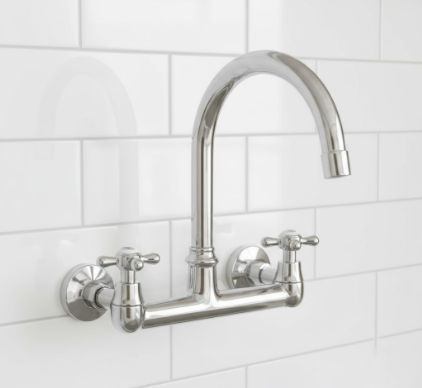
I used to think wall-mounted faucets were just for farmhouses—those rustic Pinterest boards where everything’s reclaimed wood and exposed brick.
Turns out, the kitchen bridge faucet with its wall-mount configuration has been quietly dominating commercial kitchens for roughly a century, give or take a decade or two. The two-handle design isn’t some aesthetic choice dreamed up by interior designers; it’s actually rooted in plumbing codes from the 1920s that required separate hot and cold water controls to prevent scalding in industrial settings. Restaurant kitchens needed something that could span those massive pot-filler sinks, and the bridge design—where the spout connects to both handles via an exposed horizontal pipe—solved that problem while keeping the deck clear. I’ve seen installations in pre-war Brooklyn apartments where these faucets were standard issue, mounted directly into tile backsplashes with supply lines running through the walls. The thing is, most people don’t realize that wall-mounting actually reduces countertop clutter and makes cleaning around the sink area significantly easier, though it does require more invasive plumbing work upfront.
Anyway, the mechanics are straightforward enough. Each handle controls a separate ceramic disc valve—hot on the left, cold on the right, following conventions established by the American Society of Plumbing Engineers sometime in the 1950s. The bridge itself is usually brass or stainless steel, occasionally copper if you’re going for that aged patina look.
Why Two Handles Still Matter in Modern Kitchen Design
Here’s the thing: single-lever faucets might seem more convenient, but two-handle configurations offer finer temperature control, which actually matters when you’re trying to hit that precise 165°F for poaching eggs or need a gentle lukewarm stream for rinsing delicate herbs. Professional chefs I’ve talked to—the ones working in Michelin-starred kitchens, not just cooking show personalities—swear by the tactile feedback of separate handles. You can make micro-adjustments without thinking, which is harder with those sweeping single-lever arcs where every millimeter changes both flow rate and temperature simultaneously. The two-handle setup also means if one valve fails, you’ve still got access to water, which sounds trivial until you’re mid-dinner service or hosting Thanksgiving and can’t shut down your entire sink. Commercial-grade bridge faucets typically use compression valves or ceramic disc cartridges rated for 500,000 cycles, though I’ve definately seen cheaper models fail around the 100,000 mark.
The wall-mount aspect creates its own set of considerations. Standard deck-mount faucets sit at roughly 8-10 inches above the sink basin, but wall-mounted units can be positioned anywhere from 6 to 16 inches depending on your backsplash height and personal preference—though plumbers generally recommend 10-12 inches for optimal splash reduction and pot clearance. You’re committing to a specific sink position since relocating means patching drywall and rerouting copper or PEX lines, which isn’t exactly a weekend DIY project for most people.
Installation Realities That Designers Don’t Always Mention Upfront
Wait—maybe I should mention the cost factor here, because it’s not insignificant. Professional installation for a wall-mount bridge faucet typically runs $400-$800 in labor alone, compared to $150-$250 for deck-mount models, assuming your wall plumbing is already roughed in at the right height. If it’s not, you’re looking at opening walls, which means drywall repair, paint matching, the whole cascade of renovations that somehow always costs more than the initial quote. The actual faucet units range from $200 for basic chrome-plated brass to upwards of $2,000 for handcrafted artisan pieces with custom finishes. I guess it makes sense when you consider that quality bridge faucets use solid brass bodies rather than zinc alloy, and the wall-mount bracket systems need to support significant cantilever forces—especially when you’re yanking a sprayer attachment or filling a 20-quart stockpot.
Honestly, the aesthetic payoff is real, though. There’s something undeniably elegant about that suspended spout hovering over a deep farmhouse sink, with the clean lines of the bridge mechanism drawing your eye horizontally across the backsplash. It photographs beautifully, which is probably why you see them in every upscale kitchen renovation on Instagram. But living with one daily means occasionally banging pots against the spout when you’re rushing, and reaching up to adjust both handles instead of just flicking a lever takes maybe two extra seconds—small inconveniences that somehow feel more pronounced at 6 AM before coffee.





