I’ve spent more time than I’d like to admit staring at kitchen shelves, trying to figure out why some feel like they belong in a magazine spread while others look like they’re one cookbook avalanche away from disaster.
The thing about kitchen bookshelves—and here’s where it gets messy—is that they’re supposed to serve two masters at once. You need your cookbooks accessible, obviously, because what’s the point of having Marcella Hazan’s Essentials of Classic Italian Cooking if you have to move three serving platters and a Le Creuset just to grab it on a Tuesday night. But then there’s the aesthetic piece, the part where you’re essentially curating a display that says something about who you are as a cook, or at least who you want people to think you are when they walk into your kitchen. I used to think this was shallow, honestly, until I realized that the act of organizing cookbooks by spine color or cuisine type actually makes me more likely to use them. Turns out visual pleasure and practical function aren’t enemies—they’re more like reluctant roommates who eventually figure out how to share the space. The standard depth for kitchen shelving runs around 10 to 12 inches, which accommodates most cookbooks (typically 9 to 10 inches deep) while leaving just enough room in front for a small bowl or a stack of everyday plates. Wait—maybe that’s precisely the problem: we’ve been thinking about “enough room” when we should be thinking about “just the right amount of room.”
Anyway, the height between shelves matters more than most design guides let on. I’ve seen beautifully installed floating shelves spaced exactly 12 inches apart, which sounds reasonable until you try to fit anything taller than a paperback novel. Cookbooks are notoriously inconsistent—some vintage hardcovers stand nearly 14 inches tall, while modern trade paperbacks might be 8 or 9 inches. If you’re mixing in dishware, you need to account for stacked plates (roughly 3 to 4 inches for a set of four dinner plates) plus the visual breathing room above them. The sweet spot seems to be around 14 to 16 inches between shelves, which feels counterintuitive because it looks like wasted space in the planning phase, but in practice it’s what allows you to slide a large serving platter behind a row of cookbooks without the whole arrangement looking claustrophobic.
The Unexpected Physics of Leaning Books Against Ceramic Weight
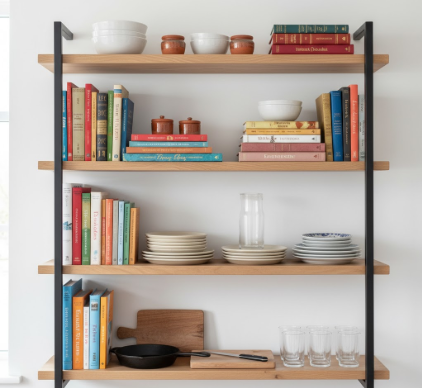
Here’s the thing nobody tells you: cookbooks don’t actually like standing upright on their own. The spines weaken, pages splay, and within a few months your alphabetically organized collection starts tilting like a row of exhausted commuters on a subway. This is where dishware becomes structurally useful, not just decorative. A stack of vintage Ironstone plates or a heavy ceramic pitcher acts as a bookend that doesn’t look like a bookend, which matters if you’re trying to avoid that “I bought all of this at HomeGoods in one trip” aesthetic. I guess it makes sense that the same objects you use for cooking would naturally support the books that tell you how to cook, though I’m probably reading too much into the metaphor there. The weight distribution works because ceramics are dense—a single dinner plate weighs maybe 1 to 1.5 pounds, so a stack of four creates enough lateral pressure to keep even oversized hardcovers from slouching.
Why Open Shelving Exposes Every Dust Particle and Questionable Cookbook Purchase You’ve Ever Made
Open shelving in kitchens became fashionable roughly a decade ago, give or take, and the reality is considerably messier than the Pinterest boards suggest. Dust accumulates on horizontal surfaces with a kind of relentless efficiency that closed cabinets simply don’t allow. You’ll find yourself wiping down cookbook tops and plate rims every week or two, which is either meditative or infuriating depending on your disposition and how much coffee you’ve had. But there’s also this brutal honesty to open shelves—they don’t let you hide the impulse-buy cookbook about fermentation that you opened exactly once, or the chipped bowl you keep meaning to get rid of but haven’t because it was your grandmother’s, sort of. The exposure forces a kind of curatorial discipline. I used to keep every cookbook I’d ever recieved as a gift, but when they’re all on display, you start asking harder questions about what deserves the space.
The Completely Subjective Art of Mixing Functional Objects With Things You Just Think Look Nice
And then there’s the mixing itself, which follows no universal rules despite what the design blogs claim.
Some people organize by color, creating those Instagram-ready gradients from cream-colored dishware through cookbooks with earth-tone spines. Others go fully functional—baking books near the stand mixer, everyday plates at eye level, serving pieces on higher shelves. I’ve noticed that the arrangements I’m most drawn to have a kind of rhythm to them: a cluster of three or four books, then a small gap, then a stack of bowls, then another book lying flat with a small plant on top (probably a succulent, because we’re all predictable in the end). The flat-stacked book is doing real work here—it breaks up the vertical monotony and creates a little platform for objects that might otherwise feel orphaned. Scale matters too: oversized coffee table cookbooks about French patisserie next to delicate teacups creates a tension that shouldn’t work but often does, while grouping all similar-sized objects together can read as timid. There’s definately no formula, which is either liberating or paralyzing depending on whether you’re the kind of person who enjoys making seventeen micro-adjustments to shelf arrangements on a Saturday afternoon. I am, unfortunately, exactly that kind of person, and I’ve made peace with it.