I used to think tiles were just tiles.
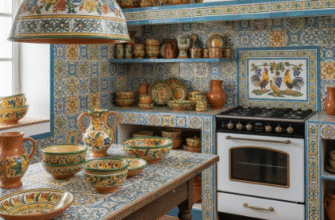
Then I walked into a kitchen in Seville—not even a fancy one, just someone’s actual cooking space—and the walls were covered in these intricate geometric patterns that seemed to shimmer and shift depending on where I stood. The homeowner, an older woman who spoke maybe three words of English, gestured at the backsplash with what I can only describe as casual pride, like she was showing me her refrigerator magnets. But these weren’t magnets. These were zellige tiles, hand-cut fragments of glazed terracotta arranged into patterns that mathematicians still study today, and they’d been there since her grandmother’s time. Turns out, what we now call “arabesque” or “Moorish” tilework isn’t just decorative—it’s a visual language that encoded everything from religious devotion to mathematical innovation across roughly 800 years of Islamic architecture, give or take a century depending on who you ask. And now it’s showing up in suburban kitchens in Ohio.
The Geometry That Refuses to Repeat (Even When It Does)
Here’s the thing about authentic Moorish tile patterns: they’re designed around the principle of tawhid, or unity.
Islamic artists avoided representational imagery—no people, no animals in sacred spaces—so they turned to geometry and calligraphy instead. What they created were patterns based on circles divided into equal segments, usually multiples of six or eight, which then generated stars, hexagons, and interlocking polygons that could theoretically extend infinitely in any direction. The mathematician Eric Broug, who’s spent decades reverse-engineering these designs, told me once (well, told a lecture hall I was sitting in) that most arabesque patterns use just a handful of core shapes repeated and rotated. But the brilliance is in the arrangement—the way a 12-pointed star nestles against an octagon, which butts up against a cross-shaped void, which somehow loops back to create the illusion of endless, non-repeating complexity. Modern kitchens usually cheat this, honestly. They’ll take one dramatic motif—say, an eight-pointed star in cobalt and white—and just repeat it in a grid, which is fine, I guess, but it misses the whole point of the original compositions.
Why Your Backsplash Might Be Historically Inaccurate (And Why That’s Okay)
Most “Moorish” tiles you’ll find at Home Depot are machine-made ceramics printed with patterns inspired by—but not copied from—historical sources.
The traditional method involved cutting small pieces of glazed tile by hand, then assembling them face-down in sand or plaster, a technique that required years of apprenticeship and produced slight variations in every single piece. You can still find artisans doing this in Fez and Granada, but it’s expensive and time-consuming, and the tiles are fragile. Modern interpretations often use decals or inkjet printing on uniform ceramic squares, which means you lose the subtle irregularities—the wobbly edge of a hand-cut piece, the way the glaze pools unevenly in the curves. I’ve seen both kinds installed side-by-side in a boutique hotel in Marrakech, and the difference is noticable if you look close, but from three feet away? Honestly, the machine-made stuff holds up pretty well. The colors are more consistent, the grout lines are cleaner, and you don’t have to worry about individual tiles cracking because someone sneezed wrong during installation.
The Practical Realities of Installing Elaborate Geometric Patterns in a Room Where You Cook Bacon
Let’s talk maintenance.
Arabesque tiles—especially the ones with deep relief or complex multi-color glazes—are gorgeous until you splatter tomato sauce on them. Grout is the enemy here; those intricate patterns mean lots of grout lines, and grout stains, and grout requires scrubbing, and suddenly your beautiful homage to Alhambra Palace is a cleaning nightmare. Some designers recommend using epoxy grout, which resists staining better than traditional cement-based grout, but it’s harder to work with and more expensive. Another option is to use the tiles as an accent—maybe a small section behind the stove, or a border at eye level—rather than covering every vertical surface. I visited a farmhouse in upstate New York where the owners had installed a single row of Moroccan-style star tiles as a chair rail in the breakfast nook, and it worked beautifully, partly because they weren’t trying to turn their kitchen into a museum exhibit, just nodding at the aesthetic without committing fully.
What These Patterns Actually Mean (Or Meant, Anyway)
There’s a tendency to treat arabesque designs as purely decorative, but that undersells their original intent.
In medieval Islamic thought, geometry was a way to contemplate the divine—the idea being that God’s creation follows mathematical order, and by studying and recreating that order, you could get closer to understanding the nature of existence itself. The endless patterns symbolized infinity; the interlocking shapes represented the interconnectedness of all things. Obviously, when you slap a six-inch zellige tile onto your kitchen island, you’re probably not meditating on the unity of creation—you just think it looks cool, which is a perfectly valid reason to choose a tile. But there’s something quietly powerful about knowing that the pattern above your sink has intellectual and spiritual roots stretching back to 9th-century Baghdad, where scholars were translating Euclid and inventing algebra while Europe was still figuring out feudalism. It doesn’t make your morning coffee taste better, but maybe it makes the space feel a little more deliberate, a little less generic. Wait—maybe that’s the real appeal of Moorish tiles in modern kitchens: they’re a way to inject history and meaning into a room that’s otherwise dominated by stainless steel appliances and IKEA cabinetry.