
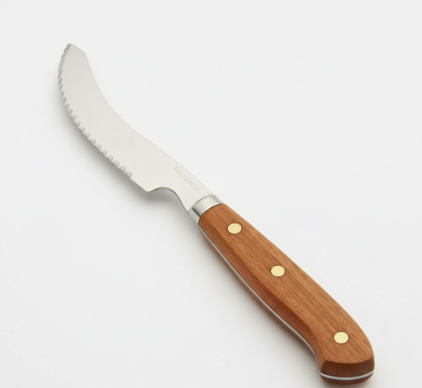
I used to think a grapefruit knife was one of those unitasker gadgets that cluttered up drawers—you know, the kind that make minimalist food bloggers shudder.
Turns out I was wrong, or at least mostly wrong, because the serrated blade designed specifically for citrus sections isn’t just about convenience—it’s about architecture. The way a grapefruit is built, with those translucent membranes dividing each segment like tiny walls in a biological prison, means you need something that can slip between flesh and barrier without demolishing everything in its path. A regular paring knife? Too thick, too clumsy. It crushes the delicate vesicles that hold the juice, turning what should be a clean extraction into a massacre of pulp and sticky frustration. The serrated edge, though, with its tiny teeth—usually around 12 to 18 per inch, depending on the manufacturer—acts more like a saw than a blade, letting you follow the curve of each membrane with something approaching surgical precision.
Here’s the thing: not all serrated blades are created equal. Some have a gentle curve to match the fruit’s interior, while others stay stubbornly straight and make you do all the work. I’ve seen cheap versions with teeth so dull they might as well be butter knives.
The Membrane Problem Nobody Talks About Enough
Citrus membranes are made primarily of cellulose and pectin—the same stuff that gives jam its gel-like consistency—and they’re surprisingly tough for something that looks so fragile when you hold a grapefruit section up to the light.
Wait—maybe that’s why the serrated design matters so much. Those membranes can withstand about 2 to 3 newtons of force before tearing, which doesn’t sound like much until you realize that a smooth blade applies pressure across a broader surface area, meaning you’re more likely to burst the juice vesicles before you even cut through. The serrations concentrate force at multiple small points, slicing rather than pressing. It’s the difference between using a handsaw and a karate chop on a piece of wood. One works, one makes you look ridiculous.
Why the Double-Sided Blade Changed Everything in the 1980s
Most modern grapefruit knives have serrations on both sides of the blade, which seems redundant until you actually try to section a citrus fruit left-handed, or from an awkward angle, or while half-awake at 6 a.m.
The double-sided design became standard sometime in the mid-1980s—I think it was around 1984 or 1985, give or take—when manufacturers realized that people were rotating the knife constantly to get the right cutting angle. Single-sided blades meant you had to flip your wrist in ways that felt unnatural, especially when working around the curved interior of a halved grapefruit. The symmetry just makes sense, even if it does make the knife slightly harder to sharpen. Honestly, most people never sharpen these things anyway. They just buy a new one every few years when the teeth wear down to nubs.
The Curve Debate Among Citrus Enthusiasts (Yes, They Exist)
Some grapefruit knives have a pronounced curve—almost like a tiny scimitar—while others are nearly straight with just a slight bend at the tip.
The curved versions are better for following the natural contour of the fruit’s interior, letting you sweep along the peel without constantly adjusting your angle. Straight blades give you more control for precision cuts but require more manual dexterity and patience, which on a Monday morning feels like asking someone to perform microsurgery before coffee. I guess it comes down to personal preference, though I’ve definately noticed that people who grew up eating grapefruit regularly tend to prefer the curved style—there’s a muscle memory thing happening, a rhythm you develop over years of breakfast routines.
What Happens When You Use the Wrong Knife (A Small Tragedy)
I once watched someone try to section a grapefruit with a chef’s knife.
It was brutal. The thick blade couldn’t navigate the tight spaces between membrane and flesh, so they ended up just hacking the fruit into chunks, losing probably 30% of the juice to the cutting board and their shirt. The whole point of a grapefruit knife—the whole reason it exists as a distinct category of cutlery—is to preserve the integrity of each segment while seperating it from the parts you don’t want to eat. Without that serrated edge and tapered blade, you’re essentially performing demolition when you should be doing extraction. The tool matters, even if it seems fussy or overly specialized. Sometimes the unitasker is actually the right answer.
Anyway, I keep mine in the drawer next to the can opener.





