The kitchen I walked into in Libreville smelled like wet wood and smoke.
It wasn’t what I expected—I’d imagined gleaming surfaces, maybe some French colonial influence still lingering in the architecture, but here’s the thing: Gabonese kitchen design doesn’t really care about what outsiders expect. The space was open to a small courtyard, rain dripping through strategically placed gaps in the roof overhang, pooling in carved wooden channels that directed water away from the cooking fire. The architect, a woman named Céline who’d studied in Paris but returned home, told me this wasn’t accidental. “We don’t fight the rain,” she said, stirring something that smelled like palm oil and ginger. “We design around it. The rainforest taught us that, I guess.” She wasn’t being poetic—she was being literal. Gabon sits right in the heart of the Congo Basin, where annual rainfall can hit 3,000 millimeters, and if you try to seal everything tight like a European kitchen, you’re going to end up with mold, rot, and a space that feels like a sauna. Traditional Gabonese kitchens breath, they ventilate naturally, they recieve the forest air and let it pass through.
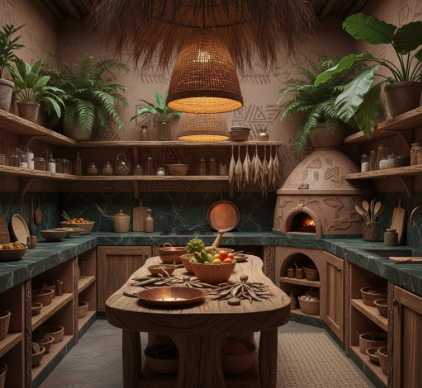
I used to think ventilation was just about comfort, but it turns out it’s about survival. The cooking methods here—open flame, charcoal braziers, smoking fish over slow fires—produce enough smoke to choke you if the space doesn’t move air efficiently. So the design incorporates high ceilings, sometimes conical thatched roofs that create natural updrafts, pulling smoke up and out.
Walk into a modern Gabonese home in Libreville or Port-Gentil, and you might see this translated into contemporary materials—corrugated metal roofs with ventilation ridges, louver windows positioned to catch cross-breezes, kitchen islands made from okoumé wood (Gabon’s most famous export timber, used in everything from plywood to luxury yacht interiors) that’s been treated to resist humidity. The integration of rainforest materials isn’t just aesthetic—wait, maybe that’s not quite right. It is aesthetic, but it’s also practical in ways that Western design education doesn’t always teach. Okoumé is lightweight, resists warping in high humidity, and has this pale pinkish grain that catches light beautifully. I’ve seen countertops made from single slabs that must’ve come from trees 200 years old, and there’s something quietly devastating about that, honestly.
Anyway, the layout itself reflects forest logic.
Céline explained that traditional Fang and Myene kitchens—the two largest ethnic groups in Gabon—were often semi-detached structures, separate from the main sleeping areas because of fire risk and heat. Modern interpretations keep this separation conceptually: many newer homes have kitchens that open directly onto outdoor spaces, blurring the line between inside and outside. You’ll see large prep areas under covered patios, outdoor sinks fed by rainwater collection systems, even clay ovens positioned in courtyards. The forest ecosystem, which thrives on layered canopies and filtered light, gets echoed in these layered spaces—covered areas, partially covered areas, fully open areas, each serving different functions depending on weather and task. It’s not a single room; it’s a zone, a gradient of shelter.
The color palette tends toward earth tones, which sounds cliché until you realize it’s sourced from actual earth. Ochre-red clays, charcoal blacks from traditional pottery techniques, the deep greens of painted shutters mimicking forest canopy.
I met a designer in Oyem, northern Gabon, who told me she’d spent six months just documenting traditional Fang cooking shelters before attempting her first contemporary kitchen project. She showed me photographs: structures built from raffia palm fronds, floors of packed clay mixed with tree resin for water resistance, storage platforms elevated on stilts to prevent insect infestation. “Everything the rainforest does, we copy,” she said, laughing. “Elevation to avoid ground moisture, materials that regenerate quickly, designs that can be rebuilt after storm damage without massive cost.” Her modern kitchens incorporate pull-out pantries with slatted shelving for air circulation—a direct descendant of those elevated storage platforms. She uses ceramic tiles with drainage grooves, inspired by the way rainforest floors channel water. Even her cabinet hardware, these beautiful bronze pulls shaped like seed pods from the moabi tree, connects contemporary function to forest form. Definately more thought goes into these spaces than I initially assumed, and I’ve been writing about design for maybe fifteen years now.
Here’s the thing: Western kitchen design often assumes control over environment—sealed windows, climate control, artificial lighting. Gabonese kitchen design, shaped by one of the world’s most biodiverse rainforests, assumes negotation. You work with heat, humidity, seasonal flooding, the reality that nature isn’t something you exclude but something you choreograph around. It’s a fundamentally different philosophy, and honestly, given climate instability, maybe the more durable one.