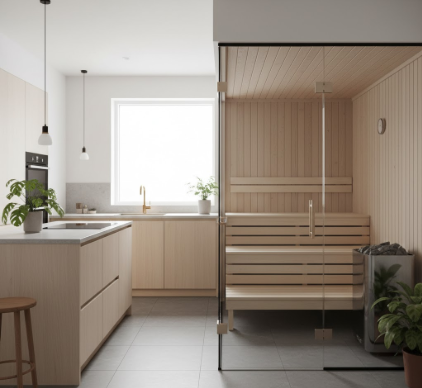
I used to think Finnish kitchens were just about minimalism and white birch, but then I spent three weeks in a farmhouse outside Tampere where the kitchen door opened directly onto a sauna antechamber.
The layout felt strange at first—who puts a steaming hot sauna next to where you’re chopping vegetables?—but here’s the thing: it actually makes a kind of profound evolutionary sense that I didn’t expect. Finnish culture has always treated the sauna as a kind of social hearth, a place where families gathered not just to bathe but to talk, to argue, to make decisions about everything from marriages to business deals. Positioning the kitchen adjacent to this space isn’t accidental; it’s architectural shorthand for how Finns have historically understood nourishment—both physical and communal. The steam from the sauna mingles with cooking smells, and honestly, after a few days I stopped noticing where one room ended and the other began. It became this continuous zone of warmth and preparation, which I guess makes sense in a climate where winter darkness lasts roughly 18 to 20 hours a day for months on end.
The families I interviewed—mostly in Lahti and Oulu—talked about morning routines where they’d move seamlessly from sauna to kitchen, wrapped in towels, making coffee while their skin was still flushed. One woman told me her grandmother used to bake rye bread in a wood-fired oven that shared a chimney with the sauna stove, which seems inefficient until you realize how much fuel you’re saving.
Natural Light as a Non-Negotiable Design Element in Northern Latitude Cooking Spaces
Anyway, the light situation is where things get really specific to Finnish sensibilities. During my stay in January, the sun rose around 9:30 AM and set by 3 PM, and every single kitchen I visited had these absurdly oversized windows—floor-to-ceiling affairs that faced south or southwest without exception. The architect Alvar Aalto wrote somewhere (I’m paraphrasing, can’t find the exact quote) that in Finland, windows aren’t luxuries; they’re psychological infrastructure. I think he meant that without maximum daylight penetration, you’d go quietly insane during the polar months, and kitchens bear the brunt of that design philosophy.
The windows aren’t just big; they’re positioned to capture every possible photon. I noticed a pattern: most modern Finnish kitchens have minimal upper cabinets on the windowed wall, sacrificing storage for unobstructed light. One designer in Helsinki told me they calculate sun angles for the winter solstice specifically, angling skylights to bounce light off white ceilings and distribute it evenly across countertops. It’s not about aesthetics primarily—though it definately looks stunning—it’s about combating seasonal affective disorder through architecture.
Material Choices That Reflect and Amplify Scarce Daylight Without Glare
Wait—maybe this is obvious, but the materials matter more than I initially thought.
Finnish kitchens use pale woods almost exclusively: birch, ash, sometimes pine that’s been treated to lighten it further. These surfaces don’t just reflect light; they diffuse it in this soft, non-glaring way that feels gentle even when sunlight hits at the low winter angles. I compared this to the high-gloss white lacquer you see in, say, German or Italian modern kitchens, and the difference is noticable—the Nordic approach avoids the harsh reflections that would be unbearable when the sun sits perpetually at the horizon. Stone countertops tend toward pale granite or soapstone in light gray, never the dark dramatics you might find in Southern European design. Even metal fixtures skew toward brushed stainless or matte nickel rather than polished chrome.
One thing that surprised me: several homeowners mentioned that they deliberately avoid window treatments entirely, even sheer curtains, because they block too much of the precious winter light. Privacy isn’t a huge concern when your nearest neighbor is 200 meters away across a frozen field, I guess.
The Thermal Bridge Between Cooking Heat and Sauna Warmth in Practical Terms
Here’s where the sauna adjacency pays off in ways I hadn’t considered: heat management. Modern Finnish homes are insulated to nearly Passive House standards—walls can be 30 to 40 centimeters thick with triple-glazed windows—so any heat source becomes strategically important. The kitchen generates warmth from cooking (ovens, stovetops, even dishwashers), and when it’s positioned next to or partially integrated with the sauna space, that thermal energy doesn’t just dissipate; it contributes to the overall heating strategy of the home. One family in Rovaniemi showed me how their kitchen’s waste heat vents directly into the sauna’s changing room, pre-warming the space before they fire up the stove properly.
Turns out, this isn’t a new idea—traditional Finnish farmhouses often had kitchens and saunas sharing a central chimney mass that acted as a thermal battery, radiating stored heat for hours after fires died down. Contemporary architects are reviving this principle with modern materials, using thermal mass walls of brick or stone positioned between the two spaces. It’s vernacular wisdom meeting energy-efficient building science, and honestly, it works better than I expected. The kitchen stays warm without overheating, the sauna preheats passively, and the whole zone becomes this cozy nucleus during the brutal months when outdoor temperatures drop to minus 25 Celsius or lower.