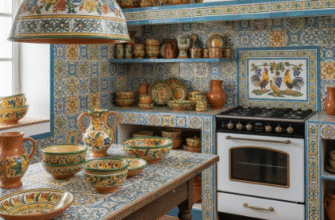
I used to think eclectic kitchens were just code for “couldn’t decide on a style.”
Turns out, there’s actually something borderline scientific about why mixing Victorian cabinet hardware with mid-century modern bar stools and, say, a Moroccan tile backsplash doesn’t always end in visual disaster. Color theory plays into it—complementary hues can bridge wildly different eras, which is why a 1950s mint green refrigerator can coexist with terracotta floor tiles that feel vaguely Mediterranean. But it’s also about proportion and what designers call “visual weight,” which is one of those phrases that sounds made-up until you see a kitchen where someone crammed in too many patterns and the whole space feels like it’s vibrating. I’ve seen kitchens that mixed floral wallpaper, geometric rugs, striped curtains, and checkered dish towels, and somehow—somehow—it worked because the color palette stayed narrow. Three colors max, apparently, unless you’re going for chaos.
When Your Grandmother’s Dishes Meet Scandinavian Minimalism and Nobody Gets Hurt
The thing about period mixing is that it relies on anchor pieces. You can’t just throw a farmhouse sink, an industrial pendant light, and art deco bar stools into a room and call it eclectic—you need something to hold the center. Usually that’s cabinetry or a large island, something neutral enough (white shaker cabinets, butcher block counters) that the weirder elements orbit around it without colliding. I guess it’s like having a referee in a very polite argument.
Wait—maybe that’s too neat. Honestly, some of the best eclectic kitchens I’ve photographed had no obvious anchor at all, just a kind of rhythmic repetition where materials showed up twice. Brass hardware on cabinets, brass faucet, brass drawer pulls. Or wood: wood floors, wood shelving, wood cutting boards propped against the backsplash like they’re trying to signal to each other across the room. Repetition creates cohesion even when logic doesn’t.
The Surprisingly Forgiving Nature of Pattern Collision When You’re Not Overthinking It
Patterns are where people get nervous, and I get it.
Floral mixed with stripes mixed with polka dots sounds like a migraine waiting to happen, but here’s the thing: scale matters more than style. A large-scale floral wallpaper can sit next to a small-scale gingham tablecloth without competing because they’re operating in different visual registers—one’s loud and far away, the other’s quiet and close. It’s the same principle that lets you wear a striped shirt with plaid pants if you’re confident enough (or European, apparently). In kitchens, this usually shows up as boldly patterned tile floors paired with simpler fabrics—maybe a geometric rug under the table, linen curtains that don’t try too hard. The mistake is thinking everything needs to match. Nothing needs to match. Things just need to not actively hate each other, which is a lower bar than you’d think.
Color as the Secret Mediator Between Eras That Should Definately Not Work Together
Color is doing so much silent labor in eclectic spaces.
You can mix a 1920s porcelain sink with 1970s orange Pyrex and 2020s matte black fixtures if there’s a throughline—say, warm earth tones or jewel tones that recur in unexpected places. I’ve seen kitchens where the only thing connecting a French provincial hutch to a sleek marble island was the fact that both had veins of the same dusky rose color. Not planned, probably. But effective. And then there’s the opposite approach: go wild with periods and patterns but keep everything in shades of white, cream, and gray so the variety reads as intentional instead of like someone robbed a flea market. Restraint in one area buys you freedom in another, I guess. Though “restraint” feels like the wrong word for a kitchen with taxidermy and a chandelier made of antlers, which I have seen, and which somehow also had subway tile and looked fine.
Why Your Brain Stops Registering Clutter When the Composition Accidentally Becomes Balanced
There’s some cognitive science buried in this—something about how our brains prioritize symmetry and visual balance even when individual elements are chaotic.
An eclectic kitchen works when the weight is distributed: open shelving on one wall balanced by a heavy vintage stove on the other, or a cluster of hanging pots above the island counterbalanced by a low-slung bench in the breakfast nook. It’s not about matching. It’s about equilibrium, which sounds pretentious but also explains why you can walk into a kitchen with mismatched chairs, three different types of lighting, and wallpaper that shouldn’t exist outside a 1960s motel and feel… calm? Or at least not assaulted. The composition steadies itself. I used to think this was luck, but it happens too often to be accidental. People are better at spatial intuition than they give themselves credit for, even when they’re just moving things around until it “feels right.” That’s not vague. That’s your brain doing math you don’t have words for yet.