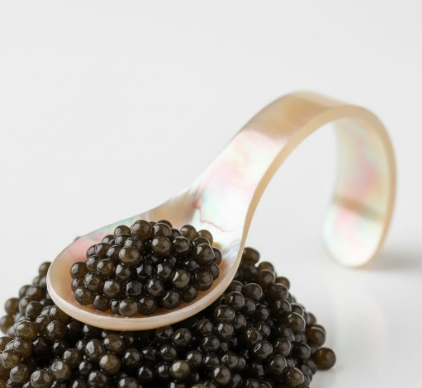
I never thought I’d care about spoons.
But here’s the thing—when you’re standing in your kitchen at 11 PM with a jar of actual caviar (a gift, not a flex), you start questioning everything you thought you knew about cutlery. My friend Maria, who worked at a Michelin-starred restaurant in Copenhagen for roughly three years, give or take, once told me that metal spoons can make caviar taste metallic. I laughed. She didn’t. Turns out, she was absolutely right, and the science behind non-metallic caviar spoons is way more fascinating than I expected, even if it sounds like the most bougie problem humanity has ever tried to solve.
Why Your Regular Spoon Is Basically Ruining Everything
Metal oxidizes when it contacts salt.
That’s it. That’s the whole chemistry, except it’s not, because the interaction between trace metals—iron, copper, nickel—and the delicate brine surrounding sturgeon eggs creates this subtle but definately noticeable flavor shift. Some people describe it as “tinny,” others say it’s more like licking a battery (which, honestly, how do they know what that tastes like?). The point is, traditional utensils made from stainless steel or silver can release ions that bond with the fatty acids in caviar, altering both taste and aroma. I used to think this was pretentious nonsense until I did a blind taste test myself—one spoon mother-of-pearl, one stainless steel. The difference wasn’t huge, but it was there, lurking at the edge of perception like that feeling when you forget someone’s name mid-conversation.
Materials That Won’t Mess With Your Expensive Fish Eggs
Mother-of-pearl remains the gold standard, probably because it’s been used for this purpose since Russian aristocrats were still a thing. It’s inert, smooth, and doesn’t react chemically with salt or fat. Bone, horn, and certain types of wood also work well—they’re porous enough to avoid the oxidation problem but dense enough not to absorb flavors themselves. Then there’s plastic, which sounds deeply inelegant but actually performs beautifully in laboratory tests measuring flavor preservation.
Modern silicone spoons have entered the chat too.
They’re flexible, dishwasher-safe, and completely flavor-neutral, though they lack the aesthetic weight that makes eating caviar feel like an event rather than just another Tuesday. I’ve seen high-end caviar producers include tiny plastic spoons with their products, which feels simultaneously practical and like they’re admitting the whole thing is a bit ridiculous. Maybe it is. But if you’re already spending $200 on three ounces of beluga, why wouldn’t you spend another $15 on a spoon that won’t sabotage the experience?
The Sensory Science Nobody Talks About Enough
Our tongues are wildly sensitive to metallic compounds—we can detect iron at concentrations as low as one part per million, which made sense evolutionarily when contaminated water could kill you but now mostly just makes us picky about silverware. Caviar’s flavor profile sits in this precarious zone of subtle salinity, umami depth, and buttery richness that gets overwhelmed easily. Temperature matters too; metal conducts heat faster than organic materials, so a metal spoon can warm the eggs slightly during transfer, affecting texture. I guess it makes sense when you think about it—these are ingredients where freshness and handling define quality, so every variable becomes amplified.
When Tradition Accidentally Invented the Right Solution Before Anyone Knew Why
The funny part? Aristocratic caviar service developed non-metallic spoons centuries before anyone understood oxidation chemistry. They just knew, empirically, that it tasted better this way. Sometimes trial and error beats theory to the finish line, and we reverse-engineer the explanations later. Modern materials science has confirmed what wealthy Russians figured out through sheer repetition and probably a lot of wasted sturgeon roe. Now we have the luxury of choosing between historical elegance—those gorgeous iridescent mother-of-pearl utensils that cost more than my first car—and utilitarian efficiency in the form of a $.50 plastic implement that does the exact same job.
I still don’t know which one I’d choose.
Probably whichever was already in the drawer, honestly, because at a certain point even the most compelling science can’t compete with simple convenience, and maybe that’s the real lesson here—that caring about details is exhausting, even when those details are technically correct.