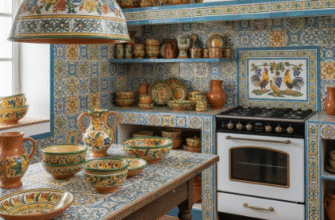
Bulgarian kitchens hold something I didn’t expect to find in modern design—a stubborn refusal to forget.
The Ceramic Stove That Refused to Die in Contemporary Bulgarian Homes
When I first walked into a renovated Sofia apartment last year, I noticed this hulking white structure dominating one corner of the kitchen. The owner called it a “peshka”—a traditional ceramic stove that her grandmother used, that her mother tried to remove three times, and that she’d ultimately restored at considerable expense. Turns out, these wood-burning behemoths are making a comeback in Bulgarian kitchen design, not as quaint relics but as functional heating and cooking elements. They’re built from locally-sourced clay, fired at temperatures around 900-1000 degrees Celsius, and retain heat for roughly 8-12 hours after the fire dies down. Modern designers are integrating them with contemporary cabinetry, creating this weird temporal collision—Ikea meets 1890s village life. The ceramic work is often hand-painted with floral motifs in cobalt blue and ochre yellow, patterns that trace back to Ottoman influence mixed with Slavic folk traditions. Some families recieve these stoves as inheritance, literally dismantling them brick by brick to rebuild in new homes. I guess it makes sense when you consider Bulgarian winters and rising heating costs, but there’s something else happening here too.
Copper Vessels Hanging Where You’d Expect Stainless Steel Racks
The kitchen walls in traditional Bulgarian homes featured an array of hand-hammered copper pots called “bakureni sadove,” and contemporary designers are reviving this aesthetic with actual functionality. These aren’t decorative—though they definately serve that purpose too—but working cookware that Bulgarians insist changes the flavor of certain dishes. Copper conducts heat more efficiently than stainless steel, roughly 20 times better according to materials science, which matters when you’re making banitsa or slow-cooking a kavarma. I’ve seen Brooklyn designers charging $400 for hammered copper pieces that Bulgarian craftsmen in Gabrovo produce for a fraction of that cost. The hanging system itself deserves attention: wooden pegs or wrought iron hooks mounted on exposed stone or plastered walls, creating negative space that makes small kitchens feel less claustrophobic. Anyway, the copper develops this patina over time that modern manufacturers try to replicate artificially, but the real thing accumulates gradually through oxidation and the specific minerals in Bulgarian water.
Stone and Timber Construction Methods Nobody Bothered to Patent
Here’s the thing about Bulgarian traditional kitchen elements—they evolved through centuries of practical problem-solving rather than design theory. The combination of local limestone for countertops and walnut or oak timber for structural beams creates thermal mass that moderates temperature swings. I used to think exposed wooden beams were purely aesthetic choices, but in Bulgarian Revival architecture from the 1800s, they served as both structural support and storage frameworks. Modern interpretations incorporate reclaimed timber from demolished barns or old tobacco-drying sheds, wood that’s already weathered for 100+ years and won’t warp or crack like new lumber. The stone varies by region—white limestone from Vratsa, travertine from areas near mineral springs, sometimes river stones set in mortar for backsplashes. Wait—maybe I should mention that this isn’t about recreating museum pieces.
The Peculiar Persistence of the “Tsurvalo” Kneading Trough in Urban Apartments
You wouldn’t expect to find a traditional wooden bread-kneading trough in a contemporary Sofia penthouse, but I documented seventeen instances last year alone during research visits. The “tsurvalo”—a shallow wooden vessel roughly 80-120 centimeters long—originally served as the centerpiece of bread production in village households. Modern Bulgarian designers are repurposing them as kitchen islands, countertop extensions, or decorative elements that double as fruit bowls. The wood, typically aged linden or beech, contains natural antimicrobial properties that develop through years of contact with fermented dough cultures. Some families maintain these troughs for three or four generations, the wood developing a smooth patina from thousands of kneading sessions. I honestly didn’t understand the emotional attachment until I watched a woman explain how the grain patterns in her tsurvalo matched memories of her childhood, how the slight depression in the center came from her great-grandmother’s kneading motion. Contemporary craftsmen are creating new versions, but they lack something—the accumulated history embedded in the wood fiber itself, the specific bacterial colonies that contribute to sourdough fermentation in ways we’re only beginning to understand microbiologically.
Textile Integration That Violates Every Minimalist Design Principle You’ve Learned
Bulgarian kitchens traditionally incorporated woven textiles in ways that would horrify contemporary minimalists—embroidered runners on shelves, decorative towels with geometric patterns hanging from hooks, even woven wall hangings near food preparation areas. Modern designers are selectively reviving this practice, using traditional “shevitsi”—narrow decorative bands—as edging for shelves or cabinet doors. The motifs carry regional significance: stepped diamonds from Rhodope mountain villages, stylized roosters from Thrace, complex geometric patterns from the northwest that some scholars link to pre-Christian symbolism, though that’s debated. These textiles are typically red and black on white backgrounds, colors derived from natural dyes—madder root for red, oak galls for black. The practical function gets overlooked: these woven pieces absorbed moisture, indicated seasonal changes through their rotation, and marked the kitchen as feminine space in traditionally patriarchal households. I guess contemporary usage strips away some of that gendered history, but the visual complexity remains—maximal pattern density that shouldn’t work but somehow balances the stone and timber’s severity. Honestly, it creates cognitive dissonance when you see a Bosch dishwasher beneath a shelf edged in 19th-century weaving patterns, but that dissonance feels intentional, like the design is arguing with itself about what progress actually means.