
I used to think Austrian kitchens were just about cleanliness and those impossibly organized spice racks.
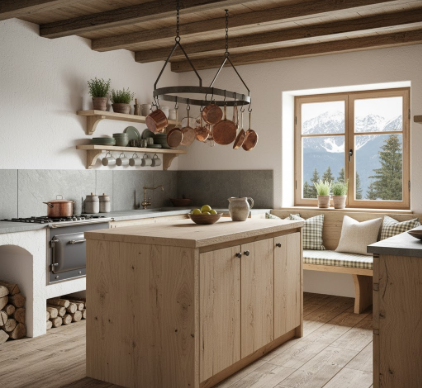
Turns out, there’s this whole other dimension—something raw and almost ancient—that comes from the Alps themselves. The mountains aren’t just a backdrop in Austrian design; they’re practically a mandate. Walk into a traditional Austrian kitchen in Tyrol or Salzburg, and you’re hit with this overwhelming presence of wood: oak, pine, larch, sometimes stone pine if the family’s got money or history. It’s not the polished, IKEA-fied version of wood either. We’re talking about planks that still show knots, grain patterns that look like topographic maps, surfaces that feel like they’ve absorbed decades of bread dough and coffee spills. The Alpine influence isn’t decorative—it’s structural, philosophical even. These kitchens were built to withstand isolation, long winters, and the kind of self-sufficiency that modern life has mostly forgotten. I guess that’s why they feel so foreign and so comforting at the same time.
Here’s the thing: the wood isn’t randomly chosen. Austrian craftsmen have this near-obsessive relationship with local timber. Larch, for instance, grows at high altitudes and develops this incredible density—it’s naturally resistant to moisture and insects, which matters when your kitchen doubles as the warmest room in a mountain house.
Stone pine, or Zirbenholz, is another obsession, though it’s expensive and getting rarer. People claim it has health benefits—something about essential oils in the wood reducing heart rate—and while I’m skeptical of the science, I can’t deny that stone pine kitchens smell incredible, like a forest distilled into furniture. Oak shows up in older farmhouses, dark and heavy, the kind of wood that makes you think about centuries rather than decades. The Alpine influence means every material has to earn its place through durability and local availability. No tropical hardwoods, no engineered composites unless absolutely necessary. It’s pragmatic, but it’s also deeply tied to identity—Austrian mountain culture has always been about working with what the landscape provides, not against it.
How Natural Wood Defines Every Surface and Decision
Cabinets, countertops, ceiling beams, even the floor—wood dominates in a way that would feel overwhelming in a minimalist Scandinavian space.
But Austrian kitchens don’t aim for minimalism. They aim for Gemütlichkeit, that untranslatable word that means coziness mixed with belonging mixed with a kind of unpretentious warmth. The wood is often left unfinished or treated with natural oils rather than varnish, so it ages visibly. Scratches accumulate. Water rings appear. The kitchen becomes a record of use, which is maybe the opposite of how we think about kitchen design now, where everything’s supposed to look perpetually new. I’ve seen countertops made from single slabs of larch, three inches thick, that have been in use for forty years—they’re scarred and stained, but somehow more beautiful for it. The Alpine aesthetic doesn’t fetishize perfection; it fetishizes authenticity and endurance. Honestly, it’s a little intimidating if you’re used to worrying about resale value.
The Stubborn Persistence of Traditional Joinery Techniques
Walk into a high-end Austrian kitchen today, and you might still find dovetail joints and mortise-and-tenon construction.
This isn’t nostalgia—it’s a calculated choice. Modern adhesives and fasteners work fine, but traditional joinery allows wood to expand and contract with humidity changes without cracking or warping. The Alps are humid in summer, bone-dry in winter when heating systems run constantly. A kitchen built with screws and glue might last twenty years; one built with proper joinery can last a century. Austrian cabinetmakers still apprentice for years, learning to cut joints by hand before they’re allowed near power tools. It’s artisanal in the truest sense, though the craftsmen themselves would probably roll their eyes at that word. They’d say it’s just how you build things if you want them to work. The Alpine influence here is less about aesthetics and more about respect for materials—understanding that wood is alive, even after it’s been cut and planed, and that good design accomodates that.
Why Stone and Ceramic Show Up as Grounding Counterpoints
Not everything is wood, though it can feel that way at first glance.
Austrian kitchens often incorporate stone—granite, slate, sometimes local limestone—particularly around stoves and sinks where heat and water make wood impractical. The contrast is deliberate: warm wood against cool stone creates a sensory balance that keeps the space from feeling too rustic or too sterile. Ceramic tiles, often hand-painted with floral or geometric patterns, show up as backsplashes, preserving a tradition that dates back to when kilns were as common as bakeries in Alpine villages. These elements aren’t decorative flourishes; they’re functional inheritances from a time when every material had to justify its presence through utility. I used to think the mix of textures would feel chaotic, but it doesn’t—it feels layered, like the kitchen has a history that predates its current occupants. Wait—maybe that’s the point. Austrian design doesn’t erase the past; it builds on top of it, literally and figuratively.
The Unexpected Influence of Hunting Lodges and Rural Farmhouses
A lot of contemporary Austrian kitchen design traces back to Jagdhütten—hunting lodges—and old farmhouses where kitchens were communal, multifunctional spaces.
These weren’t places for quick meals; they were where families gathered for hours, where meat was butchered and preserves were made, where decisions got hashed out over schnapps and coffee. The furniture reflected that: long wooden tables, benches instead of chairs, open shelving because cabinets with doors were expensive and unnecessary when you used everything regularly. Modern Austrian kitchens, even in Vienna apartments, often echo this layout—islands that double as dining tables, exposed storage, a bias toward horizontal space rather than vertical. The Alpine influence is less about mountains per se and more about the social patterns mountains enforced: isolation that bred self-reliance, long winters that made the kitchen the heart of the home, landscapes that demanded respect and adaptation. It’s why even sleek, contemporary Austrian kitchens often feel grounded in a way that’s hard to articulate. They’re not trying to impress you—they’re trying to shelter you.




