I used to think Angolan kitchens were just Portuguese kitchens transplanted wholesale to Africa, but that’s not quite right.
The truth is messier and more interesting. When Portuguese colonizers arrived in Angola in the late 15th century—around 1482, give or take a few years depending on which historian you ask—they brought with them not just their language and religion but also their ideas about how domestic spaces should function. The kitchen, that central hearth of family life, became a contested zone where European architectural conventions collided with African realities. Portuguese designs emphasized enclosed cooking spaces, usually tucked away from main living areas, with heavy masonry construction and small windows to keep out the Mediterranean heat. But Angola isn’t Portugal. The climate is different, the available materials were different, and most importantly, the cooking traditions were fundamentally different. So what emerged over five centuries wasn’t pure Portuguese or pure Angolan—it was something else entirely, a hybrid architecture that still shapes how millions of people cook today.
Here’s the thing: colonial influence doesn’t just disappear when colonizers leave. In Luanda and other coastal cities, you can still see the Portuguese layout preferences—kitchens separated from dining areas, often positioned at the back of the house with their own external entrance. This wasn’t just aesthetic; it was about class and labor hierarchies that the Portuguese imported directly from Lisbon.
The Azulejo Tiles That Nobody Talks About Anymore
Walk into any mid-century Angolan home built during the colonial period, and you might notice something unexpected on the walls.
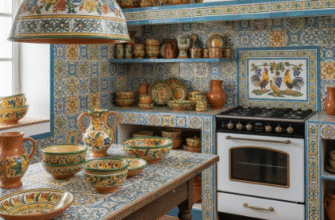
Azulejos—those distinctive Portuguese ceramic tiles, usually blue and white, sometimes depicting pastoral scenes or geometric patterns—became a staple of Angolan kitchen design during the peak colonial years from roughly 1920 to 1974. They weren’t just decorative. The tiles served practical purposes: they were easy to clean, reflected light in spaces that often lacked adequate windows, and resisted the humidity that would destroy painted plaster in a matter of months. But they also served as visual reminders of Portuguese dominance, little fragments of Lisbon embedded in African walls. I’ve seen kitchens in Benguela where families have carefully preserved these tiles decades after independence, not out of colonial nostalgia but because they’re genuinely beautiful and functional. Other families have ripped them out entirely, replacing them with locally made alternatives. The tiles became symbols, and symbols are never neutral. What’s fascinating is how Angolan artisans eventually began producing their own versions, incorporating African motifs—geometric patterns from traditional textiles, stylized representations of local plants and animals—into the Portuguese tile format. Wait—maybe that’s the real story here, not the preservation or destruction of colonial aesthetics but their transformation into something new.
Outdoor Cooking Spaces and the Architecture of Resistance
Honestly, the most significant aspect of Angolan kitchen design might be what happens outside the main house entirely.
Traditional Angolan cooking often occurred in outdoor spaces—open-air hearths where women would prepare funje (cassava porridge) or muamba (a rich chicken stew) over wood fires. The Portuguese indoor kitchen model never fully replaced this practice, even in urban areas. Instead, many Angolan homes developed dual kitchen systems: a formal indoor kitchen with Portuguese-style features like tiled counters and enclosed stoves for certain types of cooking, and an outdoor area—sometimes just a simple shelter with a corrugated metal roof—where traditional cooking methods continued uninterrupted. This wasn’t just about preference or tradition; it was practical. Cooking with wood smoke indoors in a poorly ventilated Portuguese-style enclosed kitchen was unbearable. The outdoor spaces also served social functions that the solitary Portuguese kitchen couldn’t accomodate—they were places where extended family gathered, where cooking became a communal activity rather than isolated domestic labor. Some architectural historians argue that these outdoor cooking spaces represent a form of architectural resistance, a refusal to fully adopt colonial spatial logic even when the physical structures suggested otherwise.
The Concrete Counter Phenomenon Nobody Can Quite Explain
There’s this weird thing you’ll see in Angolan kitchens built between the 1950s and 1980s: massive concrete counters, often poured in place, incredibly thick and heavy.
They’re everywhere, in rich homes and poor ones, in Luanda and in rural towns. I guess they emerged from a combination of factors—concrete was relatively cheap and available, trained masons were more common than carpenters who could build wooden cabinetry, and Portuguese construction methods emphasized masonry over woodwork anyway. But the scale of these counters goes beyond mere practicality. They’re monuments, permanent structures that couldn’t be easily moved or modified. In a country that experienced decades of civil war after independence in 1975, maybe that permanence meant something. Or maybe I’m reading too much into it. Architectural decisions aren’t always laden with meaning; sometimes people just build what they know how to build with the materials they have. Still, when you see these concrete counters in abandoned colonial-era homes, overgrown with vegetation, they endure long after wooden structures have rotted away. They’re definately the most visible legacy of Portuguese construction techniques, even if their psychological significance remains unclear.
Ventilation Wars: Louvers, Shutters, and the Battle Against Tropical Heat
Turn out the Portuguese really didn’t understand tropical architecture when they first arrived.
Their initial kitchen designs—small windows, heavy walls, enclosed spaces—made sense in Portugal’s temperate climate but were absolutely miserable in Angola’s heat and humidity. Over time, adaptations occurred. Louvers replaced solid shutters, allowing air circulation while keeping out rain. Windows grew larger. Ceilings got higher. Kitchen doorways were positioned to create cross-ventilation, drawing hot cooking air out while pulling cooler air in. These weren’t innovations the Portuguese brought from home; they were lessons learned from African building traditions, gradually incorporated into colonial architecture often without explicit acknowledgment. By the 1960s, the typical urban Angolan kitchen looked significantly different from its Portuguese counterpart—more windows, more ventilation, more concessions to local climate realities. Some architects call this “tropicalized Portuguese” design, which feels like an inadequate term for what was really a forced evolution, the climate itself demanding changes that colonial authorities might have otherwise resisted. The louvers especially—those angled slats that appear in kitchen windows throughout Angola—represent a quiet victory of environmental necessity over imported architectural dogma, even if nobody at the time framed it that way.