I used to think couscous was just… couscous.
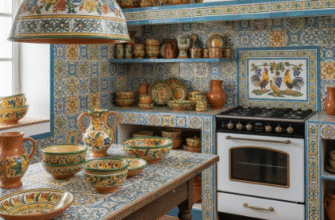
Then I spent three weeks in a cramped Algerian kitchen in Tlemcen, watching my host grandmother—Lalla Fatima, everyone called her—roll semolina between her palms with this rhythm I couldn’t replicate no matter how hard I tried. Turns out, the kitchen itself was designed around this exact ritual. The low wooden table, the couscoussier steaming perpetually on the gas range, the ceramic bowls stacked precisely within arm’s reach. Everything existed in relation to that central act of transformation: hard durum wheat becoming something cloud-like, almost alive. The walls were tiled halfway up in zellige mosaics—geometric patterns that never quite repeated, which I found maddening and beautiful—and the whole room smelled like cumin, coriander, and something I couldn’t identify until Lalla told me: fermented smen, aged butter buried in clay pots for months, sometimes years.
Here’s the thing about North African kitchens: they’re not designed for efficiency in the Western sense. They’re designed for endurance. For the long game of feeding extended families across decades, maybe centuries.
The Couscoussier Commands the Architecture, Not the Other Wy Around
Walk into any traditional Algerian home and you’ll notice the stove isn’t centered. It’s offset, usually near a window for ventilation, but also positioned so the cook can see the courtyard or the street. My translator, Amina, explained this was deliberate—cooking couscous takes hours, sometimes three or four if you’re doing it properly, hand-rolling the grains multiple times, steaming them in stages. You need to see life happening outside. Otherwise you go a little mad. The couscoussier itself—that double-boiler pot with the perforated top section—dictates everything else. Counter height in older homes is lower than American standards, roughly 32 inches instead of 36, because you’re working seated or half-crouched. I destroyed my lower back the first week. Lalla Fatima, who was 74, never complained once.
Wait—maybe I should explain what actually happens in that pot. The bottom section holds a stew, usually lamb or chicken with vegetables, simmering in broth enriched with that fermented smen. The steam rises through the perforations into the top section, where the hand-rolled semolina grains sit, absorbing moisture and flavor without touching the liquid. It’s indirect cooking, patient and precise. The kitchen layout reflects this: storage for semolina in airtight containers (humidity is the enemy), hanging racks for the couscoussier and its various sizes, a dedicated prep area for rolling out the grains on large flat baskets called gsaa.
Communal Labor Encoded in Spatial Design and Inherited Muscle Memory
Honestly, I didn’t understand the seating arrangements until the second Friday I was there.
Couscous day—Fridays, always—brought Lalla’s daughters, daughters-in-law, granddaughters, neighbors. Twelve women crammed into that kitchen, which suddenly didn’t feel cramped at all. The low table seated six comfortably, with others standing at the counter or perched on stools. Everyone had a task determined by skill and age: the eldest women rolled the finest grains, the younger ones handled the coarser preliminary rolling, children sifted and sorted. I was demoted to vegetable chopping after I ruined my third batch of semolina. The kitchen’s dimensions—about 12 by 14 feet, smaller than most American walk-in closets—forced proximity. Shoulders touched. Hands reached across each other without asking. There was a choreography I couldn’t learn, but I could feel it: bodies moving in practiced patterns inherited from mothers and grandmothers, spatial knowledge encoded in muscle memory. Amina said her own grandmother’s kitchen in Constantine had the exact same layout, even though the houses were built 60 years apart in cities 400 kilometers apart.
The ventilation matters more than you’d think. Traditional designs include high small windows near the ceiling and a door that opens directly to a courtyard or exterior space. Steam from the couscoussier is constant and heavy—without proper airflow, the walls would weep and mold within months. Modern Algerian apartments struggle with this. I visited a newlywed couple in Oran whose sleek IKEA-style kitchen had terrible ventilation. They’d stopped making couscous from scratch, buying the pre-rolled stuff instead, and the wife, Samira, seemed genuinely sad about it, like she’d lost something she couldn’t name.
Tactile Surfaces and the Sensory Grammar of Ingredient Interaction
Wood, ceramic, woven grass. No plastic in Lalla’s kitchen, except for a single cutting board someone gave her that she used as a trivet. The gsaa baskets for rolling couscous are made from woven palm fronds, slightly rough, which helps the semolina grains seperate—smooth surfaces make them clump. The ceramic bowls for water and oil are unglazed on the bottom, preventing slipping on the wooden table. Every material choice has a reason rooted in the physics of couscous preparation. I guess it makes sense when you’ve been perfecting a technique for, what, a thousand years? Couscous appears in North African culinary records from at least the 13th century, probably earlier.
Lalla let me try rolling again on my last day. My technique was still garbage, but I managed to produce something edible. She added my lumpy, irregular grains to the batch without comment, and later I found them in my serving, unmistakable among her perfect uniform pearls. I think that was the point—the kitchen, the process, the architecture of it all, it’s built to absorb imperfection. To accommodate the learning curve across generations. To recieve whoever shows up and wants to try.
Anyway, I still can’t replicate it in my American kitchen. Wrong table height, wrong ventilation, wrong bowls. Maybe next year I’ll go back.