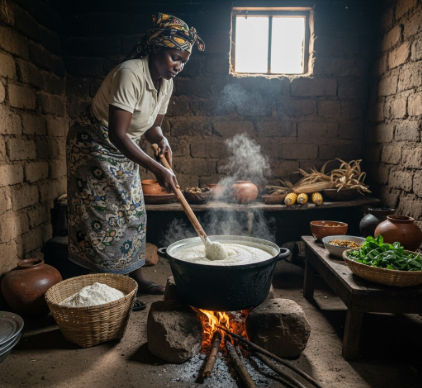
The cast-iron pot isn’t decorative.
I’ve watched gogos—grandmothers—in rural Masvingo Province stir maize meal into boiling water with wooden spoons smoothed by decades of use, their wrists executing tight circular motions that look effortless but would probably wreck mine in under five minutes. The pot sits directly over wood coals, no grate, no fancy trivet, because that’s how sadza gets made—roughly three times a day, give or take, in millions of Zimbabwean households where this thick porridge isn’t just food, it’s the gravitational center of every meal. Western kitchen designers obsess over granite countertops and soft-close drawers, but here’s the thing: if your kitchen can’t accomodate a proper sadza-making setup, you’ve essentially built a beautiful, expensive room where actual cooking becomes awkward theater. The pot needs clearance. The cook needs elbow room. The fire—or stove, in urban homes—needs to sustain consistent high heat for that critical moment when the meal thickens into its final form, and I guess that’s not something IKEA catalogues typically address.
Why the Stirring Arm Matters More Than You’d Think in Spatial Planning
Ergonomics textbooks talk about the kitchen work triangle, but they don’t mention the sadza arc—that sweeping motion from pot to bowl to serving dish. I used to think counter height was just about chopping vegetables. Turns out, when you’re leaning over a heavy pot, applying downward pressure while stirring a mixture that fights back with the consistency of wet cement, those extra two inches of counter elevation make the difference between a comfortable cooking session and a sore shoulder that lasts three days. Traditional outdoor cooking areas actually get this right by accident: the fire pit sits low, you stand or squat, your body weight does half the work.
The Ventilation Problem Nobody Wants to Discuss Until Smoke Fills the Ceiling
Wood smoke carries nostalgia until it triggers your smoke detector at 6 AM. Modern Zimbabwean kitchens—especially in Harare’s newer suburbs—try to split the difference between gas stoves and ancestral cooking methods, which creates this weird tension where the range hood can handle bacon grease but not the particulate cloud from a proper wood fire. Some families maintain two cooking spaces: a indoor kitchen for eggs and tea, an outdoor area for sadza, because trying to make both work in one room just makes the paint peel faster. Honestly, the amount of airflow you need is substantial—maybe three times what a standard extractor fan provides—and I’ve seen builders install those wimpy 200-cubic-foot-per-minute hoods thinking they’ll suffice, which is like bringing a teaspoon to a flood.
Storage Designed Around Maize Meal Sacks Not Matching Tupperware Sets
A 10-kilogram bag of mealie meal is not a photogenic pantry item.
It’s a lumpy, often repurposed fertilizer sack that needs to stay dry, stay sealed against weevils, and remain accessible because you’ll reach into it multiple times daily. Those pull-out spice racks and lazy Susans look great in shelter magazines, but what you actually need is a floor-level cabinet with enough width for the bag to lay flat, or a elevated platform that keeps it off the ground during rainy season when groundwater seeps through concrete. Some rural kitchens use metal bins with tight lids—practical, ugly, totally effective. The aesthetics-first approach that dominates contemporary design doesn’t really account for bulk staple storage, which is probably why so many beautiful kitchens end up with a torn maize sack slouching next to the refrigerator like an embarrassed guest. Wait—maybe that’s too harsh. But the disconnect is real: designers prioritize cereal box organization when the actual challenge is managing 20 kilos of raw grain without creating a pest buffet.
The Social Geometry of Cooking Sadza With An Audience of Advice-Givers
Sadza preparation isn’t solitary. Aunties drift in, children hover, someone always has commentary about your water ratio or stirring technique, which means the kitchen needs conversational space—not just cooking space. I guess it makes sense that traditional cooking areas are semi-outdoor, with stools arranged in loose semicircles where people can watch, talk, shell peas, argue about whose sadza has the better texture. Enclosed kitchens with a single entry point turn this communal event into an awkward squeeze. You need room for three people minimum: the cook, the observer offering unsolicited tips, and the child being taught the proper wrist rotation. Western open-plan designs accidentally get this right by removing walls, but they usually do it to show off the kitchen to dinner guests, not to accomodate actual cooking pedagogy happening in real time.