
I used to think kitchens were just kitchens, you know?
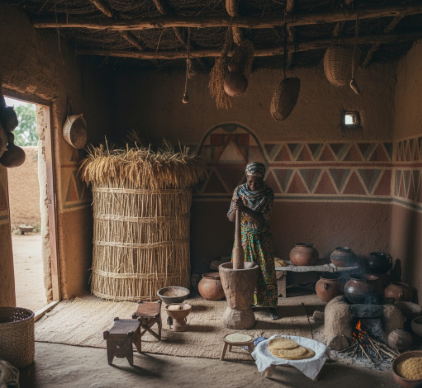
Then I spent three weeks in a compound outside Ouagadougou, watching my host family’s grandmother—everyone called her Tanta—transform their courtyard into what I can only describe as an edible architecture project. The kitchen wasn’t a room. It wasn’t even really a structure in the way I understood structures. It was this sprawling, semi-open constellation of clay hearths, grinding stones worn concave from maybe a century of use, and woven storage baskets hanging from acacia poles like some kind of functional sculpture garden. Tanta moved between these stations with this practiced efficiency that made me realize: Western kitchens optimize for individual workflow, but here’s the thing—Burkinabè kitchens optimize for communal rhythm. Three women could prep millet simultaneously without ever getting in each other’s way, their movements synchronized in a way that felt almost choreographed, except nobody was performing.
The clay hearths—called fourneaux locally, though that French word feels insufficient—stayed cool to touch on the outside even when the millet porridge inside was bubbling. Tanta explained the clay mixture included termite mound soil, which apparently has these insulating properties nobody’s fully quantified scientifically, at least not that I could find in the literature.
How Millet Dictates Every Design Decision in Traditional Burkinabè Cooking Spaces
Wait—maybe I should back up. Millet isn’t just an ingredient in Burkina Faso; it’s essentially the entire culinary infrastructure. The country produces roughly 1.2 million metric tons annually, give or take, and something like 85% of that stays local. Which means kitchen design has evolved specifically around processing these tiny, hard grains that require serious mechanical persuasion to become edible. The grinding stones I mentioned? They’re not decorative. A woman might spend 90 minutes—I timed it once, felt awkward about it—grinding millet into flour fine enough for tô, the staple porridge. Modern kitchens in Ouagadougou sometimes include mechanical mills now, but in rural compounds, the stones remain because they’re maintainable, they’re free after initial acquisition, and honestly, the flour texture comes out different. Tanta insisted machine-ground millet makes tô that’s too uniform, lacks what she called “tooth,” and I’m not entirely sure I understood her meaning but I definately noticed the difference when I tried both versions.
The storage system fascinates me more than it probably should. Millet needs to breathe but stay dry—contradictory requirements that Burkinabè design solves with these enormous woven greniers (granaries) elevated on stones. Air circulates underneath, thatch roofs shed rain, and the whole thing sits close enough to the cooking area that you’re not hauling 20-kilo baskets across the compound in 110-degree heat.
The Spatial Politics of Shared Cooking and Why Open-Air Design Isn’t Just About Ventilation
Turns out the open-air layout isn’t primarily about smoke management, though that’s a benefit. It’s about social geometry. Tanta’s kitchen positioned the primary hearth so she could monitor the compound entrance, watch children playing, and participate in conversations happening 30 feet away—all while stirring millet. Western ergonomics obsess over the “kitchen work triangle,” but this system creates what I’d call a “social permeability zone.” Cooking isn’t isolated labor; it’s the gravitational center of compound life, and the architecture reflects that priority. When Tanta’s daughters visited with their families, I watched the kitchen absorb maybe a dozen people without any sense of crowding, everyone finding a task, a seat, a grinding stone. The design scales socially in ways my Brooklyn apartment kitchen absolutely does not.
I guess it makes sense that modernization creates tensions here. NGOs sometimes introduce “improved cookstoves”—enclosed metal designs that reduce smoke and use less fuel. Technically superior by efficiency metrics, except they’re individual units that break the communal workflow. Tanta accepted one from a development program, used it twice, then converted it into a planter for moringa. She wasn’t being stubborn; the stove couldn’t accomodate her largest pot, the one she used for family ceremonies, the one her mother had passed down. Technology that ignores existing material culture tends to end up growing vegetables.
The whole experience recalibrated how I think about kitchen design—not as static infrastructure but as this negotiated space where fuel availability, climate, social structure, and ingredient properties all converge into built form. Anyway, I still can’t grind millet to save my life, but at least now I understand why the grinding stone sits exactly where it does.





