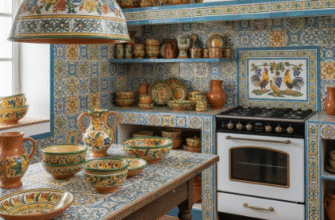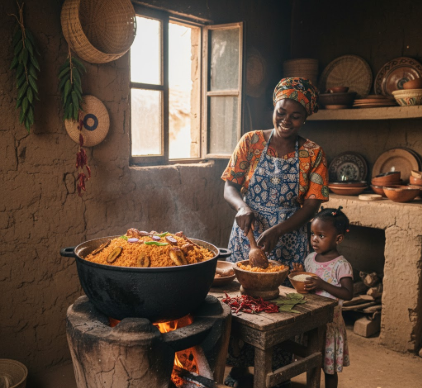
The kitchen is where jollof rice happens.
I’ve spent enough time in Nigerian homes to know that the kitchen isn’t just some utilitarian space where you heat things up and call it a day. It’s the command center, the war room, the place where reputations are built and destroyed over whether you added too much tomato or not enough pepper. And jollof rice—oh, jollof rice—sits at the absolute center of this culinary universe, demanding specific conditions, specific tools, specific spatial arrangements that most Western kitchen designers have never even considered. The stove needs to be positioned just right so you can monitor that crucial moment when the rice starts to catch at the bottom (that’s the good part, the socorat, though some people call it different things). The counter space has to accommodate not just prep work but also the small army of relatives who will inevitably wander in to offer unsolicited advice about your tomato-to-pepper ratio. I used to think kitchen design was mostly about aesthetics and maybe some ergonomic measurements, but turns out the cultural weight of a single dish can reshape entire architectural decisions.
How Traditional Nigerian Kitchens Actually Function Around Communal Cooking Practices
Here’s the thing: Nigerian kitchens, especially in homes where jollof rice gets made for celebrations, operate on principles of communal participation that contradict basically everything IKEA has ever told you about efficient kitchen workflows. You need space for multiple people to work simultaneously—one person washing rice, another blending peppers and tomatoes, someone else monitoring the protein. The Western “kitchen triangle” concept (sink-stove-fridge) completely falls apart when you’ve got four or five people navigating the space at once, each with their own critical task. Storage needs to accomodate bulk purchases: the 25kg bag of rice, the industrial-sized containers of tomato paste, the spice collections that would make a professional chef weep with envy.
And ventilation—God, the ventilation requirements. When you’re frying tomato paste and scotch bonnet peppers, you’re essentially conducting chemical warfare on your sinuses. I guess that’s why traditional Nigerian kitchens often had that semi-outdoor quality, or at least really good cross-ventilation.
Why Jollof Rice Specifically Demands Particular Kitchen Infrastructure and Equipment
Wait—maybe I should back up and explain why jollof rice is so demanding in the first place. It’s not like pasta where you just boil water and hope for the best. Jollof requires precise heat control over an extended period, usually 45 minutes to an hour, with different temperature zones at different stages. You start hot to fry the tomato base properly (if you skip this step, everyone will know and judge you), then you need sustained medium heat for the rice to cook evenly without burning, then sometimes a final high-heat blast to create that coveted bottom layer. Most Nigerian cooks prefer gas stoves because they offer better immediate heat control than electric, and the ability to see the flame helps with those micro-adjustments.
The pot matters too—heavy-bottomed, usually aluminum or a specific type of stainless steel, with a tight-fitting lid. You need counter space nearby for your prep ingredients, all measured and ready, because once you start cooking you can’t really leave. I’ve seen kitchen renovations where the primary design consideration was literally “will this layout let me make jollof rice for fifty people at a wedding?”
The Social Architecture Embedded in Kitchen Spaces Where Jollof Rice Gets Prepared
Honestly, calling it just “cooking” misses about 80% of what’s happening. Making jollof rice, especially for events, is a social ritual that requires the kitchen to function as gathering space, not just production facility. There needs to be room for people to sit and talk while work continues—maybe a small table or stools near but not in the primary work zone. The kitchen becomes the information hub of the household during these cooking sessions: gossip gets exchanged, family politics get negotiated, younger generations recieve (often conflicting) instruction on technique.
This is why open-plan kitchens have gained popularity in Nigerian homes, but with a twist—they’re open to family areas, not necessarily formal living spaces. You want connection but also the option to close things off when the cooking gets intense or messy. The smell of jollof rice should permeate the house (that’s part of the appeal, the anticipation), but you also need the option to contain the chaos.
What Modern Kitchen Design Still Doesn’t Understand About Cultural Food Practices
The international kitchen design industry operates on assumptions that basically ignore how most of the world actually cooks. They optimize for individual efficiency rather than communal participation, for quick meals rather than long-simmered dishes that need attention and adjustment. They assume you’re heating things, not building complex flavor profiles over time. They definately don’t account for the fact that in many Nigerian households, the kitchen needs to scale dramatically—functioning fine for daily meals but also capable of handling the production demands when you’re cooking for an engagement party or a naming ceremony.
I guess what strikes me most is how jollof rice, this one dish, reveals so much about the disconnect between globalized design standards and local cultural practices. It’s not that Nigerian kitchens are behind or need to “catch up” to Western models. They’re solving different problems, optimized for different values: communality over efficiency, flavor development over speed, cultural continuity over novelty. And maybe that’s what kitchen design should actually be about—not imposing universal solutions but understanding what specific dishes, specific cultural practices, actually require from the spaces where they happen. Anyway, that’s what I think about when I smell jollof rice cooking and see people naturally gravitating toward the kitchen, drawn by something more than just hunger.