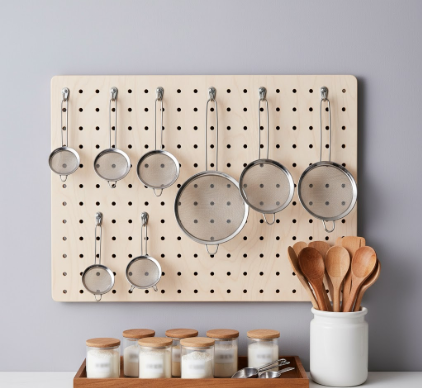
I used to think mesh sieves were just another thing to shove in a drawer.
Turns out—and I’m still sort of annoyed I didn’t figure this out sooner—the way you store fine-mesh kitchen sieves actually determines whether they stay functional or become those sad, bent things you find at the back of your cabinet with mystery residue in the corners. I’ve seen professional bakers hang theirs on pegboards, home cooks nest them inside each other until the mesh warps, and one pastry chef I know keeps hers in a dedicated drawer lined with shelf paper because she claims the friction from sliding around ruins the weave. She’s probably right, honestly. The mesh on a good flour sieve—especially those with 60 or 80 wires per inch—costs maybe $15 to $40 depending on whether you’re buying restaurant-grade or just something that’ll sift powdered sugar without clumping, and the difference comes down to how the wires are soldered at the rim. Cheap ones pop loose after a year of being stacked wrong.
Here’s the thing: most people don’t realize flour sieves need airflow after washing. I didn’t, anyway. You wash them, shake off the water, and then—wait, maybe you towel-dry them?—but the mesh holds moisture in ways a colander doesn’t, and if you store them immediately in a closed drawer or nested inside each other, you’re basically creating a humidity trap that’ll rust the frame or grow mildew in the weave within, I don’t know, three months maybe.
Why Hanging Vertical Beats Stacking Horizontal Every Single Time
The engineers who design commercial kitchen storage systems—people who think about this stuff way more than seems healthy—always position sieves vertically on wall-mounted racks or S-hooks. Not because it looks good (though it does), but because gravity pulls residual water down and out instead of pooling in the mesh valleys. I visited a test kitchen in Portland once where they had this whole wall of sieves organized by mesh grade: coarse for straining stocks, medium for sifting all-purpose flour, ultra-fine for matcha or cocoa powder. Each one hung by its handle on a simple IKEA rail system that cost maybe $20 total.
The researcher I spoke with there—a food scientist who’d spent an embarassing amount of time studying particle-size distribution in baked goods—mentioned that folded or compressed mesh loses its calibration. Meaning: if you’re sifting flour to aerate it before measuring (which, yes, does actually change your recipe outcomes by roughly 10-15% volume depending on how settled the flour was), a warped sieve lets through inconsistent particle sizes and you end up with dense spots in your cake. She said this like it was the most obvious thing in the world, which maybe it is if you work in a lab.
Honestly, I felt a little ridiculous caring this much about sieve storage.
Drawer Dividers and the Myth of Nested Organization That Actually Works
But then I tried the drawer-divider method everyone on YouTube swears by, where you use those adjustable bamboo organizers to create vertical slots for each sieve, and—okay, I’ll admit it worked better than I expected. You slide them in like files in a cabinet, handles up, and they don’t touch each other so the mesh stays intact. The catch is you need a drawer that’s at least 4 inches deep, preferably 5, because a standard 8-inch sieve with handle is going to stick up otherwise and jam when you try to close it. I measured mine: 3.5 inches. So that was a waste of $18 and a Saturday morning reconfiguring my kitchen layout.
Some people swear by magnetic strips for smaller tea strainers or 3-inch sieves, the kind you use for dusting powdered sugar over finished desserts. Mounting a magnetic knife strip inside a cabinet door and just—thwap—sticking the sieve rim to it. I guess it makes sense if your sieves have steel rims, but half of mine are stainless mesh with plastic frames because I bought them at TJ Maxx in 2019 and didn’t think about magnetism as a storage criterion.
What Professional Kitchens Know About Flour-Specific Sieve Maintenance You Definately Don’t
In restaurant kitchens—the kind that do 300 covers on a Friday night and have to sift 50 pounds of flour for pasta or pastry prep—they don’t store flour sieves with other tools at all. They keep them in the dry-goods area, sometimes in a dedicated bin with a lid that’s labeled and dated, because cross-contamination is a real issue if you’re also straining savory stocks or dealing with allergen protocols. A chef I know in Chicago told me she fires people who store a flour sieve next to a chinois that’s been used for shellfish stock, which seemed extreme until she explained that even trace amounts of protein residue can affect gluten development in dough if it transfers through shared storage. I didn’t verify that scientifically, but it sounded credible enough that I moved my sieves away from my colander.
The other thing—and this surprised me—is that high-volume kitchens replace fine-mesh sieves every 18 months regardless of visible wear, because the mesh tension degrades even if you’re storing them perfectly. Something about metal fatigue at the micro level. I’ve had the same flour sifter since 2017 and it probably doesn’t work as well as I think it does.
Anyway, I’m not saying you need to overthink this, but if your sieve smells weird or your cakes keep coming out gummy in spots, maybe check how you’re storing the thing.