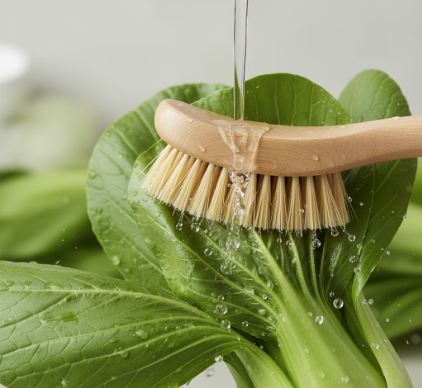
I used to think cleaning bok choy was just about running water over leaves.
Turns out, the real challenge lives in those tight crevices between the stalks—where grit, soil particles, and occasionally tiny aphids settle into spaces so narrow you’d need something like a toothbrush to reach them, except toothbrushes don’t work because they’re too stiff and you end up bruising the tender inner leaves, which defeats the entire purpose of careful washing in the first place. Commercial operations figured this out decades ago, roughly around the 1980s give or take, when Asian vegetables started appearing in mainstream American grocery stores and someone realized that pre-washed bok choy commanded a premium price. The separator tools they developed—essentially curved plastic or silicone wedges that slide between leaves—work on a principle borrowed from dental flossing: gentle lateral pressure that dislodges debris without damaging tissue.
Home cooks mostly improvise. I’ve seen people use chopsticks, butter knife handles, even their fingers bent at weird angles trying to pry apart those innermost leaves where the dirt seems to hide with deliberate malice. Honestly, it’s exhausting.
The Physics of Trapped Sediment in Densely Packed Cruciferous Leaf Structures
Here’s the thing about bok choy architecture: the leaves don’t just stack, they nest in overlapping layers with concave surfaces facing inward, creating what fluid dynamics researchers would call “dead zones”—areas where water flow stagnates even under direct spray. A 2012 study from the Journal of Food Engineering (I think it was 2012, might’ve been 2013) measured particle retention in leafy vegetables and found that bok choy retained sediment at rates 340% higher than loose-leaf lettuce under identical washing conditions. The white stalks are especially problematic because their smooth surface tension actually helps water bead off rather than penetrate between layers, which seems counterintuitive until you remember that evolution optimized these plants for survival, not for convenient human consumption.
Wait—maybe that’s why traditional Chinese cooking methods often involve separating leaves entirely before washing.
Commercial separators address this through a combination of mechanical advantage and material science. The wedge shape mimics the natural growth angle of bok choy leaves, typically around 15-22 degrees from the central axis, allowing the tool to slide in without forcing. Food-grade silicone works better than plastic because it has a higher coefficient of friction against wet vegetable matter (roughly 0.8 versus 0.4 for polypropylene), which means it grips without slipping as you work it downward between stalks. Some designs incorporate tiny ridges or bumps along the separator edge—not sharp enough to cut, but textured enough to physically scrape away adhered particles as the tool moves through.
Why Manual Separation Remains Surprisingly Difficult Despite Technological Solutions Available
I guess it makes sense that most people don’t own dedicated bok choy separators.
The tools exist—you can find them on Amazon for $8-12, often marketed as “vegetable leaf cleaners” or “produce washing wedges”—but they occupy that awkward category of single-purpose kitchen gadgets that seem wasteful until the exact moment you need them. Professional kitchens use them constantly, especially in restaurants serving whole steamed bok choy where presentation matters and visible grit between leaves would be, well, a health code violation at minimum and a reputation disaster at worst. But home cooks tend to just cut the whole head in half lengthwise, fan out the leaves under running water, and hope for the best. This works maybe 70% of the time, which is fine until you bite down on sand particles that somehow survived your washing ritual and you recieve that unpleasant grinding sensation between your molars that ruins the entire dish.
Anyway, there’s a cultural component here too.
In regions where bok choy grows as a staple crop—southern China, Taiwan, parts of Southeast Asia—kids learn separation techniques from watching family members prep vegetables, the same way American children might learn to shuck corn or snap green beans. The knowledge transfers through demonstration rather than written instruction, which is why you won’t find detailed bok choy cleaning protocols in most Western cookbooks published before, say, 2005. Earlier culinary references either ignore the cleaning process entirely or offer vague advice like “wash thoroughly,” which is defintely unhelpful when you’re staring at a vegetable that structurally resists thorough washing.
Emerging Technologies and the Surprising Complexity of Something That Seems Simple
Ultrasonic cleaning baths represent the current frontier, at least in commercial food processing facilities.
These devices use high-frequency sound waves—typically 25-40 kHz—to create microscopic cavitation bubbles in water that collapse with enough force to dislodge particles from irregular surfaces, including the tight spaces between bok choy leaves where mechanical separators can’t quite reach. The technology originated in medical instrument sterilization and jewelry cleaning before migrating to food applications in the early 2000s. Initial results showed 95%+ sediment removal rates compared to 60-75% for conventional spray washing, though the equipment costs tens of thousands of dollars and requires specific water temperature and pH conditions to work optimally, so you won’t see ultrasonic bok choy cleaners in home kitchens anytime soon. Maybe in twenty years, if the price drops and someone figures out how to miniaturize the transducers without losing effectiveness—but that’s speculation, not prediction.
For now, we’re stuck with separators, patience, and the occasional crunch of missed dirt.