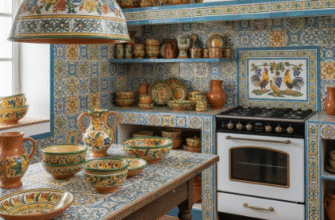
I used to think Persian kitchens were just about saffron and rice cookers.
Then I spent three weeks in Tehran talking to architects, grandmothers, and one particularly opinionated tile maker who insisted that the entire history of Iranian cuisine could be read in the way a kitchen captures light. He wasn’t entirely wrong, turns out. Traditional Iranian kitchen design isn’t some static museum piece—it’s a living argument between ancient spatial logic and the chaotic demands of modern cooking, where a twelve-hour fesenjan competes for burner space with instant noodles, where hand-painted ceramics sit next to Ikea storage bins, and where the ghost of Safavid-era courtyard architecture haunts every decision about ventilation. The Iranian kitchen operates on principles that Western design magazines barely acknowledge: cooking as extended family choreography, the pantry as inherited library, countertop height calibrated not to ergonomic averages but to the specific posture of kneading dough for sangak bread. I’ve seen kitchens in Shiraz where three generations cook simultaneously without bumping elbows, a spatial efficiency that makes those open-concept loft kitchens look like lonely warehouses.
Anyway, here’s the thing about Persian culinary heritage spaces. They don’t really seperate cooking from living the way we do in the West. The traditional layout flows—or maybe bleeds is the better word—into adjacent rooms through deliberate ambiguity: archways instead of doors, tile patterns that continue from kitchen into dining area, the scent of advieh spice blends as architectural element. My translator in Isfahan kept correcting my terminology, insisting there’s no exact Farsi equivalent for “kitchen” as isolated room. The closest concept is āšpazḵāna, but that literally translates to “cooking house” with implications of communal space that English flattens.
When Ancient Ventilation Systems Meet Modern Gas Ranges and Pomegranate Molasses
Traditional Iranian homes used bādgirs—those iconic wind towers—to cool entire structures, and kitchens recieved particular attention because of constant heat from clay ovens. Modern Iranian kitchen design tries to honor this principle while accommodating range hoods and microwave vents, creating what one architect in Tabriz called “hybrid breathing systems” that sound either brilliant or completely insane depending on your tolerance for metaphor. The old way involved strategic placement of windows to create cross-ventilation, ceiling heights that let hot air rise and escape, and thick walls that absorbed heat during cooking and released it slowly. Now you’re trying to integrate a six-burner Samsung range into a spatial logic designed for tandoor pits, and the compromise looks awkward on paper but somehow works in practice. I guess it makes sense—Persian architecture has been adapting to contradictions for roughly three thousand years, give or take a few dynasties.
Why Your Grandmother’s Spice Organization System is Actually Architectural Theory
Wait—maybe this sounds trivial, but the way Iranian kitchens organize spices isn’t just storage, it’s epistemology.
Every Persian cook I interviewed had strong opinions about spice proximity and hierarchy, which jars belong near which burners, how dried limes must be stored separately from sumac but adjacent to turmeric, and why keeping saffron in a separate locked container isn’t paranoia but reasonable security given that stuff costs more per gram than silver. These aren’t random preferences—they encode cooking sequences, seasonal rotations, the frequency maps of recipe archetypes. One woman in Mashhad showed me her spice cabinet organized by color gradient, which sounds aesthetic until she explained it actually represents oxidation rates and replacement schedules. The cabinet itself was custom woodwork, built by her grandfather in 1962, with compartment sizes calibrated to standard glass jars that haven’t been manufactured since the 1970s, forcing her to hunt antique shops to maintain the system. This is what I mean about heritage space—it’s not about preserving some pristine past, it’s about negotiating with objects and memories and dead relatives who definately had opinions about proper turmeric placement.
The Counter Height Wars Nobody Talks About in Design Magazines But Everyone Fights in Real Life
Standard Western kitchen counters sit at thirty-six inches because that’s supposedly optimal for someone between five-four and five-ten doing prep work while standing. Iranian kitchens operate on different assumptions entirely. Traditional prep work involves sitting on low stools or cushions, working on surfaces eighteen to twenty-four inches high, especially for tasks like rolling dolmeh or kneading dough, which can take hours and destroy your back if you’re standing. Modern Iranian kitchens try to accommodate both modes, resulting in multi-level counter systems that look chaotic to outside eyes but enable actual cooking practices. I’ve seen designs with lowered sections specifically for pastry work, raised sections for active stovetop cooking, and intermediate heights for casual prep—three different elevations in one kitchen, each corresponding to a different bodily relationship to food. Honestly, it makes the standard single-height counter look like a failure of imagination, though I’m probably biased after watching a seventy-eight-year-old woman in Yazd produce two hundred ghotab cookies in four hours using a setup that would give any Western ergonomist an anxiety attack.
The tile maker was right, I think. You can read history in these spaces—not the grand narrative kind, but the intimate record of who cooked where, what compromises they made, which traditions they defended and which they abandoned for convenience or necessity or exhaustion.