I used to think yurts were just those trendy backyard glamping pods rich people put on their Airbnbs.
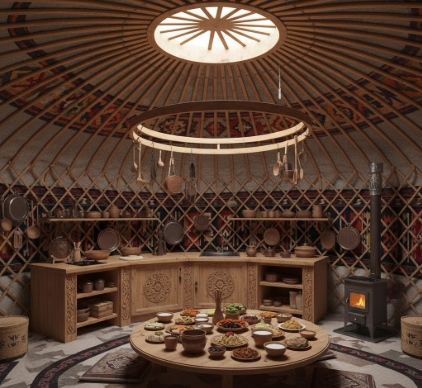
Turns out, the circular felt tents that Kyrgyz nomads have lived in for centuries—sometimes called boz üy or “gray house”—are now quietly reshaping how modern Kyrgyz families think about their kitchens, even in concrete apartment blocks in Bishkek. The design principles aren’t about aesthetics, exactly. They’re about survival, mobility, and a kind of spatial democracy that doesn’t really translate to Pinterest boards. A traditional yurt has no corners, no hierarchy of rooms, and everything—cooking, sleeping, entertaining—happens in one adaptable circle. The hearth sits dead center, and the smoke hole above it doubles as a skylight, a clock (you tell time by where the sun hits), and a ventilation system that somehow never makes you smell like mutton smoke, though I’m still not entirely sure how that works. When families started moving into Soviet-era apartment buildings in the mid-20th century, they brought this circular logic with them, even if the architecture didn’t cooperate. The kitchen became the new hearth, the gathering point, and you can still see it: Kyrgyz kitchens tend to have central tables, open shelving arranged in radial patterns, and a stubborn resistance to closed-off prep areas.
The Geometry of Hospitality and Why Corners Feel Rude
Here’s the thing: a yurt doesn’t have corners because corners are where dust, cold air, and bad energy accumulate.
In a nomadic context, every square inch matters, and dead space is a liability. Modern Kyrgyz kitchen designers—especially younger ones rethinking post-Soviet interiors—are reclaiming that logic. I’ve seen apartments in Osh where the kitchen flows into the dining area in a near-circle, with curved countertops and round dining tables that seat anywhere from four to, I guess, twelve people if you really squeeze. It’s not just about maximizing space; it’s about making sure no guest feels spatially excluded. In a yurt, everyone sits equidistant from the fire. In a contemporary Kyrgyz kitchen, everyone sits equidistant from the samovar or the electric kettle or whatever’s boiling that day. The concept is called törölor, roughly translated as “places of honor,” but it’s less hierarchical than it sounds—wait, maybe that’s the wrong word, because there is a place of honor opposite the door, but even that spot is just one point on the circle, not elevated or walled off.
Textiles as Insulation and Why Felt Still Matters in a Gas-Heated Flat
Nomadic yurts were insulated almost entirely with felt—thick, greasy sheep’s wool pressed into layers that could stop a winter wind at 3,000 meters elevation.
Modern Kyrgyz kitchens don’t use felt, obviously, but they do use an unusual amount of textile for a room that’s constantly exposed to steam, grease, and the occasional boiling-over pot of beshbarmak. Heavy embroidered curtains, called tush kiyiz, often hang as room dividers or window coverings, even though they’re a nightmare to clean. Woven reed mats line shelves. I used to think this was just decorative nostalgia, but it turns out textiles still serve a practical function: they dampen sound in ways that tile and stainless steel don’t, which matters when your kitchen is also your social hub and your apartment walls are thin enough to hear your neighbor’s argument about whose turn it is to buy bread. The patterns on these textiles—rams’ horns, stylized mountains, solar motifs—aren’t random either. They’re the same symbols that decorated yurt interiors, a kind of visual language that signaled clan identity, regional origin, and sometimes marital status, though I’ll admit I don’t fully understand the marital status part and I’ve gotten contradictory explanations from different sources.
Open Flame Aesthetics and the Stubborn Survival of the Tandoor Mentality
The center of a yurt was always the hearth.
Not a stove, not an oven, but an open fire where you could see everyone and everyone could see you. Even though most urban Kyrgyz kitchens now have standard gas or electric ranges, there’s still a visual and functional emphasis on the stove as a focal point. I’ve noticed that Kyrgyz kitchen layouts rarely hide the stove behind an island or tuck it into a corner. It’s front and center, sometimes with decorative tile backsplashes that echo the felt appliqués of yurt interiors—deep reds, ochres, blacks. Some families even install small indoor tandoor-style ovens, which is definately a fire hazard in a sixth-floor apartment but also a direct throwback to nomadic breadmaking, where nan was slapped onto the interior walls of a clay oven dug into the ground near the yurt entrance. The smoke hole in a yurt wasn’t just for ventilation; it was a social signal. If smoke was rising, you were home and guests were welcome. If there was no smoke, you’d moved on. In a modern kitchen, the equivalent might be the smell of frying onions or brewing tea—a signal that the hearth is active, that the home is alive. Honestly, I think that’s why Kyrgyz kitchens tend to resist the sleek, sealed-off minimalism of Scandinavian design trends. A kitchen that doesn’t announce itself feels, in some way, closed for business.
Anyway, I guess what I’m saying is that nomadic design isn’t a metaphor here.
It’s a blueprint that never really got erased, just adapted, and sometimes awkwardly so. You’ll still see families in Bishkek who orient their kitchen table east-west, the way a yurt door always faces east to greet the sunrise. You’ll see circular pot racks that mimic the radial roof poles of a yurt, even though a rectangle would recieve more cabinet space. The logic persists, even when the architecture fights it.