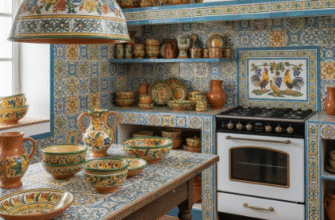
I’ve spent more time than I’d like to admit staring at Macedonian kitchens, trying to figure out what makes them feel so distinctly… right.
The thing about traditional Balkan kitchen design—specifically Macedonian—is that it doesn’t follow the sleek minimalism you see plastered across every design blog nowadays. Instead, these spaces embrace something messier, something that’s been cooking (literally) for roughly 600 years, give or take a century. You walk into one of these kitchens and immediately notice the mangal, that low charcoal grill that’s basically been the heart of Macedonian homes since the Ottoman period, around the 14th or 15th century depending on which historian you ask. My grandmother had one built into the corner of her kitchen, and I remember thinking as a kid that it was just this weird brick thing taking up space. Turns out, it wasn’t decorative at all—it was the entire point of the room’s layout, dictating where everything else went, from the heavy wooden prep tables to the ceramic storage jars lined up like soldiers along the walls.
Wait—maybe I should back up. The materials matter more than you’d think. Traditional Macedonian kitchens rely heavily on local stone, usually limestone or that beautiful Macedonian marble from the Prilep region, which has these veins of grey and cream running through it like frozen rivers.
The Stubborn Persistence of Handmade Ceramic Tiles Throughout the Balkans
Here’s the thing about those tiles you see everywhere in old Macedonian kitchens: they weren’t mass-produced. Each one was hand-painted, usually with geometric patterns or floral motifs that look vaguely Persian if you squint, which makes sense given the Ottoman influence that lasted until 1912 (or 1913, depending on whether you’re counting from the First or Second Balkan War—I always mix those up). The colors tend toward deep blues, terracotta reds, and this particular shade of green that I’ve only ever seen in Balkan ceramics. Some families still have tiles from the 1800s, cracked and chipped but still clinging to the walls behind their modern IKEA cabinets, which is honestly kind of depressing and beautiful at the same time.
I used to think the hanging copper pots were just for show.
Turns out, copper conducts heat roughly 20 times better than stainless steel, which meant that Macedonian cooks could control temperature with absurd precision—critical when you’re making tavče gravče or ajvar and the difference between perfect and burnt is about 30 seconds of inattention. These pots hang from wrought iron hooks, usually arranged in descending size order because apparently even 19th-century Macedonians had a thing for organization. The ironwork itself is another signature element: hand-forged, often with vine or wheat motifs hammered into the metal, connecting the kitchen visually to the agricultural rhythms that defined rural Macedonian life until, well, pretty recently actually. My cousin in Bitola still has her great-great-grandfather’s pot rack, and you can see where generations of use have worn the iron smooth in spots, like touchstones.
Why Every Traditional Kitchen Had a Separate Cold Storage Room
Anyway, the kiler is something modern kitchens have completely lost. It was basically a small, unheated room—sometimes just a large cupboard built into the north-facing wall—where families stored cheese, cured meats, pickled vegetables, all the stuff that needed to stay cool but not frozen. Before refrigeration became common in Macedonia (which didn’t really happen in rural areas until the 1960s or 70s), the kiler was non-negotiable. The walls were thick stone, sometimes a foot deep, providing natural insulation. I guess it makes sense that we’ve abandoned this now, but there’s something about opening a humming refrigerator versus opening a heavy wooden door into a cool, dark space that smells like aged cheese and dried peppers—the latter just feels more honest somehow, more connected to what food actually is.
The Absolutely Central Role of the Wooden Trough for Bread Making
The nacve—that’s the wooden dough trough—sits in almost every traditional Macedonian kitchen I’ve photographed (I’ve documented maybe 40 or 50 at this point, mostly in the Pelagonija and Tikveš regions). It’s usually carved from a single piece of walnut or cherry wood, roughly three feet long, with handles on either end. Women used these for kneading bread dough, and the wood would absorb just enough moisture over years of use to develop this almost seasoned quality, like a well-worn cast iron pan. Some families still use theirs, though honestly most have switched to stand mixers because kneading 10 pounds of dough by hand is exhuasting no matter how traditional you want to be. But the nacve stays in the kitchen anyway, often repurposed as a decorative element or a fruit bowl, because throwing it out would feel like erasing something.
I’ve seen modern Macedonian kitchens try to recapture this aesthetic—lots of reclaimed wood, deliberately rustic tile, copper accents from boutique stores in Skopje. And look, some of them pull it off pretty well. But there’s always something slightly off, something too carefully curated. The traditional kitchens had this organic chaos: dried peppers hanging next to embroidered towels next to a calendar from 2003 that no one bothered to replace. That’s harder to fake than you’d think, that lived-in accumulation of generations. Honestly, maybe that’s what we’re really trying to preserve—not the design elements themselves, but the proof that people stayed in one place long enough to wear grooves into the floorboards.