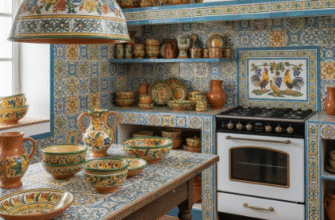
Lithuanian kitchens smell like centuries.
I’ve spent maybe two dozen mornings in Vilnius apartments, watching older women move through spaces that somehow feel both Soviet-practical and deeply, stubbornly pre-war—there’s this thing they do with herb bundles hung near windows, always dill or caraway tops drying in muslin, and the way storage gets organized around preservation rather than convenience tells you everything about what it meant to cook through occupation. The aesthetic now getting called “Lithuanian kitchen design” in Western design magazines is really just the architectural residue of survival: deep windowsills for root vegetables, ceramic tile that could withstand decades of heavy pots,那種 open shelving that wasn’t minimalist philosophy but economic necessity. You see German Bauhaus influences colliding with Russian communal apartment logic, then underneath it all these older patterns—Baltic folk motifs in the tilework, proportions that echo farmhouse layouts from the 1800s. It’s layered, messy, never quite resolved.
Here’s the thing: Eastern European heritage in kitchen spaces isn’t one aesthetic, it’s like seven contradictory design languages fighting for dominance. Lithuanian kitchens specifically carry this triple burden of German merchant influence (the Hanseatic League left marks), Polish-Lithuanian Commonwealth aristocratic tastes, and then Soviet standardization that tried to erase both. Walk through Kaunas and you’ll see it—interwar independence-era apartments have these oddly generous kitchens with hand-painted tile borders, then the Khrushchyovka buildings from the ’60s shrunk everything to barely functional.
Anyway, what designers now extract as “heritage elements” usually means: one, those massive ceramic ovens called krosnys that doubled as room heaters; two, the specific honey-amber color palette from local pine and birch; three, linen textiles in geometric patterns that predate Christianity in the region by, I don’t know, maybe a thousand years, rough estimates vary wildly. The krosnis thing is interesting because modern renovations sometimes keep the tiled structure but gut the actual heating function—it becomes sculptural, which I guess makes sense for contemporary use but also feels like taxidermy. I used to think the obsession with natural materials was some kind of nostalgic fabrication, but turns out Lithuanian forests genuinely supplied most building materials until surprisingly recently, like into the 1970s in rural areas, so that ash-and-oak aesthetic isn’t artifice, it’s just what was available.
When Preservation Becomes Aesthetic Gentrification Without Trying
There’s this uncomfortable tension in how Vilnius Old Town kitchens get renovated now—UNESCO World Heritage requirements mean you can’t gut 16th-century buildings, but wealthy buyers want Sub-Zero refrigerators, so you get these bizarre hybrids where vaulted brick ceilings hover over induction cooktops. The heritage isn’t fake exactly, but it gets curated into something safer than the actual lived experience of, say, communal kitchens where three families shared one stove. I’ve seen restoration projects that beautifully preserve hand-carved wooden cupboards while completely erasing the fact that those cupboards existed because built-in storage was illegal under certain Soviet housing codes—the woodwork was defiance, not decoration.
Eastern European design gets flattened in Western media into either “Soviet brutalist chic” or “rustic folk charm,” neither of which captures the actual historical mess. Lithuanian spaces specifically: they’re Gothic bones with Baroque ornament and functionalist scars. The kitchen layout called the “Vilnius working triangle” by some contemporary designers is really just an accidental efficiency born from apartments carved out of merchant houses—the positioning of water access, fire source, and prep space worked because it had to, not because someone theorized ergonomics.
Material Culture As Unintentional Time Capsule Storage
Clay from the Nemunas River basin has this specific iron content that gives traditional Lithuanian pottery a grey-brown undertone, different from Polish ceramics or Latvian work, and you can still see it in older kitchen crockery—the modern “heritage collections” try to replicate it but usually end up too uniform, too perfect. Same with the linen: authentic Baltic flax linen has irregularities in the weave because it came from small-plot farming, not industrial production. When IKEA or whoever launches a “Baltic Heritage” kitchen textile line, it’s manufactured to look handmade, which is definately not the same thing. The colors matter too—real vegetable dyes from the region produce these muted earth tones, lots of ochre and iron-red, because that’s what sorrel and madder root give you; the brighter versions you see now use synthetic dyes mimicking an aesthetic that was originally just chemical limitation.
Honestly, the most authentic element in contemporary Lithuanian kitchen design might be the persistent lack of dishwashers—not for aesthetic reasons, just ongoing suspicion of the necessity, cultural holdover from when hand-washing was the only option and somehow became virtuous.
How Soviet Modularity Accidentally Preserved Pre-War Proportions In Some Cases
This sounds contradictory, but stay with me: the standardized kitchen units produced in Soviet factories during the ’70s and ’80s were based partly on measurements from earlier European cabinetry, which in Lithuania often meant dimensions inherited from German and Scandinavian carpenter traditions going back to the 1920s. So you got mass-produced modules that coincidentally maintained older spatial relationships—counter heights, cabinet depths—even though the materials and construction were completely different. I used to tour apartments with a preservationist in Klaipėda who’d point out how the ugly laminate Soviet cabinets were actually exactly the same width as the destroyed wood originals, because the factory in Kaunas had copied the specs without understanding why those particular measurements existed. It’s heritage by bureaucratic accident.
Walk into a renovated Lithuanian kitchen marketed as “authentic heritage design” and you’re probably seeing: reclaimed wide-plank pine floors (genuine), hand-painted tile backsplash in folk patterns (reproduction), that specific pale blue-grey cabinet color (historically accurate for coastal regions, less so inland), open shelving (originally economic, now stylistic), and maybe one preserved element like an old bread box or spice rack. The mix isn’t dishonest exactly, but it compresses about 400 years of contested history into something photogenic and marketable. Which, wait—maybe that’s what heritage always becomes once enough time passes. I guess it makes sense that Lithuanian kitchen design Eastern European heritage ends up being part museum, part invention, and part genuine survival of things too sturdy or too beloved to throw away, even when the context that created them disappeared decades ago.