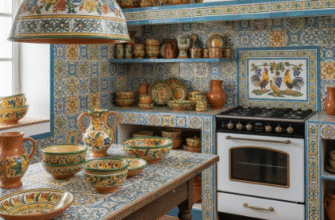
I’ve been obsessing over Slovenian kitchens for about three months now, and honestly, I’m not entirely sure how it started.
Slovenia sits wedged between the Alps and the Adriatic—geographically awkward, culturally fascinating—and nowhere is this duality more visible than in how people design their kitchens. You walk into a home in Ljubljana or Bled, and there’s this strange harmony: warm Mediterranean tiles meeting cool Alpine minimalism, terracotta clay jugs sitting on sleek marble counters, rough-hewn wood beams overhead while sunlight floods through floor-to-ceiling windows. It’s like the country can’t decide whether it wants to be Italy or Austria, so it just became both. And the thing is, it works. I used to think fusion design meant compromise, some watered-down middle ground where nothing feels authentic. But Slovenian kitchens don’t compromise—they layer. They argue with themselves. One corner whispers “mountain lodge,” another shouts “coastal villa,” and somehow the conversation feels cohesive.
The Alpine influence shows up in the bones: heavy timber cabinetry, stone flooring, that obsessive attention to craftsmanship that feels almost Germanic. Then the Mediterranean crashes in with color—burnt orange backsplashes, olive-green accents, open shelving stocked with preserves in glass jars.
Here’s the thing: this fusion isn’t some recent interior design trend cooked up by influencers.
Slovenia’s geographic split has been shaping domestic spaces for centuries, maybe longer. The northern regions—closer to Austria and the Julian Alps—developed kitchens built for cold winters: compact layouts, wood-burning stoves, thick insulation. Meanwhile, the western Primorska region, hugging the Italian border and the coast, borrowed from Mediterranean traditions: outdoor cooking areas, ventilation for summer heat, lots of natural light. When you combine those instincts in a single modern kitchen, you get something that feels both ancient and contemporary. I guess it makes sense that Slovenians would blend these influences rather than pick sides—the country itself is only about 20,000 square kilometers, roughly the size of New Jersey, so climates overlap fast.
Anyway, the materials tell the story best.
Walk into a typical Slovenian kitchen designed with this Alpine-Mediterranean fusion in mind, and you’ll probably notice the wood first—oak, beech, sometimes walnut—often left with a matte finish, almost unpolished, which gives it that rustic Alpine weight. But then you’ll see the terracotta floor tiles, imported or locally made, their warm reddish tones bouncing Mediterranean light around the room. Countertops might be Carrara marble or local limestone, cool to the touch, visually light. Open shelving (very Mediterranean) displays copper pots, ceramic bowls, maybe some woven baskets—but the shelves themselves are often chunky, reclaimed wood (very Alpine). It’s this constant push and pull. Wait—maybe that’s the wrong metaphor. It’s not push and pull; it’s call and response, like a conversation between two landscape personalities that have been living together for so long they’ve started finishing each other’s sentences.
The color palette does something similar, though it took me a while to notice. Alpine design traditionally leans neutral—grays, whites, soft browns, the occasional dark green. Mediterranean kitchens love warmth: ochre, terracotta, sky blue, olive. Slovenian fusion kitchens split the difference by using neutral bases (white walls, gray stone floors) and injecting warmth through accents: a burnt-orange range hood, sage-green cabinetry, brass fixtures. It’s restrained but not cold.
Turns out, the layout philosophy matters just as much as aesthetics.
Alpine kitchens tend toward efficiency—everything within arm’s reach, minimal wasted space, a pragmatic approach born from long winters spent indoors. Mediterranean kitchens, by contrast, sprawl a bit more: they invite lingering, conversation, the possibility that lunch might stretch into dinner. Slovenian designers seem to split this too, creating compact work triangles (sink, stove, fridge) surrounded by generous gathering spaces—an island with bar seating, a breakfast nook with cushioned benches, French doors opening onto a terrace. You can cook efficently, then linger indefinately. The kitchen becomes both workshop and living room, which I guess reflects how Slovenians actually use the space: cooking is serious, but so is hospitality.
I keep coming back to one detail: the windows.
Slovenian kitchens almost always maximize natural light, a Mediterranean impulse, but they frame views of mountains or forests, Alpine scenery. It’s like the architecture is trying to hold two landscapes in your peripheral vision at once. Maybe that’s the real genius here—not that Slovenian design fuses two styles, but that it forces you to see both, simultaneously, without choosing.