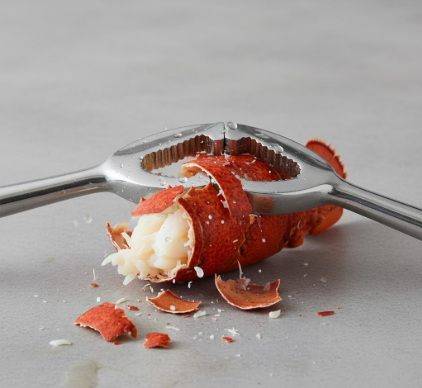
I used to think lobster crackers were just, you know, those metal nutcracker-looking things your grandmother kept in a drawer.
Turns out—and here’s the thing—the entire category of tools designed to break through hard shells represents thousands of years of human ingenuity colliding with our desperate desire to eat what nature explicitly designed to be hard to eat. The earliest shell-cracking implements date back roughly 100,000 years, give or take, to coastal communities in what’s now South Africa, where archaeologists found stones worn smooth in specific patterns suggesting repeated use against shellfish. These weren’t sophisticated tools, obviously, but they got the job done, and that’s basically the story of shell-cracking technology right up until the Victorian era when someone decided these things needed to look like tiny guillotines. The mechanics haven’t changed much: you’re concentrating force onto a small area to exceed the shell’s tensile strength, which for a lobster claw ranges between 900 and 1,200 pounds per square inch depending on the species and how much that particular lobster lifted weights, I guess.
Modern lobster crackers come in basically three designs, each with their own irritating drawbacks. There’s the plier style, the nutcracker style, and the scissors style—and if you’ve ever used any of them, you know they all share the delightful feature of occasionally sending shell fragments directly into your eyeball.
Why Leverage Matters More Than You’d Think, and Also Why Your Hands Hurt
The physics here aren’t complicated, but they’re weirdly satisfying once you understand them. A typical lobster cracker uses second-class lever mechanics—the fulcrum’s at one end, you apply force at the other, and the shell sits in the middle getting absolutely demolished. The mechanical advantage ratio on a decent cracker runs about 4:1, meaning you’re generating four times the force you’re actually applying, which sounds great until you realize you’re still applying like 50 pounds of grip strength and your hand cramps up after the third claw. I’ve seen people—myself included, honestly—just give up and use the back of a chef’s knife instead, which works but also makes you look slightly unhinged at dinner parties. The really expensive crackers, the ones running $40 or more, usually feature ergonomic handles with rubber grips and optimized pivot points that genuinely do reduce hand fatigue, though whether that’s worth forty dollars depends entirely on how often you’re eating lobster and how much you value your metacarpals.
Wait—maybe the real innovation isn’t the cracker at all.
The Dark Side of Shell Architecture That Engineers Actually Study
Lobster shells are composite materials made primarily of chitin—the same stuff in insect exoskeletons—mineralized with calcium carbonate in a structure that’s honestly kind of brilliant from an engineering perspective and absolutely infuriating from a eating-dinner perspective. The shell exists in layers, each oriented in slightly different directions, creating what materials scientists call a “Bouligand structure” after the French scientist who described it in the 1970s. This arrangement makes the shell incredibly resistant to crack propagation, meaning once you start a crack, it doesn’t just zip around the whole shell like it would in, say, an eggshell. Instead, the crack hits a new layer, changes direction, loses energy, and you have to start over. It’s the biological equivalent of those bollards that stop cars from ramming into buildings—except it’s designed to stop you from getting at the delicious meat inside. Researchers at MIT and other institutions have actually studied lobster shell architecture to develop better body armor and impact-resistant materials, which is either really cool or really depressing depending on whether you’re currently struggling with a stubborn claw.
Some restaurants just crack them for you in the kitchen, which feels like cheating but is definately the right choice.
When the Tool Becomes the Ritual, or Why We Even Bother Anymore
Here’s what nobody tells you about lobster crackers: half their function is social performance. Using a proper cracker, working methodically through each claw and tail section, extracting clean pieces of meat—it signals patience, sophistication, willingness to work for your food. It’s the same reason people still shuck their own oysters or crack their own crabs when pre-picked meat exists. The tool isn’t just functional; it’s ceremonial, a small barrier between you and instant gratification that somehow makes the gratification better. Or at least that’s what I tell myself when I’m twenty minutes into disassembling a lobster and there’s shell debris in a six-foot radius around my plate and I’m wondering why humans ever left the ocean if we were just going to spend this much effort trying to eat its inhabitants. The Japanese have specialized lobster scissors that cost upwards of $200, hand-forged by craftspeople who’ve spent decades perfecting the angle of the blade and the tension of the spring, and honestly? I get it. If you’re going to do something difficult and slightly absurd, you might as well have a beautiful tool for the job.
The mess, I guess, is part of the point.