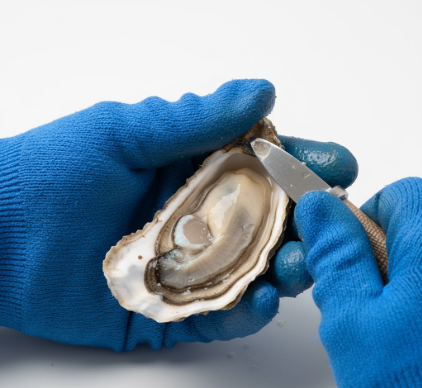
I used to think oyster knives were pretty much all the same—just a stubby blade with a handle, right?
Turns out, the design matters more than you’d expect, and I mean really matters when you’re trying to pry open something that evolution spent millions of years perfecting as a fortress. The blade needs to be short, maybe 2.5 to 3 inches, with a pointed tip that can wiggle into that tiny hinge gap where the two shells meet. Some knives have a slight curve, others are dead straight, and honestly I’ve seen professional shuckers argue about this like it’s a religious debate. The handle should be thick enough that when you’re gripping it—really gripping it, because you will be—it doesn’t dig into your palm after the fifth or sixth oyster. New Haven style knives are wider and flatter, Boston styles are narrower, and then there’s the Galveston knife which looks almost comically small until you realize it’s designed for those delicate Gulf oysters that practically open themselves compared to the rocky beasts from colder waters.
Here’s the thing: most people hold the oyster wrong. They cup it in their palm like they’re cradling a baby bird, which is exactly how you end up in the emergency room with a puncture wound that requires stitches and a tetanus shot.
The correct grip—and I cannot stress this enough—involves wrapping the oyster in a thick kitchen towel, folded maybe three or four times, with only the hinge exposed. You place it on a flat surface, hinge facing you, and you keep your hand behind the blade at all times. Always. The blade goes in at a slight downward angle, maybe 10 degrees or so, and you’re not stabbing—you’re wiggling and twisting until you feel that tiny pop when the hinge gives way. Then you slide the knife along the inside of the top shell to cut the adductor muscle, which is basically the oyster’s last-ditch effort to stay closed. Flip the top shell off, slide under the meat to detach it from the bottom shell, and you’re done. Except nobody’s first dozen oysters look anything like this descriptin—they’re mangled, there’s shell fragments everywhere, and you’re sweating like you just ran a marathon.
Wait—maybe I should mention the statistics, because they’re kind of terrifying?
Emergency room visits for oyster-related injuries spike dramatically during holiday seasons, roughly around Thanksgiving through New Year’s, when amateur shuckers decide they want to impress dinner guests. One study from 2019 found that approximately 2,000 people per year in the US alone end up seeking medical attention for shucking accidents, and that’s probably an underestimate because a lot of folks just bandage themselves up and don’t report it. The most common injury is a stab wound to the palm—specifically that fleshy part between your thumb and index finger—followed by finger lacerations. I guess it makes sense when you think about the physics: you’re applying significant force to a slippery, irregularly shaped object with a sharp implement, and the shell can give way suddenly, sending the blade wherever momentum takes it.
Anyway, professionals use a technique called the side entry method that’s actually safer for beginners.
Instead of attacking the hinge straight on, you insert the knife between the shells at the side, near the front lip where there’s sometimes a slight gap. You work it in gently—and I mean gently, not like you’re trying to break into a safe—then twist to pop the seal. This distributes the force differently and gives you more control because you’re levering sideways instead of pushing forward. Some people swear by the hinge method, some by the side method, and honestly both work fine once you’ve done it a few hundred times and developed the muscle memory. The key safety element, which somehow gets left out of most instructions, is that you need to anticipate the knife slipping and position everything so that when it does slip, it goes into the towel or the cutting board, not into you. Mesh gloves designed for oyster shucking exist—they’re made from cut-resistant fibers, look kind of like chainmail gloves—but they can make it harder to feel what you’re doing, which creates its own problems. I’ve seen chefs refuse to wear them for exactly that reason, though I’ve also seen the scars on their hands and thought maybe the trade-off isn’t worth it.