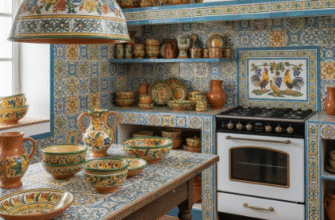
I used to think Talavera tiles were just another trendy Instagram thing—you know, the kind of design element that shows up in every third renovation post with a caption about “authentic vibes.”
Turns out, I was wrong about that, or at least partially wrong, because these hand-painted ceramic tiles have been around since the 16th century when Spanish artisans brought majolica techniques to Puebla, Mexico, and the whole thing became this wild fusion of Indigenous, Spanish, Italian, Chinese, and Arabic design traditions that honestly makes my head spin a little when I think about how many cultural currents had to converge in exactly the right way. The tiles get their name from Talavera de la Reina in Spain, but the Mexican versions developed their own distinct character over roughly 400 years, give or take a few decades, with specific regulations now governing what can actually be called authentic Talavera—it has to come from Puebla or Tlaxcala, use specific clay mixtures, and undergo a particular firing process that takes something like three months from start to finish.
Here’s the thing: when you’re designing a kitchen with these tiles, you’re not just picking out a backsplash. You’re making a choice about visual density, because Talavera patterns don’t exactly whisper—they shout in cobalt blues, sunny yellows, terra cotta oranges, and this particular shade of green that I’ve seen described as “colonial green” but really it’s more like the color of oxidized copper mixed with spring leaves.
Wait—maybe that’s too poetic, but the point stands.
The patterns themselves range from geometric repeats to floral explosions to these intricate arabesques that make you wonder how anyone painted them without losing their mind, and every tile is slightly different because they’re hand-painted, which means your backsplash will have imperfe ctions that mass-produced tiles simply can’t replicate.
The Practical Reality of Installing Hundreds of Tiny Artistic Statements Behind Your Stove
I guess it makes sense that people worry about whether Talavera tiles can handle kitchen heat and moisture and the occasional splatter of tomato sauce.
They can, mostly, assuming you’ve bought actual certified Talavera and not some import knockoff, because the authentic stuff gets fired at temperatures exceeding 1,800 degrees Fahrenheit in a two-stage process—first the bisque firing, then the glaze firing—which creates a remarkably durable surface that’s been holding up in Mexican kitchens for centuries before anyone invented the concept of “heat-resistant backsplash materials.” But here’s where it gets messy: the tiles are porous despite that firing process, so you absolutely need to seal them properly, and even then, some designers recommend avoiding them directly behind cooktops where grease buildup becomes a real issue, though I’ve definately seen kitchens where they said screw it and tiled everything anyway and it looked spectacular even if it required more maintenance than subway tile would have demanded.
The cost runs higher than you’d expect—authentic Talavera tiles typically range from $8 to $25 per tile depending on complexity and size, and suddenly your backsplash budget is rivaling your appliance budget.
Anyway, most people don’t tile entire kitchens in Talavera because that would be visual chaos on a level that even maximalists might find exhausting.
Balancing Exuberance with Restraint When Every Surface Wants Attention
The standard approach involves strategic placement: a backsplash here, a border there, maybe an accent strip along the countertop edge or around a window, because Talavera tiles function best as punctuation marks rather than entire paragraphs. I’ve seen kitchens where designers mixed solid-color Talavera tiles with patterned ones in a checkerboard arrangement, creating breathing room for the eye, and others where they used simple white subway tiles for 80% of the backsplash and inserted a Talavera mural as a focal point behind the range, which honestly struck me as the smartest compromise between wanting the cultural richness and not wanting your kitchen to feel like a museum gift shop exploded.
The color palette matters more than you’d think when you’re working with cabinets and countertops and flooring that all have their own opinions about what should dominate the visual field.
Traditional Mexican kitchens often pair Talavera with warm terracotta floors, rough-hewn wood beams, and white or cream-colored plaster walls that let the tiles be the stars of the show, but modern interpretations sometimes go for unexpected combinations—charcoal gray cabinets with blue-and-white Talavera, or butcher block counters with multicolored tile accents that somehow work even though the rules say they shouldn’t. The tiles play surprisingly well with stainless steel appliances and concrete countertops, creating this temporal collision between centuries-old craft traditions and contemporary industrial aesthetics that feels both jarring and completely right, like finding out your grandmother and your coolest friend have similar taste in music.
Honestly, the hardest part isn’t choosing the tiles—it’s knowing when to stop.