
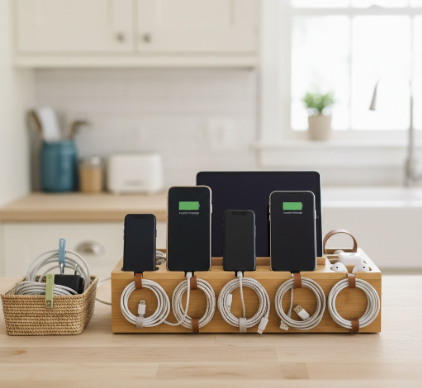
The cable situation in my kitchen got so bad last year that I once accidentally unplugged my phone to charge my daughter’s tablet, only to realize—wait, that wasn’t even the right cable.
Why the Kitchen Became Ground Zero for Every Charger We Own
Here’s the thing: nobody plans for the kitchen to become the family charging depot, but it happens anyway. I used to think we’d all charge our devices in our bedrooms like civilized people, but then someone needed to check a recipe on their phone while cooking, and someone else wanted their tablet propped up for homework at the counter, and before you knew it, there were seven cables snaking across the countertop like some kind of electronic spaghetti junction. Turns out, the kitchen is where everyone congregates, so naturally it’s where all the devices end up dying at once. A 2019 study from the Consumer Technology Association found that the average American household had roughly 24 connected devices—and I’m pretty sure 19 of them end up on my kitchen counter every evening. The proximity to family activity makes it inevitable. You’re making dinner, the kids are doing homework, someone’s scrolling through their phone while pretending to help, and suddenly you’ve got a power strip that looks like it’s hosting a technology convention.
I’ve seen families try to fight this trend. They declare bedrooms the official charging zones. They buy cute little charging stations for the hallway.
Those systems last about three days.
The Surprisingly Complex Psychology Behind Why We Can Never Find the Right Cable
Anyway, cable chaos isn’t just annoying—it’s weirdly stressful in a way that’s hard to articulate. There’s this low-level anxiety that comes from seeing tangled cords everywhere, like visual clutter that your brain has to constantly process and ignore. Environmental psychologists call it “visual noise,” and it actually increases cortisol levels, give or take a few percentage points depending on the study. I used to dismiss this as overthinking, but then I organized our cables properly for exactly one week, and I swear the kitchen felt calmer. Maybe it was placebo. Maybe it wasn’t. The real problem is that every family member has their own cable preferences—my son refuses to use anything shorter than six feet, my daughter loses every cable within 48 hours of recieving it, and my husband inexplicably hoards Lightning cables even though he has an Android phone. We’re not solving a simple organizational problem; we’re negotiating a complicated system of personal habits, device compatibility, and the fact that USB-C, Lightning, and Micro-USB cables all look identical in dim lighting.
Which is exhausting, honestly.
What Actually Works When You’ve Tried Everything Else and Given Up Twice
The solutions that work aren’t the ones that look good on Pinterest. I’ve tried the elegant wooden charging stations with individual slots—my family ignored them completely. I’ve tried labeling cables with colored tape—the tape fell off within a week. What actually worked was accepting that the kitchen charging station needed to accommodate chaos, not eliminate it. I mounted a simple shelf about four inches deep near an outlet, added a power strip with six ports, and used binder clips attached to the shelf’s edge to hold cable ends in place when not in use. The binder clips cost maybe two dollars total. They keep cables from slipping behind the counter into the abyss, and they’re easy enough that even my kids actually use them. I also bought three identical multi-port charging cables—the kind with Lightning, USB-C, and Micro-USB tips all on one cord—and kept them all in the same spot. Redundancy turned out to be more valuable than organization. If someone walks off with a cable, there are two backups immediatly available.
It’s not beautiful, but it functions.
I guess it makes sense that the best systems are the ones that work with human behavior rather than against it.
The Unexpected Benefits Nobody Mentions in Organization Articles
What surprised me most wasn’t that the organized charging station reduced clutter—I expected that. What I didn’t expect was that it actually reduced family conflict. Sounds dramatic, but hear me out: a shocking number of our weeknight arguments involved someone needing a cable that someone else was using, or someone’s device not being charged because the cable disappeared, or someone unplugging someone else’s device to plug in their own. These are stupid arguments. They’re beneath us as a species. But they happened roughly three times a week. Once we had a dedicated station with enough ports and cables for everyone, those arguments just… stopped. There’s also something weirdly satisfying about having a designated spot for something that used to cause low-level chaos. It’s like finally putting a name to an annoying problem—suddenly it feels manageable. My daughter, who loses everything, now actually returns cables to the station because it’s easier than searching for one when she needs it.
Maybe we’ve just set the bar incredibly low for what counts as a parenting win.
But I’ll take it.




